
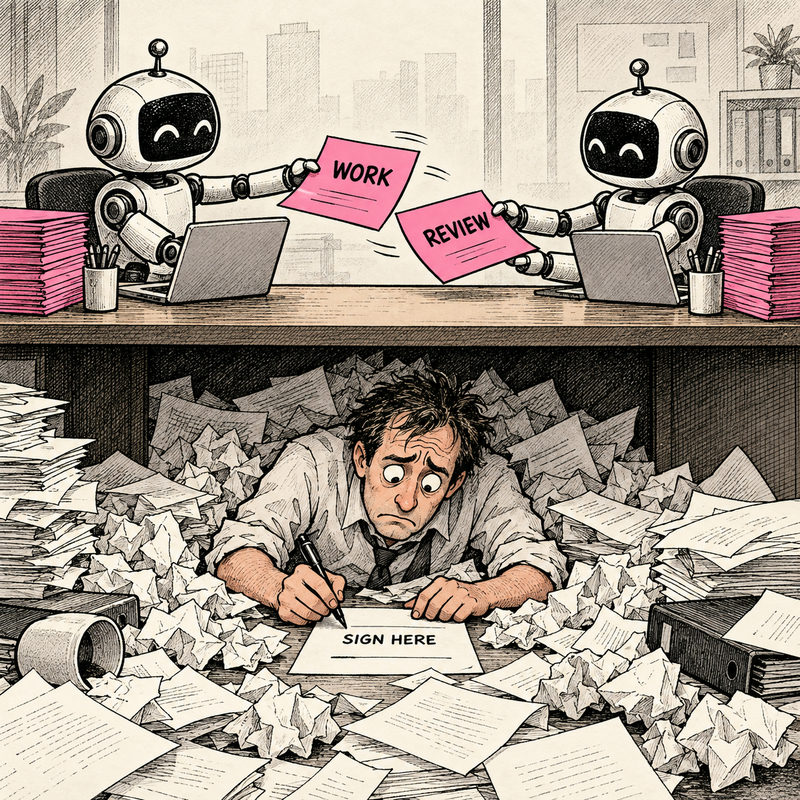
Give an employee a tool that produces polished work. Notice that polished work no longer tells you how much the employee contributed. Ask another tool to help write the employee’s performance review. Somewhere in this process, a human being will still receive the rating.
That is the loop described by a new management survey reported in TechCrunch. Nielsen surveyed 1,700 directors and senior managers in seven countries for Monday.com, a company selling work-management software. More than half said AI made employee evaluation harder; 39% said they used AI to draft performance reviews. Those are separate survey results, not proof that every baffled boss is using a robot to mark the robot’s homework. The combination is nevertheless an impressive organizational ambition: automate the output, then automate the explanation of who deserves credit.
Managers are changing the criteria too. Seventy-eight percent said they had adjusted how they evaluate staff, giving more weight to prompting, choosing tasks for AI and experimenting with workflows. That can be a reasonable adaptation. It also means the employee’s new skill is partly deciding what not to do personally, while the manager’s new difficulty is determining what the employee did personally. The promotion meeting now needs a provenance department.
Make powerful people uncomfortable.
Subscribe to Democrawonk.
Nearly half reported spending more time reviewing and guiding output. The labor has not politely vanished after the generation button was pressed. It has moved downstream, where somebody must inspect what appeared upstream. A faster draft can still create a longer afternoon for the person responsible for finding its mistakes.
The same migration is happening in the software cupboard. Fifty-seven percent said their organizations had more tools, while only 29% called their AI infrastructure fully optimized and centralized. Monday.com’s research representative said companies had expected to consolidate software. Instead, new applications, integrations and unauthorized usage were multiplying. Consolidation now needs someone to integrate the additional applications bought to achieve it.
None of these responses measures a universal productivity loss. Ninety-four percent of the surveyed managers were excited about improving work with AI. The awkwardness is that the excitement and the extra supervision can be true together. Counting generated output does not count the person checking it, just as counting new tools does not show whether the old ones disappeared.
More than half expected to manage more AI agents than people within a year. Thirty-five percent worried about responsibility for AI decisions. Here the otherwise slippery question of authorship becomes wonderfully clear. When the work is good, management may struggle to distinguish the person from the machine. When it goes wrong, the survey suggests managers have an excellent idea whose name will be needed.
Comments
Have something to say? Give this story a heckle.
Comment Rules
Argue the point. Add a joke. No threats, harassment, hate speech, spam, private personal information or unsupported accusations. First-time comments and comments with links are moderated. Full Comment Rules
Loading comments…
Questions or deletion requests? Contact Us. We retain comments and moderation records until removed. Only hashed email identifiers are stored for comment accounts.