
What Is Political Satire?
Political satire uses humor, irony, exaggeration and invention to examine political power. Its targets can include a government decision, a campaign promise, a corporate sales pitch or the explanation offered after something goes spectacularly wrong. The joke carries an observation: something about the stated principle and the actual behavior does not line up.
A politician calling a benefit for wealthy donors a sacrifice for ordinary families offers a satirist more than an opportunity for name-calling. It offers a contradiction to develop. An invented award for outstanding public service to oneself might expose that contradiction more clearly than another paragraph saying the politician is terrible.
Political satire can appear as an essay, cartoon, sketch, song, mock announcement or fictional interview. It can be liberal, conservative or skeptical of several political camps. The viewpoint shapes the argument; the strength of the observation and execution determines whether there is a joke worth reading.
Satire, Parody And Commentary: What Is The Difference?
- Satire
- Uses comic criticism to expose a target’s behavior, assumptions or incentives. Its central question is what the joke reveals.
- Parody
- Imitates a recognizable form or style. A fake earnings call, government form or campaign advertisement can be parody. It becomes political satire when the imitation makes a political argument.
- Commentary
- Explains or argues a viewpoint directly. Commentary may be funny, but it does not need a developed comic premise.
- Fabricated Reporting
- Presents invented events or claims as genuine news. Calling a page satire does not make an unsupported factual allegation accurate. Readers should be able to distinguish reported facts from invented comic scenes.
The forms overlap. A fictional press release can parody official language and satirize the policy it describes. A straight opinion article may use a satirical opening. The useful distinction is what the reader is being asked to believe and what the invention helps them notice.
How The Joke Works
A strong piece starts with a specific target and a surprising way to see it. “Politicians lie” is a complaint. A politician opening a museum of promises with no exhibits is a premise. That museum is an invented teaching example, not a report about an actual official.
- Irony: Place the public claim beside the behavior that undermines it.
- Exaggeration: Extend a real tendency until its absurdity becomes easier to see.
- Reversal: Swap the expected roles. Let a household bill interview the policymaker who promised to reduce it.
- Deadpan: Describe an absurd situation in the calm language of people pretending it is perfectly normal.
- Analogy: Move a political arrangement into a familiar setting, such as a job interview, to expose its logic.
The opening establishes the comic idea. Later paragraphs should develop it, add a necessary fact or reveal another consequence. The ending should deliver something the opening made possible. Repeating the headline with extra exclamation points is a second headline, not a payoff.
Historical Examples: From Swift To Political Cartoons
Jonathan Swift’s A Modest Proposal
In his 1729 essay, Swift adopts a calculating narrator who proposes selling poor children as food. The grotesque scheme is delivered as practical economic advice. Our reading: the clash between polite calculation and human cruelty exposes the narrator’s moral blindness. The proposal is the vehicle of criticism, not a recommendation. Read Swift’s original essay at Project Gutenberg.
Benjamin Franklin And Visual Political Argument
Franklin’s 1754 “Join, or Die” cartoon used a segmented snake to argue for colonial unity. It is an example of political symbolism rather than a requirement that every political cartoon be a joke. The Library of Congress also preserves a 1766 Franklin cartoon using a dismembered body to criticize the effects of imperial taxation. These examples show how an image can compress a political argument. Explore the originals and their context at the Library of Congress.
Political Satire Examples From Democrawonk
Here are two examples of how our original satire develops a comic idea from source reporting. These notes explain the construction; follow the links for the complete pieces and their sources.
An Imaginary Traffic School
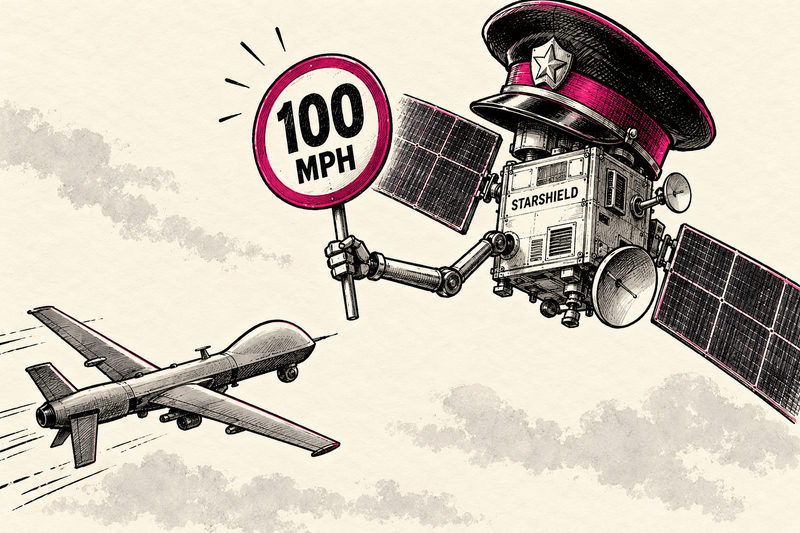
Starshield’s Speed Limit Would Like A Slower Enemy
This article turns a reported restriction on a military satellite service into a fictional traffic-school lesson. The comic contradiction is movement: an interceptor needs to catch an aircraft, while its connection comes with a speed limit. The school, instructor and dialogue are parody. The article links to the reporting behind the actual restriction and distinguishes unresolved negotiations from an agreement already reached.
Read The Complete Satire →The Future Applies For A Job
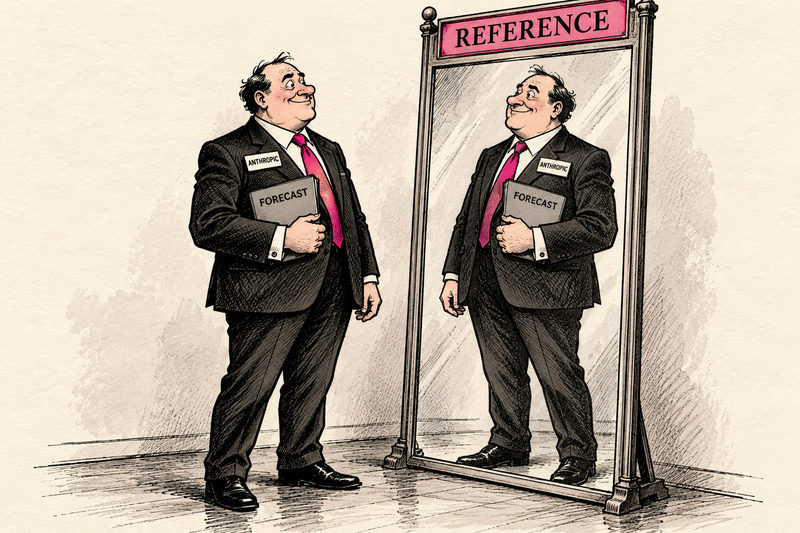
Anthropic’s $44 Trillion Future Has Listed Anthropic As A Reference
Here, a company’s conditional economic scenario becomes a fictional job applicant providing its own references. The target is the comfortable relationship between a spectacular projection and the company positioned to benefit from it. The invented interview supplies the joke; the article identifies the projection as conditional and attributes the underlying reporting. The argument does not require pretending the projected result has happened.
Read The Complete Satire →How To Read A Political Cartoon
Start with what is literally drawn. Identify the people, objects, labels and actions before deciding what the artist means. Then ask what relationship the picture creates: who controls the scene, what seems out of place and what the viewer is expected to recognize.
In our Starshield illustration above, the satellite wears a traffic-police cap and holds a speed-limit sign beside an aircraft. Those objects establish the metaphor. The caption and linked article provide the factual context. The satellite is not documentary evidence of a police officer working in orbit.
A useful cartoon rewards a second look, but the basic idea should survive a small screen. Labels can clarify a relationship; filling every available surface with an explanation usually means the drawing needs a stronger idea. The Library of Congress offers a teaching introduction to analyzing political cartoons for readers who want to go further.
Facts, Fiction And Fair Targets
Satire has room for invented scenes. Its factual foundation still matters. A proposal is not an enacted law. An allegation is not a finding. A forecast is not a result. An invented quote should not travel through an article looking like a real person said it.
At Democrawonk, the reporting behind consequential factual claims is linked, while fictional dialogue and scenarios are signaled as parody. Our targets are power, decisions, hypocrisy and incentives. People suffering the consequences should not become a convenient substitute for the people responsible.
We write from a liberal perspective. That is a declared viewpoint, not a promise to manufacture equal criticism of every party. Nor does it excuse unsupported claims about people we oppose. Read our policies and standards, learn how we make this stuff, or send a correction or question.
Read More Political Satire
Choose a subject below for introductions, selected reading and the latest articles. For a shorter hit, explore Quick Kicks. For a developed comic argument, try The Fine Print. Our standalone cartoons put the picture in charge.
Want the next round without checking back? Subscribe to the free daily digest. One daily email, because even disrespect benefits from a reasonable schedule.