
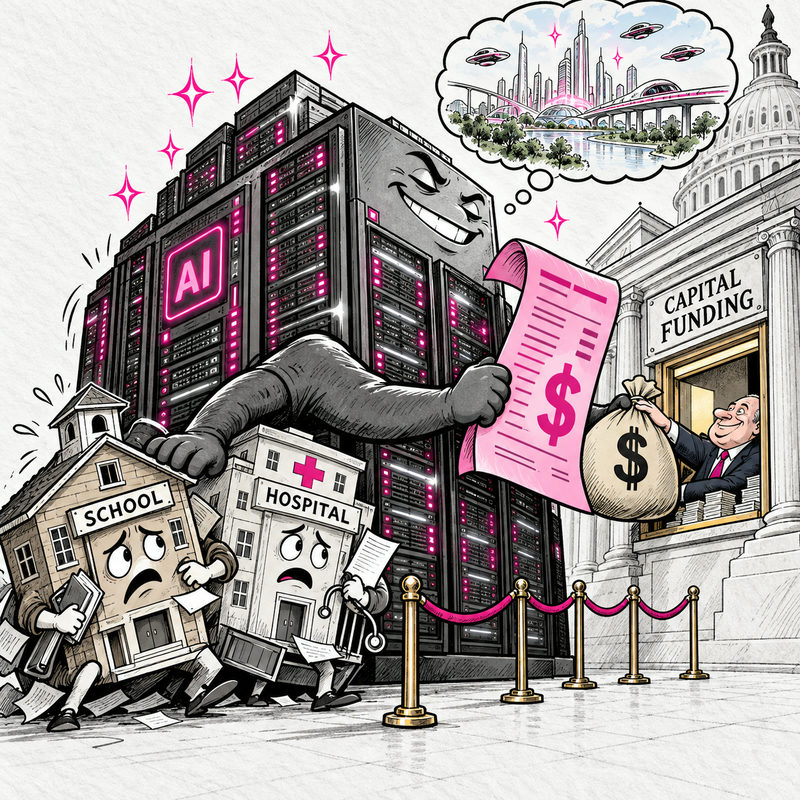
The AI boom has an awkward delivery schedule. The miraculous productivity is expected later. The competition for everybody’s money is already here, elbowing its way toward the front.
Reuters reports that central bankers meeting in Bangkok are confronting fresh inflation pressures and potentially higher borrowing costs as companies and governments pour money into AI-related infrastructure. Federal Reserve Chair Kevin Warsh described investment hitting demand before the promised improvements in supply.
So the future has arrived early for the expensive part. How considerate.
I’m not against building useful technology. I’m against treating the scale of the construction as proof that whatever comes out the other end must justify it. You can spend an extraordinary amount of money making a mistake. The amount is not the part that makes it impossible.
The central bankers’ concern is not simply that one company might overpay for some chips. AI investment is competing for capital across an economy that still contains other things people need. Governments are also borrowing for defense, energy and industrial projects. The pressure has several sources; the solution should not be to give the most fashionable one diplomatic immunity.
A hospital does not become less necessary because a data center has a better presentation.
Yet the technology industry’s great advantage in these arguments is that it gets to promise the future while everybody else has to justify the present. A school needs money for an actual roof. An AI project offers eventual transformation. Somehow the roof is the unambitious proposal, despite its excellent record of keeping rain off children.
Reuters describes uncertainty over how high the economy’s underlying interest-rate level may be moving. That is not a prediction of one inevitable rate path. It is a reason to stop pretending enormous private investment can expand without competing with anything else.
I would also like politicians to remember this when the conversation turns to public budgets. If higher borrowing costs squeeze governments, scrutinize the help being offered to powerful industries before announcing that ordinary services must demonstrate exceptional courage by disappearing.
The public should not become the economy’s adjustable setting.
Build power grids that serve people as well as large customers. Demand clear public benefits before handing out public support. Make the companies asking for advantages explain what they will finance themselves and what happens if their optimistic forecasts turn out to be an expensive work of creative writing.
And keep the risk with the people who expect the return. If investors are confident enough to claim the upside, they can remain available for the less glamorous portion of the experience. Entrepreneurship should not become a spectator sport precisely when the numbers turn red.
None of this requires predicting that AI will fail. I hope useful applications succeed. I would just prefer success to involve useful results rather than permanently lowering the standard for what powerful companies owe everyone else.
The promise is that this technology will make us vastly more productive.
Fine. Then its first productivity improvement can be reducing the amount of special treatment required to get anything done.
If the future is as profitable as advertised, it should survive the terrifying experience of paying its own way.
Comments
Have something to say? Give this story a heckle.
Comment Rules
Argue the point. Add a joke. No threats, harassment, hate speech, spam, private personal information or unsupported accusations. First-time comments and comments with links are moderated. Full Comment Rules
Loading comments…
Questions or deletion requests? Contact Us. We retain comments and moderation records until removed. Only hashed email identifiers are stored for comment accounts.