
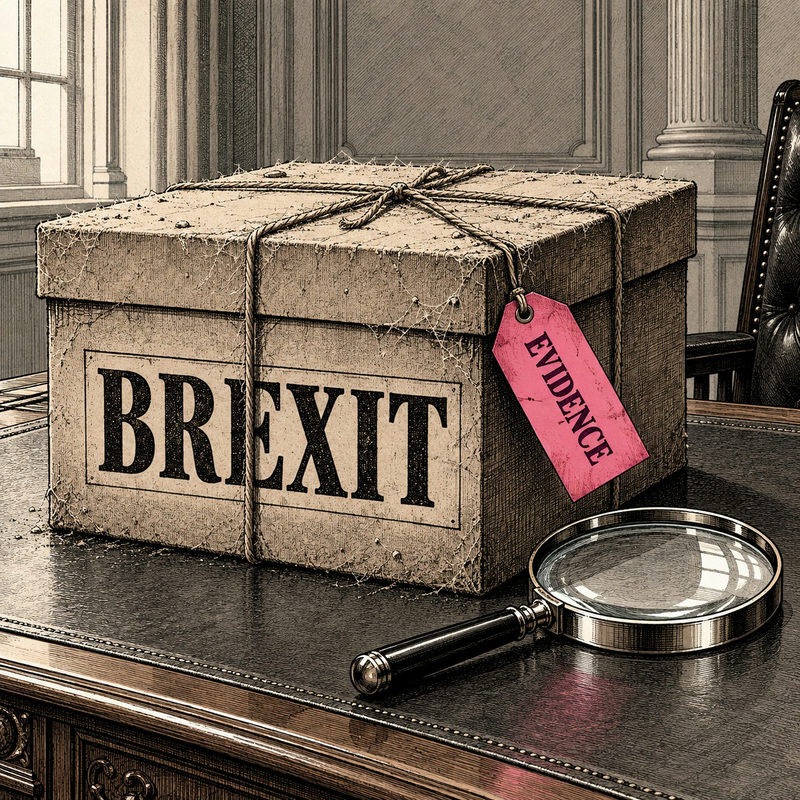
Britain has discovered an inflammatory new position on Brexit: checking how it went.
Prime Minister Andy Burnham, marking his hundredth day in office, wants an evidence-based debate about the country's relationship with the European Union. He favors closer ties and has put eventual membership among the options. The Associated Press reports that this has produced the familiar warnings about reopening old divisions. The divisions are apparently fine where they are, provided nobody opens the cupboard.
There is a real policy question under the parliamentary flinching. Britain left the EU in 2020 with a trade agreement that introduced new barriers to doing business with its enormous neighboring market. Most economists agree that Brexit damaged the British economy, AP reports. A decade after the referendum, asking what those barriers cost is not an attempt to reverse time. It is an attempt to read an invoice without being accused of starting the argument again.
Burnham also makes a more awkward challenge to the promise of taking back control. Britain sets its own immigration policy, but he argues that losing access to EU databases and agreements made unauthorized migration harder to manage. That is his case, not a settled verdict on every immigration problem. It does expose a question that a slogan cannot answer: which practical tools did independence remove?
Make powerful people uncomfortable.
Subscribe to Democrawonk.
Control is a less impressive purchase if some of the controls were disconnected during installation.
None of this means Britain is about to rejoin. Burnham remains bound by his predecessor Keir Starmer's pledge not to return to the customs union or single market. He says that could change after the next national election, which must take place by 2029. For now, the November 20 U.K.-EU summit concerns a narrower reset involving food and drink trade, energy, emissions trading and limited youth mobility.
In other words, there are negotiations, electoral commitments and choices ahead. This is not a man quietly wheeling Britain back into Brussels under a blanket.
The EU, meanwhile, welcomes the warmer tone but is wary of handing over membership benefits without membership obligations. Britain cannot resolve that by explaining that the domestic politics would be much easier if the club offered the buffet without the dues.
There are legitimate questions about public consent, workable terms and whether Burnham can assemble support within his own party. AP quotes trade expert David Henig identifying that domestic political coalition as the major challenge. Those questions deserve answers. “People argued about this before” is not one.
A policy can survive a review of its consequences. If it cannot, the review is not what broke it.
Comments
Have something to say? Give this story a heckle.
Comment Rules
Argue the point. Add a joke. No threats, harassment, hate speech, spam, private personal information or unsupported accusations. First-time comments and comments with links are moderated. Full Comment Rules
Loading comments…
Questions or deletion requests? Contact Us. We retain comments and moderation records until removed. Only hashed email identifiers are stored for comment accounts.