
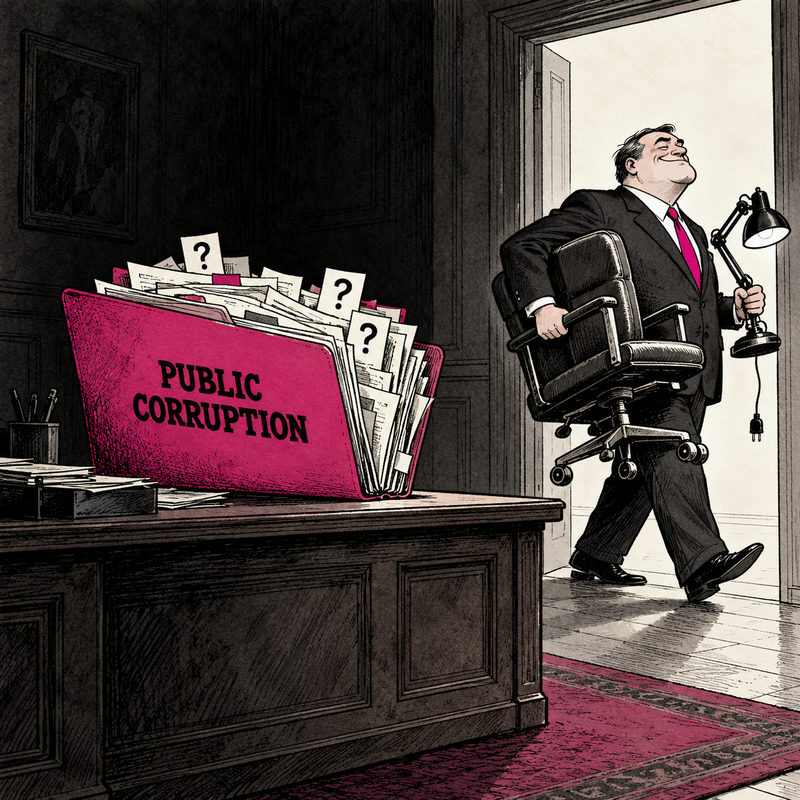
If you are worried about what an investigation might find, there are two very different kinds of good news. One is that the evidence clears you. The other is that nobody is left to examine it. The second is considerably easier on the staffing budget.
ProPublica, republished by Salon, reports that Trump's purge of anti-corruption personnel derailed a probe involving Navatek's dealings with Lindsey Graham, James Clyburn and Joe Wilson. Former chief executive Martin Kao alleged donations-for-contracts arrangements. The lawmakers were not formally designated subjects; two former executives were, but were never charged. Representatives disputed wrongdoing. Kao, convicted of fraud and campaign-finance offenses, sought a reduced sentence. His account needed testing, not automatic acceptance.
That need is precisely what makes removing the investigators such a useful outcome for anyone under scrutiny. A disputed allegation is supposed to create work. Here the work lost its workers. No troublesome requirement to persuade a jury was involved in making the questions harder to answer.
This is not a declaration that the allegations are true. The source's qualifications are substantial. A witness with an incentive to help himself can lie; records can support parts of an account without proving the whole thing. ProPublica reports that agents had found supporting records and wanted to pursue the case. That is an argument for investigating carefully, not for replacing the investigation with this column's verdict.
Make powerful people uncomfortable.
Subscribe to Democrawonk.
The FBI told ProPublica the claims were misleading and defended personnel removals as responses to misconduct or weaponization. DOJ described its work as rooting out corruption. Those are the agencies' positions. The reported result is that the people examining this particular set of allegations were gone.
Notice who gets the practical advantage. It is not limited to a single party: the reporting concerns Republicans and a powerful Democrat. Liberals do not acquire a principled exemption from wanting answers because one of the names is Clyburn. A process that disappears when the questions become uncomfortable is not improved by serving a bipartisan clientele.
The earlier FBI loyalty-test story examined what happens when agents' work becomes a liability to the agents. This report shows the other end of the arrangement: the people whose conduct would have been examined benefit from the missing examination, without necessarily having to request it.
That is the catch in treating a personnel purge as a clean break with institutional wrongdoing. Removing investigators does not remove the unresolved transactions. It removes the people paid to follow them. The file can remain full of questions while the organization proudly displays a shorter employee list.
An acquittal requires a case to be heard. An abandoned investigation can provide the convenience of an ending without the inconvenience of an answer.
Comments
Have something to say? Give this story a heckle.
Comment Rules
Argue the point. Add a joke. No threats, harassment, hate speech, spam, private personal information or unsupported accusations. First-time comments and comments with links are moderated. Full Comment Rules
Loading comments…
Questions or deletion requests? Contact Us. We retain comments and moderation records until removed. Only hashed email identifiers are stored for comment accounts.