
A federal judge has dismissed the Justice Department’s lawsuit seeking to block certification of Alaska’s Senate result if Republican incumbent Dan Sullivan loses. The government alleged that another candidate, Daniel J. Sullivan, was put on the ballot to confuse voters and help Democrat Mary Peltola. Judge Sharon Gleason found that the government had not established that the requested court order could remedy its alleged injury.
In particular, it had not supplied a workable plan to separate the relevant ballots and investigate them while preserving voter secrecy.
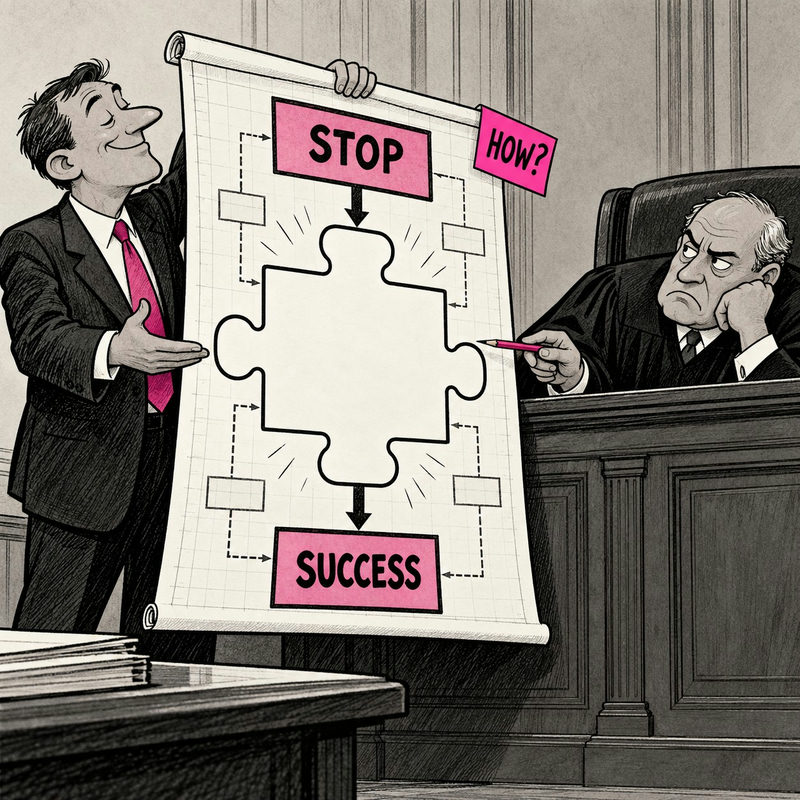
Ah. The plan had reached “stop the election result” without completing the smaller administrative step of “explain how this would work.”
This is the Justice Department. It has attorneys. It has paper. It is not a man arriving at a school-board meeting with a theory written on the back of a petrol receipt. Yet a federal judge has had to ask what, specifically, happens after the dramatic part of its request.
The alleged confusion concerns two candidates with similar names. Whether recruiting the second Sullivan involved wrongdoing remains a separate matter under criminal investigation. Nobody in the race has been charged. Peltola’s campaign denies involvement with either Sullivan campaign, and Peltola says she is not interested in tricking voters. The civil dismissal does not declare the underlying conduct innocent; it declares this proposed judicial intervention unsupported by the required showing.
And that showing includes a rather basic ingredient: the intervention must be capable of doing something useful, lawfully, rather than simply expressing how upset the government is about a possible result.
I’m picturing the operational briefing. Step one: halt certification if the Republican loses. Step two: separate ballots for the other Sullivan. Step three: investigate. Step four: preserve voter secrecy.
Lovely. How do steps two and three coexist with step four? We’ve put them in separate bullet points.
The Daily Heckler: five or six selected stories.
Political satire for your morning inbox.
That should do it. Nothing protects a constitutional concern like moving it farther down the slide.
Gleason’s order specifically criticized the absence of a workable segregation plan and the proposed unspecified investigation. “Investigation” is an impressive word, but it is not a piece of equipment you can wheel into the counting room and switch on. Somebody has to know what it is supposed to examine, how and under what constraints.
Otherwise I can solve every difficult public problem by writing “resolve situation” in a box and drawing an arrow toward success. Flooding? Resolve situation. Budget shortfall? Resolve situation, but in blue ink so finance knows it’s theirs.
The certification request also had a revealing trigger: a loss by the Republican incumbent. That condition belongs in the description, because the government was not simply asking the court to inspect a theoretical ballot-design problem in a vacuum. It wanted the power to interrupt certification following a particular electoral outcome.
If you bring a request that consequential, perhaps arrive carrying more than the legal equivalent of a suitcase labeled Important Things for Later.
The Justice Department did not immediately comment on the ruling. Its separate criminal investigation continues. Those two facts can coexist without anyone pretending a dismissed civil case either proves the alleged plot or makes every related question vanish.
But the court has declined to become the department’s project manager. It will not invent the missing mechanics, supply the secrecy protections and then congratulate the government on having requested the finished product.
For its next emergency application, the department might try a very advanced technique.
Before asking the judge to order something, ask one of its own lawyers to finish the sentence “and then we would…”
No, not “investigate.”
Use a fucking verb with instructions.
Comments
Have something to say? Give this story a heckle.
Comment Rules
Argue the point. Add a joke. No threats, harassment, hate speech, spam, private personal information or unsupported accusations. First-time comments and comments with links are moderated. Full Comment Rules
Loading comments…
Questions or deletion requests? Contact Us. We retain comments and moderation records until removed. Only hashed email identifiers are stored for comment accounts.