
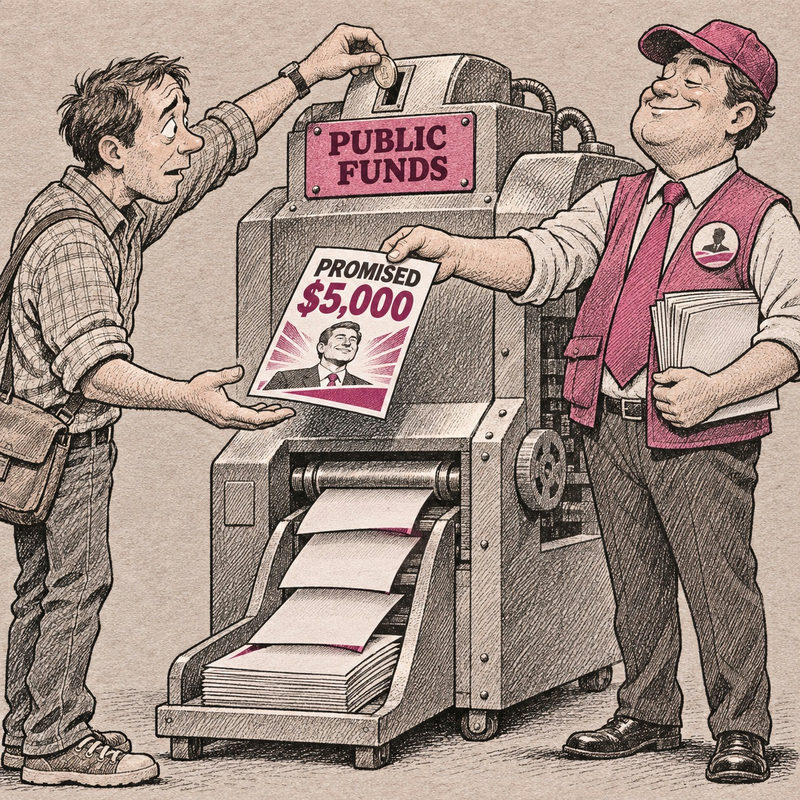
The Trump administration used public money to advertise a promise that Americans would receive $5,000 if Republicans kept Congress. You paid to hear how you might get paid.
A Guardian analysis published Sunday revisits the court fight over $20 million in taxpayer-funded advertising promoting the administration. In October, Judge Jennifer Rochon issued orders stopping government-funded ads she found purely partisan. One promoted the $5,000 claim.
It is an efficient use of your money. First it leaves your pocket. Then it returns to your screen explaining why the people spending it deserve another chance to improve your finances.
The Daily Heckler: five or six selected stories.
Political satire for your morning inbox.
Trump initially defended using public funds as standard. He later said his political fundraising operation would cover the ads. The campaign had access to campaign money. The taxpayer was apparently the more convenient first choice.
The Justice Department tried to head off the first restraining order by saying the conduct would end the next day. A legal defense built around the possibility that the ad campaign would finish before the court did.
The purchase of advertising was a real transaction with a price and a recipient. The offer to voters depended on an election result. That is an important distinction between the people selling the airtime and the people being sold the promise.
Republicans lost Congress.
Fortunately for the advertising purchase, that payment had no such condition.
Comments
Have something to say? Give this story a heckle.
Comment Rules
Argue the point. Add a joke. No threats, harassment, hate speech, spam, private personal information or unsupported accusations. First-time comments and comments with links are moderated. Full Comment Rules
Loading comments…
Questions or deletion requests? Contact Us. We retain comments and moderation records until removed. Only hashed email identifiers are stored for comment accounts.