
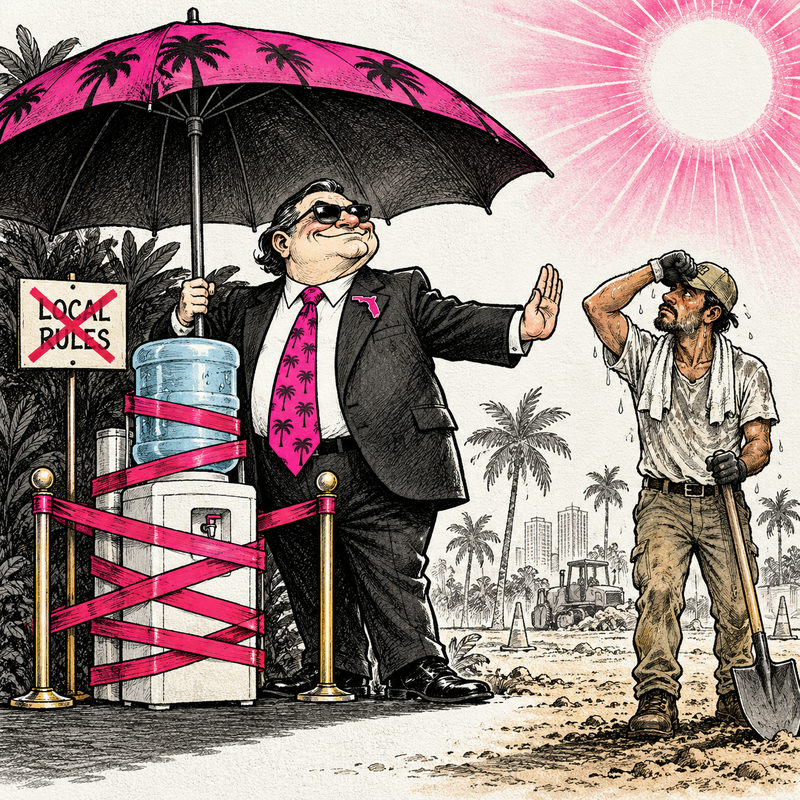
Florida has managed to make a water break a states’ rights issue. Apparently the freedom to sweat through your shirt wasn’t secure until the legislature protected it from county interference.
The Guardian reports that Miami-Dade pursued requirements for paid rest breaks, clean drinking water and first aid when the heat index reached 90 degrees. Before the county’s final vote, Florida lawmakers blocked local governments from requiring heat protections for outdoor workers.
That is an impressively specific use of government power. They didn’t merely fail to help. They made sure the people closer to the problem couldn’t get any bright ideas involving shade.
I think workers should have enforceable heat protections. Not an inspirational poster about hydration. Not a supervisor’s encouraging confidence that everybody can finish before anybody falls over. Actual requirements, with consequences for ignoring them. We regulate the temperature of food. The person carrying it should not be the part of the operation we’re comfortable leaving to chance.
And the breaks should be paid. A safety measure that reduces your paycheck comes with a financial incentive to ignore it. The word “paid” isn’t socialist confetti. It keeps taking care of your body from becoming an unauthorized withdrawal from your grocery budget.
Workers have found another route. The Coalition of Immokalee Workers’ Fair Food Program gets retailers to pay a small premium for produce from farms following a worker-protection code. Farms that violate it can lose their preferred status. Its requirements include shade, cool water, paid rest and access to medical attention without retaliation.
Notice what makes that arrangement work: an employer can lose something.
Apparently concern becomes much easier to translate into action when it can also become a lost customer. A worker’s body can sound the alarm; the purchasing department has the volume control.
This summer, the program added year-round access to electrolytes in a matter of weeks. A few weeks! Nobody needed to establish whether electrolytes were sufficiently pro-business. Workers needed them, and the program changed.
Other labor groups are adopting the approach. Good. Use the leverage that works. But nobody should need a strategy for pressuring a nationally recognizable brand to obtain protections a county was already trying to require. Your ability to get through a hot workday should not depend on whether the company farther up the supply chain has a logo worth embarrassing.
That’s my objection to making voluntary arrangements carry this much weight. A participating retailer can help enforce a standard. It cannot turn participation into a right for workers outside the program. Congratulations on finding a safer job; apparently your previous mistake was choosing the wrong supply chain.
I want a federal heat standard with teeth, and states to stop slapping away local protections. Set a floor. Let worker-led programs improve on it. If employers have better ways to keep people safe, wonderful: demonstrate them while meeting the requirement, not instead of having one.
Florida’s legislature has shown it can act decisively when a paid water break threatens to become mandatory.
Now let’s see whether it can manage that level of urgency when the thing at risk isn’t the employer’s option to say no.
Comments
Have something to say? Give this story a heckle.
Comment Rules
Argue the point. Add a joke. No threats, harassment, hate speech, spam, private personal information or unsupported accusations. First-time comments and comments with links are moderated. Full Comment Rules
Loading comments…
Questions or deletion requests? Contact Us. We retain comments and moderation records until removed. Only hashed email identifiers are stored for comment accounts.