
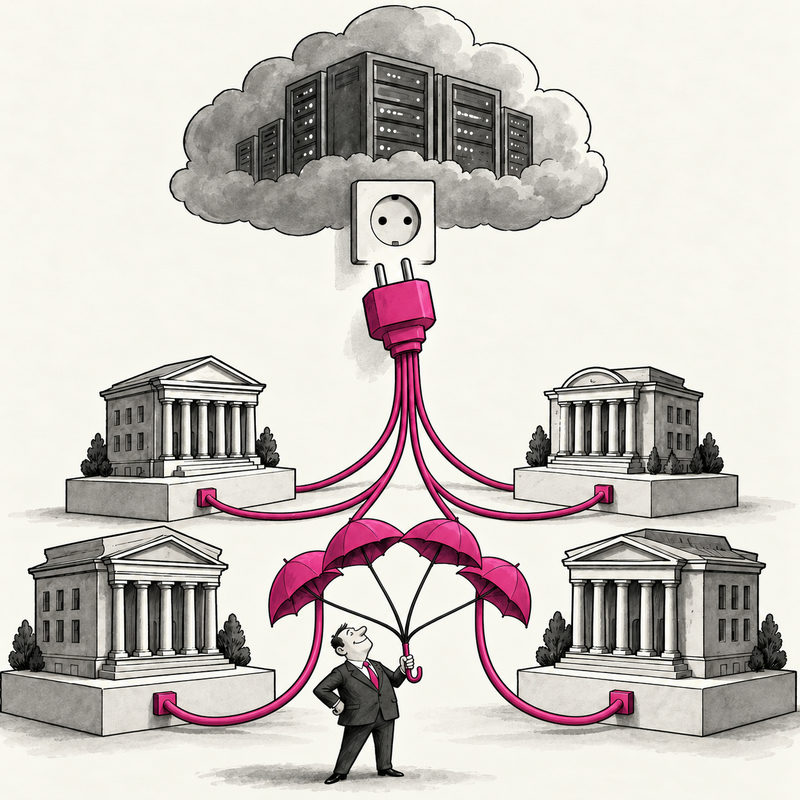
Four banking apps can occupy four separate squares on a phone and still have an extremely collective morning.
Tuesday's Google Cloud outage disrupted services at UK banks including Lloyds, Halifax, HSBC and Revolut, the Associated Press reports. The trouble centered on Google's London infrastructure. Services outside Britain could also be affected if they depended on that infrastructure.
The important word is depended. A different logo is not a different dependency. The phone has arranged the banks into separate little boxes; the underlying system has declined to respect the phone's filing decisions.
Here is the basic mechanism. An app is the part a customer touches. Behind it are services it needs to operate. If several customer-facing businesses rely on infrastructure experiencing a disruption, several apparently separate services can fail together. You do not have to move your account to Google for Google's problem to become part of your banking experience. The dependency already made the trip.
That does not mean every bank uses the same architecture, every function failed, or all of British banking stopped. It means the affected services were connected to a common problem. The distinction is important, especially if the next proposed solution is to open four apps again but with more conviction.
Make powerful people uncomfortable.
Subscribe to Democrawonk.
Revolut said customers' money and data were safe. Lloyds said its app was operating again, and Google reported signs of recovery while engineers investigated. This was a disruption with recovery underway, not evidence that deposits had evaporated. Your money can be safe while access to a useful service is having a group absence.
The commercial appeal of shared infrastructure is not mysterious. Businesses can use capabilities without building every underlying component themselves. But the convenience of sharing does not repeal the consequence of sharing. If the shared component has trouble, the customers discover a relationship that the branding department did not need to explain.
Our look at power-project queues concerned another distinction between a digital ambition and the infrastructure that must actually support it. In this case, the lesson arrived without requiring anyone to read a strategy document. The apps taught it by becoming less useful at approximately the same time.
Competition remains real at the customer-facing level. Banks can offer different products and service. What they cannot do is make a common dependency independent by choosing distinct colors for the login screen.
So when a financial service advertises convenience, the unglamorous question is how that convenience survives trouble underneath it. A useful answer describes resilience and recovery. An unhelpful answer points to the other app.
Tuesday supplied a demonstration of why. The other app was already attending the same outage.
Comments
Have something to say? Give this story a heckle.
Comment Rules
Argue the point. Add a joke. No threats, harassment, hate speech, spam, private personal information or unsupported accusations. First-time comments and comments with links are moderated. Full Comment Rules
Loading comments…
Questions or deletion requests? Contact Us. We retain comments and moderation records until removed. Only hashed email identifiers are stored for comment accounts.