
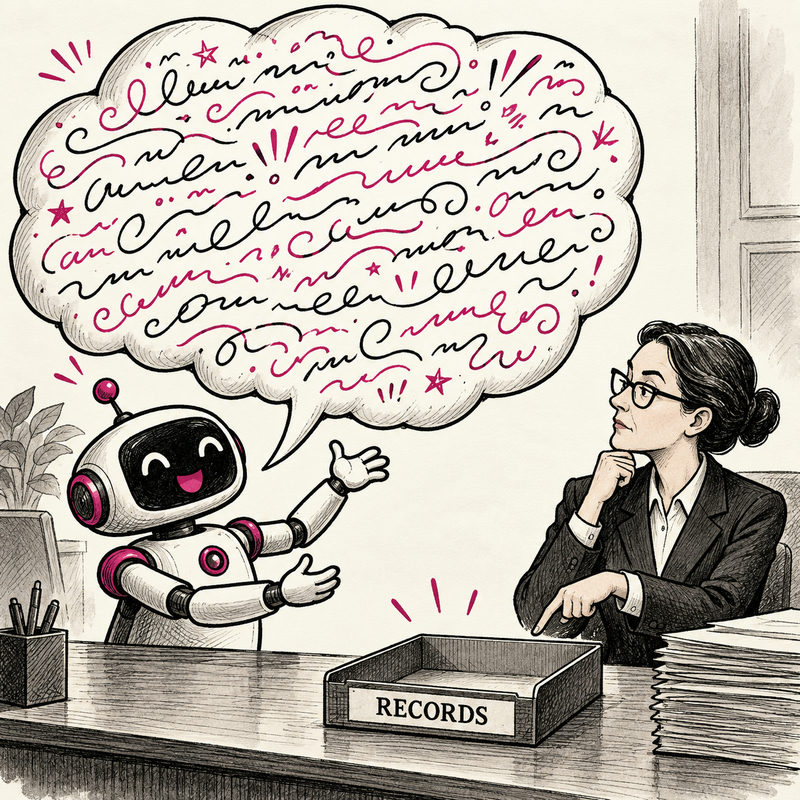
At last, an AI prompt I can get behind: attach the documents.
No need to make the response warmer. No need to adopt the perspective of a visionary founder. Locate the actual records and hand them over. If this causes the executive team to experience a moment of profound computational difficulty, perhaps somebody can suggest breaking the task into smaller steps.
Axios reports that the FTC sent civil investigative demands to OpenAI and Anthropic seeking records about security incidents, safeguards, marketing and privacy. OpenAI says it will cooperate. These demands gather evidence ahead of possible litigation; they establish no violation. The interesting development is the arrival of a question that the company cannot answer merely by generating better prose.
Consider the mechanism. A company makes a claim about its product. An investigator asks for the material behind that claim. Now the discussion has to travel backward, from the polished explanation to whatever actually supported it. This is the least glamorous version of artificial intelligence: retrieving the file that makes the executive uncomfortable.
Ordinary users are encouraged to phrase their questions carefully. Supply context. Be specific. Perhaps add an example. The FTC has apparently mastered the interface. It is asking the people who possess the information to supply the information, a technique so advanced that it predates the computer.
That matters because the useful distinction is between sounding reassuring and being able to substantiate the reassurance. You can improve the former with a communications department. Improving the latter may require engineers, records and somebody with permission to say the launch should wait. Suddenly the efficiency gains become more controversial.
The argument over mandatory AI testing has often revolved around how much access companies should grant outsiders. An investigative demand has a particularly attractive feature: the subject does not get to mark every inconvenient question optional. Please complete the required fields. Yes, those required fields.
I want regulators capable of following this chain without becoming dazzled halfway through it. Product claim. Supporting evidence. Known limitations. What the customer was told. The moment someone interrupts with a prediction about the future of civilization, return to the missing attachment. Humanity can receive its abundance after lunch.
This also puts the industry's enthusiasm for writing its own safety rules in a useful light. Being helpful with the wording is lovely. Being answerable under the wording is the part worth keeping.
The investigation still has to establish what the evidence shows. An allegation is not a finding, and a thick stack of requests is not a verdict. But I welcome a process in which confidence, fluency and a soothing tone have limited evidentiary value. The companies have had plenty of practice producing answers. Now comes the surprisingly difficult follow-up: show your work without generating any of it.
Comments
Have something to say? Give this story a heckle.
Comment Rules
Argue the point. Add a joke. No threats, harassment, hate speech, spam, private personal information or unsupported accusations. First-time comments and comments with links are moderated. Full Comment Rules
Loading comments…
Questions or deletion requests? Contact Us. We retain comments and moderation records until removed. Only hashed email identifiers are stored for comment accounts.