
The Justice Department has charged five people in a student-aid fraud crackdown involving stolen identities and alleged use of AI to impersonate students. Officials say they identified more than $32 million in actual losses tied to the specific subjects. The Education Department’s inspector general detected the patterns; the FBI helped trace the accounts and money, Ars Technica reports.
That is useful work. People who never attended a college should not discover that an ambitious stranger has enrolled them in debt.
Now comes the administration’s exciting proposal for making the work look as though it does itself.
Federal Trade Commission chairman Andrew Ferguson says computers can help stop the fraud without extra government staff and resources. “The computers help us find it, and we keep the money in the agency,” he said.
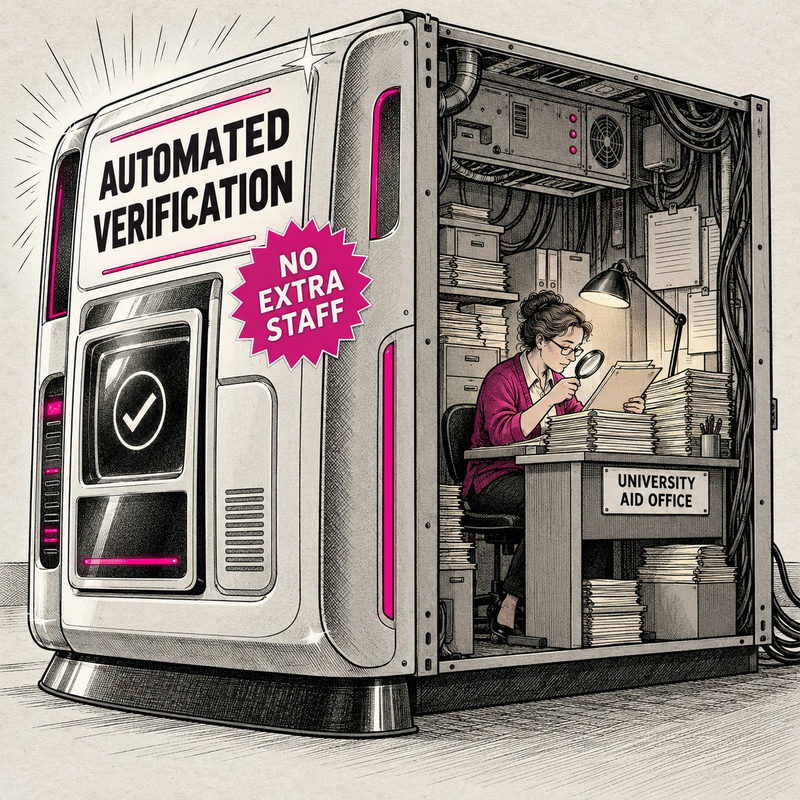
And when the automated system rejects a legitimate student? The university gets to do the follow-up verification.
Ah. There is a person inside the robot. They just work for a different institution.
This is the administrative version of a magician sawing a woman in half, except the trick is that her salary appears on two budgets and the magician only shows you his. Look at all the labor we've eliminated. Please ignore the financial-aid office protruding from the other end of the box.
The federal system asks applicants to hold government-issued identification up to a camera. It assigns risk ratings, and applicants flagged as high risk are rejected. Schools then have to establish whether a rejected application was actually genuine. Advocates warn that the added verification can delay access to aid; some low-income applicants may also need time and money to obtain suitable identification.
The Daily Heckler: five or six selected stories.
Political satire for your morning inbox.
So the machine has a beautifully narrow job description. It can say no. Somebody made of organs has to determine whether no was the correct answer.
This is a very achievable automation target. A locked door also rejects every applicant without employing a receptionist. You only start encountering personnel costs when somebody insists that some people ought to be allowed into the building.
The administration expects few real students to be flagged. Financial-aid administrators have asked for a number. Asked about the remaining volume of in-person verification, FAFSA executive director Aaron Lemon-Strauss said: “I’m not going to be able to give you a number yet.”
Wonderful. The savings can take a bow now. The workload will introduce itself later, probably carrying a stack of folders and asking where it should sit.
There have already been technical problems: a June 29–July 6 issue stopped fraud-evaluation results from being shared with certain FAFSA forms. The department reprocessed those applications. Computers, it turns out, occasionally require the participation of everyone who was supposed to have been freed by the computer.
And, and this is the part that makes me want to open the cabinet under the podium: none of this requires pretending the fraud is imaginary. The alleged scheme used stolen identities and AI-generated coursework to keep aid flowing. Investigators finding it is good. A system that catches more of it can be good. Why must every useful thing arrive wearing a cape embroidered with No Humans Required, while a university employee crawls behind it moving the wheels?
The ghost students are the problem being investigated. The ghost workforce is the sales pitch.
At least put air holes in the fucking box.
Comments
Have something to say? Give this story a heckle.
Comment Rules
Argue the point. Add a joke. No threats, harassment, hate speech, spam, private personal information or unsupported accusations. First-time comments and comments with links are moderated. Full Comment Rules
Loading comments…
Questions or deletion requests? Contact Us. We retain comments and moderation records until removed. Only hashed email identifiers are stored for comment accounts.