
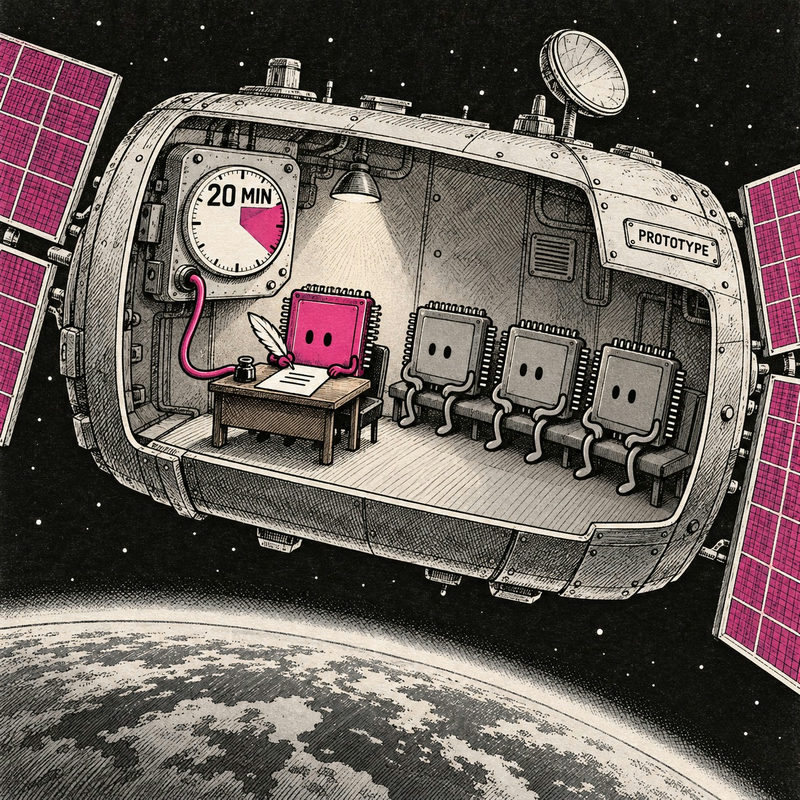
Google’s prototype space data center is online. After launching earlier this month and completing about three weeks of checks, the satellite received a prompt asking its onboard model to write a haiku about being in space, TechCrunch reports.
It did. Humanity has successfully moved a small portion of its unsolicited poetry problem off the planet.
The spacecraft carries four of Google’s Tensor Processing Units, but its power supply allows only one to operate for about twenty minutes at a time. It generates up to one kilowatt of electricity. This is a prototype, not a fully functioning orbital replacement for terrestrial data centers.
That distinction matters. Four chips aboard, one working a short shift. The future has brought roommates and is negotiating access to the microwave.
There is serious engineering happening. Google is testing how the hardware handles radiation and thermal stress. Radiation can alter stored bits and corrupt data; tests on Earth suggested the effects would be more manageable for running models than for training them. Now the company gets to compare those results with actual conditions in orbit.
Good. Test things. I am enthusiastically in favor of finding out whether the expensive thing works before ordering the civilization-sized version.
But the first public flourish is still wonderfully on brand. We have launched a computer into space, established contact across the void, and asked it to become the most geographically inconvenient participant in a creative-writing workshop.
The Daily Heckler: five or six selected stories.
Political satire for your morning inbox.
Could the machine report something useful? Yes. Google also asked it about conditions around the satellite. The company says it is operating normally. Nobody should mistake the poetry demonstration for the entire research program.
I just enjoy that even after escaping Earth, the hardware could not escape the assignment to generate content.
If these chips prove capable, Google plans two more satellites in 2027, with more power and optical links between them. The larger ambition is infrastructure that could make economic sense in the 2030s. That is an ambition, not an operating business waiting for you to upload a spreadsheet.
And there is a sizeable item under prerequisites. Google’s larger orbital vision depends on SpaceX’s still-developing Starship becoming fully and rapidly reusable. Suncatcher researchers estimated that achieving the kind of learning-driven cost reductions seen with earlier SpaceX vehicles would require 1,800 Starship flights.
Eighteen hundred. Not one successful demonstration and a particularly confident investor deck. A whole lot of repeatedly getting the enormous thing off the ground and back again.
I’m tired of futures that arrive as finished destinations while the transportation is still being invented. This one at least has the courtesy to show us the prototype: one chip, twenty minutes, a poem.
Keep doing the tests. Solve the power problem. Show the economics. But let us retain the ability to admire an experiment without immediately signing a lease on the fucking moon.
The satellite has written its verse. The business case still needs work.
Comments
Have something to say? Give this story a heckle.
Comment Rules
Argue the point. Add a joke. No threats, harassment, hate speech, spam, private personal information or unsupported accusations. First-time comments and comments with links are moderated. Full Comment Rules
Loading comments…
Questions or deletion requests? Contact Us. We retain comments and moderation records until removed. Only hashed email identifiers are stored for comment accounts.