
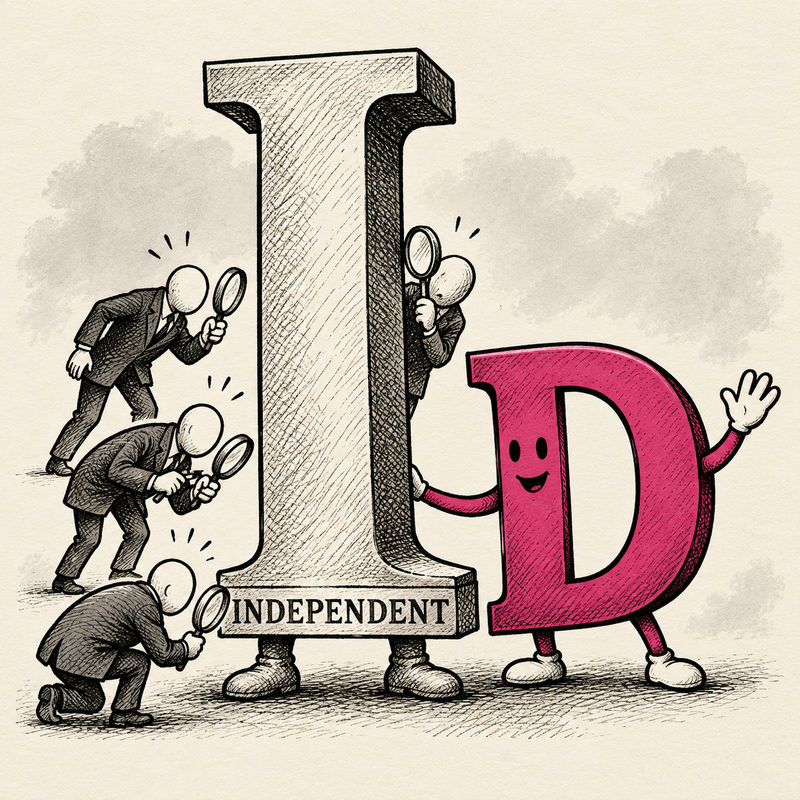
I had understood political independence to mean you made your own decisions. Evidently there is a more demanding version in which you must also ensure that nobody from either party ever agrees with one of them. This would preserve independence beautifully, at the manageable cost of making it useless.
Dan Osborn appears willing to risk usefulness. CBS News reports that the independent Nebraska Senate candidate will campaign with Democratic Rep. Ro Khanna. Osborn says he would not caucus with either party if elected. The two men have nevertheless discovered that they can attend the same event without immediately merging their congressional identities.
Khanna’s account of the arrangement is particularly good. He offered to help without visiting if his progressive profile would be a problem. Osborn invited him to come. A politician was presented with the option of discreet assistance and selected the version where voters could see the person assisting him. There must be consultants still checking the paperwork for a mistake.
Their shared interest includes pressing for disclosure of the Epstein files. That gives the appearance a purpose beyond the thrilling discovery that two men own microphones. Agreement on a concrete demand can explain a joint event. It need not establish agreement on everything else either man has ever said.
Make powerful people uncomfortable.
Subscribe to Democrawonk.
This is where I try to follow the objection. An independent candidate accepts help from a Democrat. Therefore he is not independent. Presumably the way to demonstrate freedom from party control is to let the possibility of a party’s disapproval determine who may appear at your event. The reasoning has become very strict about independence just as it removes the candidate’s ability to exercise any.
The planned gathering also includes former Republican figures Marc Racicot and Joe Walsh. That does not make the gathering a prediction of victory over Republican Pete Ricketts. It makes it a gathering. Nebraska voters retain the irritating right to decide what they think of everyone involved after seeing them together.
In Wyoming, we recently examined a Republican advertisement that left the party identification outside. Osborn’s arrangement offers a different experiment: put the affiliations where people can see them and explain the shared task. Voters might be capable of processing both pieces of information.
I am trying to find the moment at which the independence disappears. The candidate chose the guest. He has stated his caucus position. The guest is arriving under his own recognizable political identity. Perhaps independence survives all that. Perhaps the alarming part is that somebody has used it to make a decision.
Comments
Have something to say? Give this story a heckle.
Comment Rules
Argue the point. Add a joke. No threats, harassment, hate speech, spam, private personal information or unsupported accusations. First-time comments and comments with links are moderated. Full Comment Rules
Loading comments…
Questions or deletion requests? Contact Us. We retain comments and moderation records until removed. Only hashed email identifiers are stored for comment accounts.