
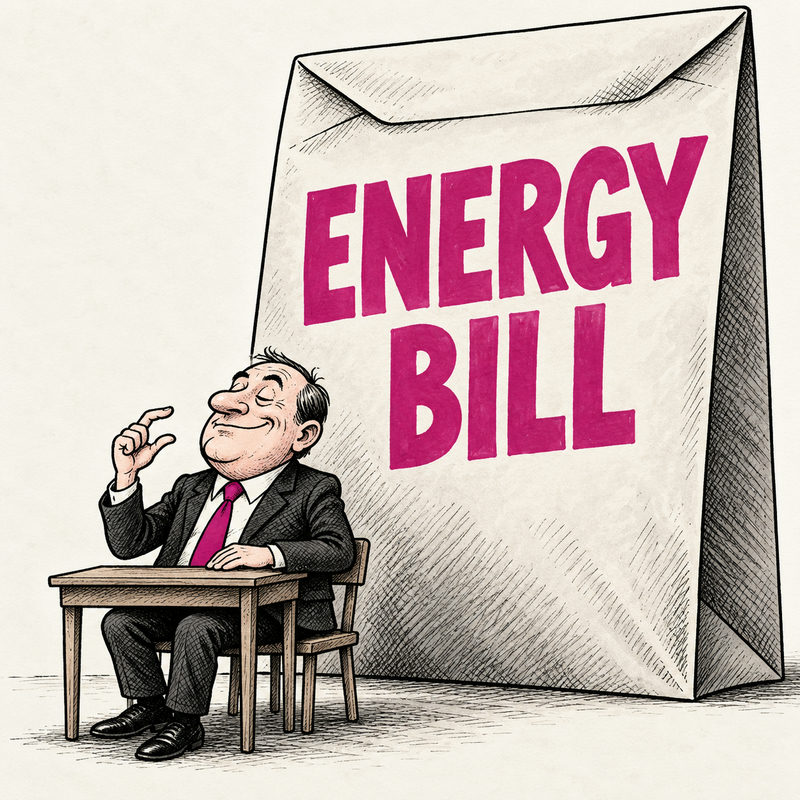
Northern Ireland is small. Its energy bills are under no obligation to show the same restraint.
BBC News NI reports that Nigel Topping, the new chair of the Climate Change Committee, is visiting farmers, businesses and politicians to examine the region's climate challenges. Asked about the consequences of inaction, he separates two questions that are often allowed to pass as one: how much a small place changes the whole world, and what it loses by failing to act at home.
The first question offers a comforting view from very far away. The second brings back the energy costs, air quality and innovation opportunities. An excuse that looked proportionate beside the entire planet begins to look rather oversized beside a household bill.
Topping warns that inaction means higher energy costs than necessary, missed opportunities and continued damage to children's health from poor air quality. Those are his warnings, not a new local health survey or a promise that any particular policy makes energy cheap overnight. But they expose the missing half of the small-place argument. Local benefits do not have to solve the whole atmosphere before they are allowed to count.
Make powerful people uncomfortable.
Subscribe to Democrawonk.
Imagine applying the opposite rule consistently. A measure would first need to demonstrate that it could rescue humanity, after which the government might consider whether it was worth doing for the people who live nearby. The eligibility requirement would be global salvation. The service area would remain Northern Ireland. Very tidy grounds for declining almost everything.
There is a less abstract detail in the BBC account. Topping points to periods without sitting ministers, when civil servants were working but policy was absent. The staff could continue; the political decisions could not. Government had retained the activity and misplaced the governing. Nobody needed to invent a complicated climate model to locate that particular delay.
He acknowledges Northern Ireland's complex politics and the damage that policy reversals do to investment decisions. Complexity is real. It is not, however, a renewable source of lower bills. Repeating it does not generate a kilowatt, though it can keep an explanation running indefinitely.
The distinction resembles the one in our account of proposed power projects: being able to describe a difficulty is not the same as getting useful infrastructure out of it. A small place still has decisions it can make and consequences it has to live with.
Viewed from space, Northern Ireland occupies little room. Viewed from inside a home paying for energy, the home occupies nearly all of it. The second perspective is also available to policymakers. They would not even need to travel very far.
Comments
Have something to say? Give this story a heckle.
Comment Rules
Argue the point. Add a joke. No threats, harassment, hate speech, spam, private personal information or unsupported accusations. First-time comments and comments with links are moderated. Full Comment Rules
Loading comments…
Questions or deletion requests? Contact Us. We retain comments and moderation records until removed. Only hashed email identifiers are stored for comment accounts.