
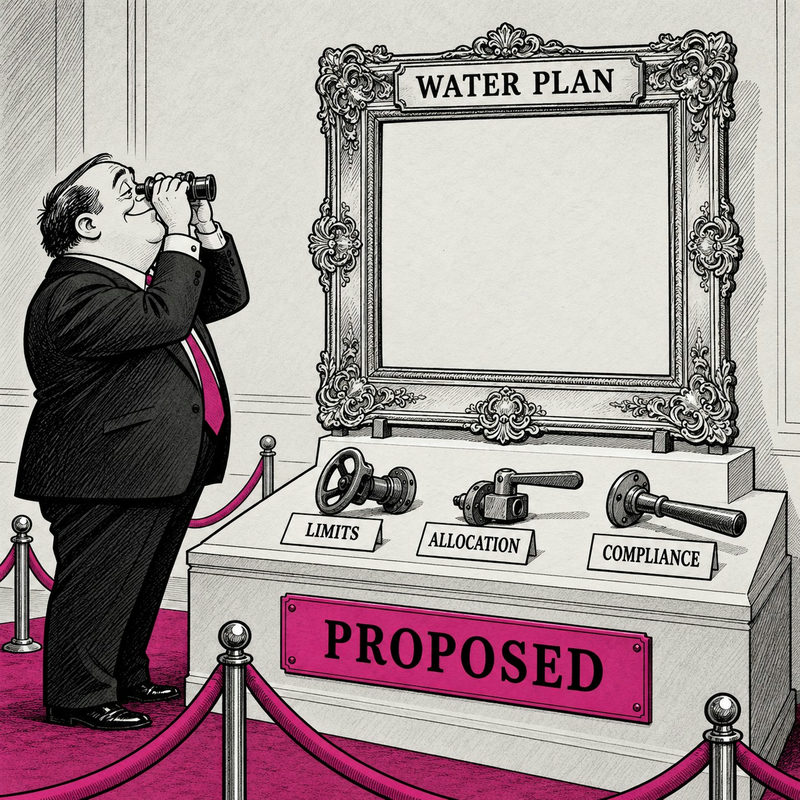
Australia’s Northern Territory government proposes removing the legal requirement that water allocation plans reserve water for the environment. The bill would also remove requirements that industry’s total use stay below the limit in each plan and that water management comply with those plans, the Guardian reports.
An ambitious upgrade from having a plan to having a plan nearby.
The environment minister, Joshua Burgoyne, says the bill does not dismantle safeguards. He points to a remaining framework of environmental assessments, approvals, mining licences, pollution controls, water planning and heritage protection. Those are real parts of the regulatory system. This is a proposal, not an enacted abolition of every environmental law in the territory.
But the items proposed for deletion have a suspiciously practical quality. Set water aside. Stay below a limit. Follow the plan. These are the bits that turn a water policy into something more demanding than a collection of excellent intentions with page numbers.
Take the first one. Rivers, springs, wetlands and water-dependent ecosystems require water. I realise this is a bold intervention into a sophisticated policy debate. Perhaps I should have paid a consultancy to express it as a liquidity dependency.
Nevertheless: wet things. Need water.
The current requirement gives that fact a place in the allocation plan. The proposal would remove the legal obligation to set aside the water. It would not repeal biology, which remains irritatingly outside the territory parliament’s jurisdiction. A wetland cannot substitute an assurance that the government still has several other environmental laws.
Then there is the proposed removal of the rule keeping industrial use below the plan’s limit. A limit that must be obeyed can be quite abrasive. It interrupts people halfway through taking more. Removing that obligation is a wonderful way to make the number less judgmental without doing anything so vulgar as producing additional water.
The Daily Heckler: five or six selected stories.
Political satire for your morning inbox.
And then, because we wouldn’t want the plan developing ideas above its station, the bill would remove the requirement that water management comply with it.
That is three separate opportunities for a written safeguard to encounter actual behaviour, selected for removal. Nobody accidentally sits on the delete key in that pattern.
The changes come as the government pursues expansion in fracking, data centres and agriculture. Environmental groups say the bill puts industry ahead of nature; the Central Land Council says it undermines transparent planning and ignores Aboriginal voices. Those are their criticisms, not a finding that a particular river has already been damaged by a bill that hasn’t passed.
Burgoyne calls the criticism fearmongering and says the government supports responsible development and effective regulation. He also points to its expansion of the Limmen Bight marine park. The remaining framework deserves to be evaluated rather than pretended out of existence.
Fine. Evaluate it. Start with the difference between protecting a place and specifying how much water it gets to keep. An extra protected place is not a measuring jug. It cannot be poured into the gap left by a deleted allocation requirement.
The remaining laws may do important work. The parliamentary decision is still ahead. But the proposed shortcut has an awkward physical limitation: deleting the environment’s reserved share does not manufacture a second supply of water. The drafting software can accommodate an unlimited number of thirsty industries. The aquifer has not installed that update.
This is where the efficiency programme starts looking incomplete. Why stop at the allocation requirement? The really obstructive provision is the one requiring a wetland to remain wet. That bastard operates continuously, never responds to ministerial assurances and cannot be streamlined by a parliamentary majority.
Perhaps the next reform can give fish a transition period to develop lungs. No compulsory timetable, obviously. We wouldn’t want nature complaining that it was being held to the plan.
Comments
Have something to say? Give this story a heckle.
Comment Rules
Argue the point. Add a joke. No threats, harassment, hate speech, spam, private personal information or unsupported accusations. First-time comments and comments with links are moderated. Full Comment Rules
Loading comments…
Questions or deletion requests? Contact Us. We retain comments and moderation records until removed. Only hashed email identifiers are stored for comment accounts.