
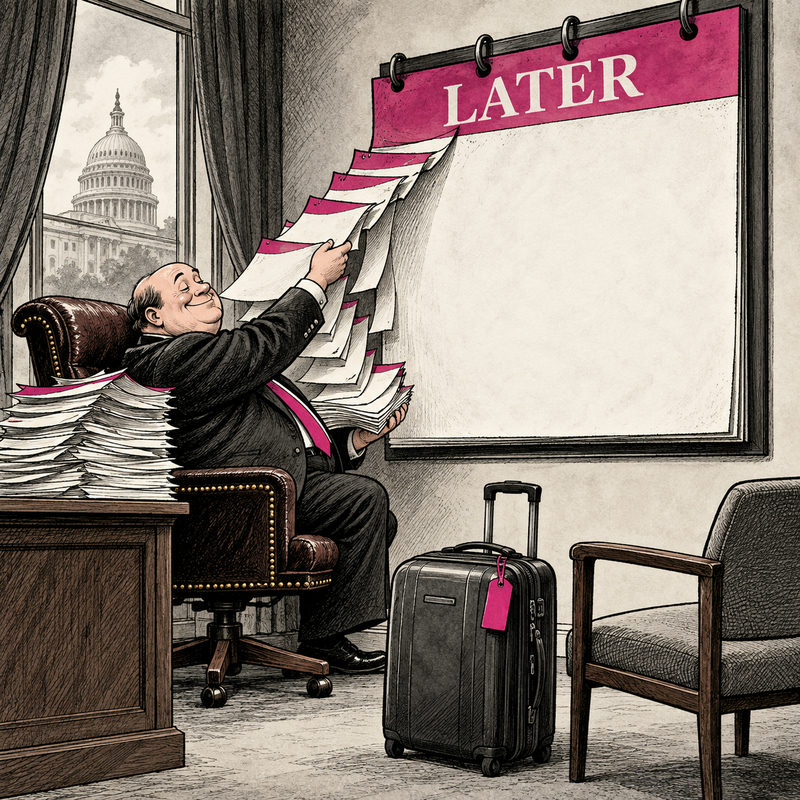
For the roughly 101,000 Ukrainians and 1,800 Sudanese whose temporary protection was due to end Monday, being allowed to remain in the United States is good news. Having to extract that news on the day of the deadline is an appalling way to run a country that regularly advertises its administrative superiority.
AP reports that the Department of Homeland Security says people covered by these measures retain protection while a further announcement awaits the appropriate time. The department supplied no duration. Apparently the appropriate time for the government to decide is a flexible concept. The appropriate time for everyone else to worry had a date printed on it.
There is a concrete distinction here. These people have received a reprieve from the immediate risk of deportation. They have not received a clear account of how long they can stay. A government should be capable of doing the first without treating the second as a premium service available in a future release.
DHS also did not answer AP's question about work permits. TPS generally permits people to work while protection remains in effect; the silence is not evidence that these permits have been cancelled. It is evidence that a fairly obvious question about people's daily lives failed to make it into the government's answer. Somewhere in the administrative imagination, remaining in a country evidently requires no further arrangements.
The source describes ongoing armed conflict in both Ukraine and Sudan. Even the representative of the restrictionist Center for Immigration Studies quoted by AP said the secretary was within his authority to continue protection. The need for a decision is not a particularly obscure puzzle. The department has managed to locate the countries. A calendar would be a useful next purchase.
This is the cruelty of indefinite temporary status: the institution owns the uncertainty, but the individual has to inhabit it. I am not describing a particular family's lease, job offer or interrupted school year; the report doesn't supply those stories. I am saying that a life involves commitments extending beyond the next departmental announcement. Washington seems to believe a human being can be left on pause without continuing to consume rent.
We have seen Britain propose extending the wait for permanent settlement. The rules differ. The institutional convenience is familiar: uncertainty can be presented as control while somebody else performs all the waiting. And when immigration enforcement undermines trust in ordinary institutions, the consequences do not remain neatly inside an immigration file.
Keep the protection. The reprieve matters. Then provide an answer people can actually plan around. If officials require more time to decide, they should explain that time in units used outside government. Days. Months. A stated period. The appropriate time is a fine phrase for choosing when to return an uninteresting phone call. It is an indecent place to ask more than a hundred thousand people to live.
Comments
Have something to say? Give this story a heckle.
Comment Rules
Argue the point. Add a joke. No threats, harassment, hate speech, spam, private personal information or unsupported accusations. First-time comments and comments with links are moderated. Full Comment Rules
Loading comments…
Questions or deletion requests? Contact Us. We retain comments and moderation records until removed. Only hashed email identifiers are stored for comment accounts.