
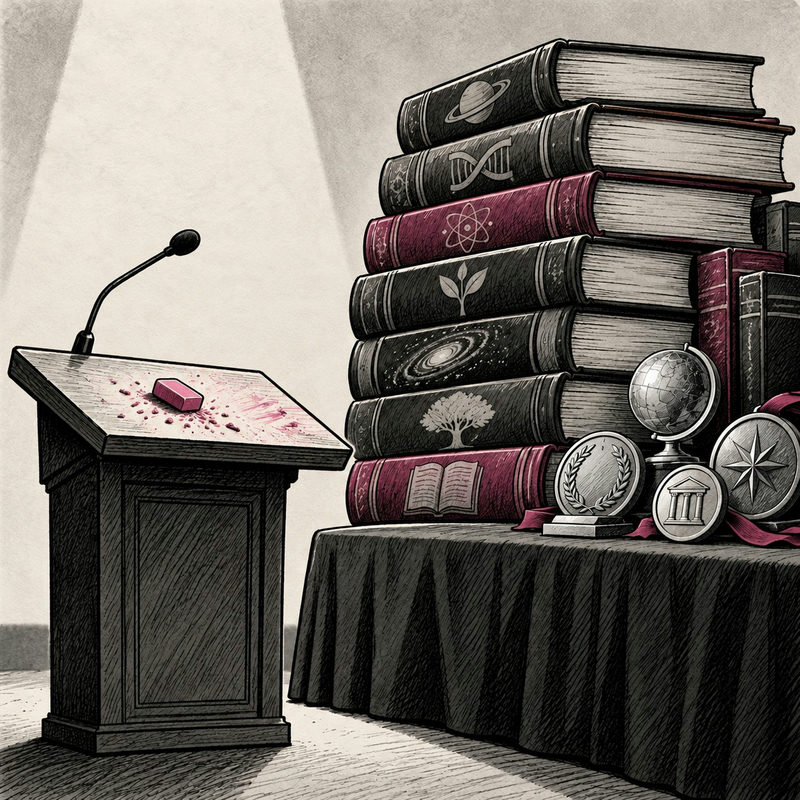
RFK Jr brought a sweeping theory of Arab intellectual failure to a Michigan campaign event. Unfortunately, he chose a theory that can be defeated by opening a list.
Speaking in support of Republican Senate candidate Mike Rogers, the health secretary claimed Arabs do not produce science or literature and do not win several major academic prizes. Al Jazeera’s account supplies a useful counterargument: people, dates and awards. An unfair advantage in a contest otherwise being conducted entirely through vibes.
Ahmed Zewail won the chemistry Nobel in 1999. Naguib Mahfouz won the literature Nobel in 1988. Omar Yaghi, born in Jordan to a Palestinian refugee family, shared the chemistry Nobel in 2025. You do not need to excavate a medieval manuscript to find a problem with Kennedy’s claim. One of the counterexamples was on last year’s calendar.
This is a remarkable standard for a health secretary. His job requires evaluating evidence. Here the evidence and the speech have achieved complete independence from one another.
The campaign setting matters. Rogers is running against Arab-American Democrat Abdul El-Sayed. Kennedy’s remarks took a Senate contest and expanded the opposition research file to an entire ethnic group. Most campaigns struggle to vet one opponent. This one has apparently completed a civilization audit between microphone checks.
The Daily Heckler: five or six selected stories.
Political satire for your morning inbox.
The Council on American-Islamic Relations called for Kennedy’s removal. Critics described the remarks as racist and Islamophobic. Those criticisms concern both the factual erasure and what a cabinet official does when he tells an audience that an entire people contributes nothing worth recognizing. That is considerably more serious than getting a trivia answer wrong at the bar.
And the rebuttal should not accidentally accept Kennedy’s premise. Arab Americans do not have to bring a Nobel medal to qualify for equal treatment. Neither do people from any other background. A hospital patient is entitled to competent public administration without first advancing chemistry.
The prize list is useful because it exposes how cheaply this particular smear was assembled. Kennedy made a claim about checkable records while holding an office whose authority depends on taking evidence seriously. A research assistant could have caught it. So could an internet connection and the faintest desire to know.
There is room for vigorous argument about El-Sayed’s policies, Rogers’s policies or the administration’s record. Instead, a federal health official delivered an ethnic generalization with the confidence of a man who had never considered that Stockholm keeps receipts.
Kennedy wanted to discuss who produces knowledge. He has certainly contributed a case study in what happens when a public official’s claim collapses on contact with it.
Comments
Have something to say? Give this story a heckle.
Comment Rules
Argue the point. Add a joke. No threats, harassment, hate speech, spam, private personal information or unsupported accusations. First-time comments and comments with links are moderated. Full Comment Rules
Loading comments…
Questions or deletion requests? Contact Us. We retain comments and moderation records until removed. Only hashed email identifiers are stored for comment accounts.