
I find it touching when a large corporation discovers that every customer is a unique individual. Usually this revelation occurs somewhere between taking everybody’s money and being asked to give some of it back.
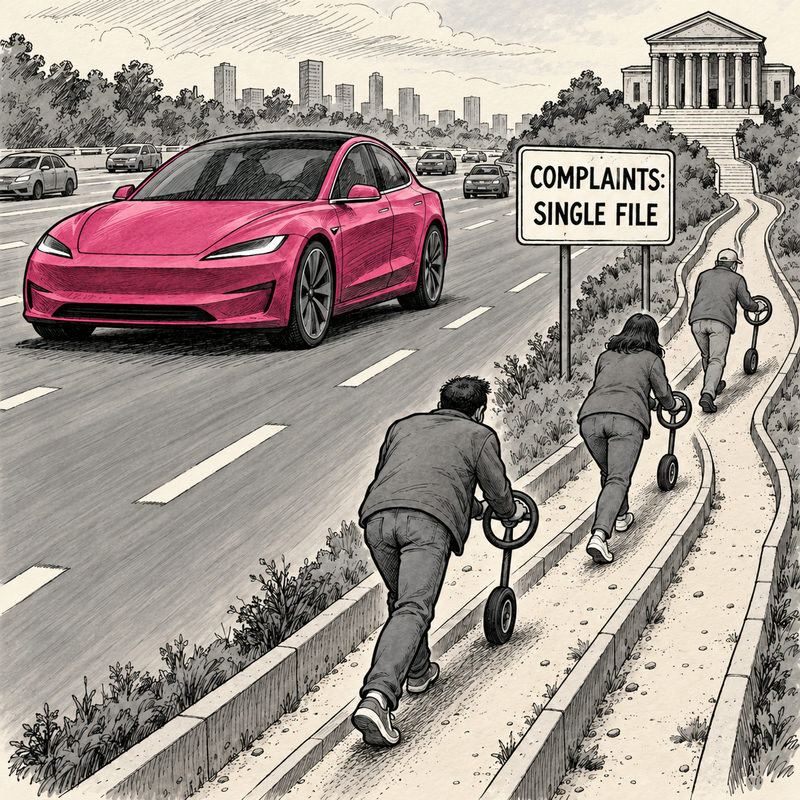
Reuters reports that a federal appeals court has overturned class certification in a California lawsuit accusing Tesla of misleading buyers about the hardware needed for full self-driving. Thousands of buyers cannot, for now, pursue those claims together in a single case.
The court did not decide Tesla told the truth. The underlying lawsuit remains pending, and Tesla denies the allegations. This was a ruling about whether the customers could proceed as a group—not a software update that suddenly made the disputed promises accurate.
That distinction deserves headlights.
The appeals panel found too many individual questions about what buyers actually saw before purchasing. The lower court had concluded that prospective buyers were likely exposed to Tesla’s website statement about the necessary hardware. The panel said the plaintiffs hadn’t shown that every class member encountered the allegedly false statement.
I understand why evidence matters. I am less enthusiastic about a consumer-protection system in which a mass-market sales pitch becomes an intensely personal experience the moment somebody wants a remedy. Apparently each of us enjoys a bespoke relationship with the same website. How luxurious. I hope mine included heated seats.
There is a practical problem here beyond Tesla. A company can afford to defend its business repeatedly. An individual customer has a job, a life, and a fairly strong preference not to acquire a working knowledge of civil procedure as an accessory.
The purchase takes minutes. The complaint apparently requires a minor in litigation.
Class actions are not a certificate that the customers are right. They are a way to make a shared claim economically possible when the law’s requirements are met. A system that insists on individual treatment needs to offer something more useful than the magnificent freedom to spend an absurd amount pursuing your own money.
The U.S. Chamber of Commerce backed Tesla, warning about the costs of overbroad and meritless class proceedings. I appreciate business’s continuing vigilance about expensive legal processes. Perhaps some of that concern could be extended to the people who don’t keep a litigation department near the break room.
My position is not that every complaint should become a class action, or that a judge should ignore differences between purchasers. It is that lawmakers should make collective consumer remedies workable and keep regulators capable of challenging misleading claims. Otherwise the advertised right to seek redress begins to resemble another feature whose practical availability requires clarification.
Tesla can contest the allegations. Customers should have a realistic route to contest Tesla. Winning the procedural argument must not become a substitute for answering the underlying one.
The company sells a vision of cars that can handle things for you.
When it comes to holding the company accountable, however, please keep both hands on the wheel. You’re on your own.
Comments
Have something to say? Give this story a heckle.
Comment Rules
Argue the point. Add a joke. No threats, harassment, hate speech, spam, private personal information or unsupported accusations. First-time comments and comments with links are moderated. Full Comment Rules
Loading comments…
Questions or deletion requests? Contact Us. We retain comments and moderation records until removed. Only hashed email identifiers are stored for comment accounts.