
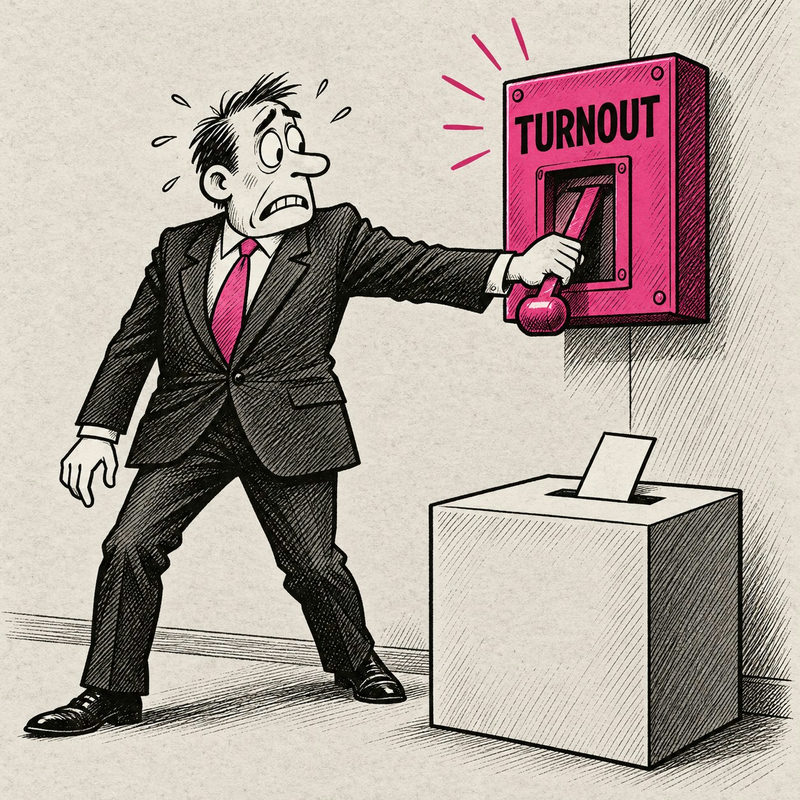
An election-day emergency meeting has an appropriately urgent sound. You imagine a failed system, a threat to public safety, something requiring the immediate attention of senior officials. In this case, the emergency was voters.
Reuters reports that Bezalel Smotrich's Religious Zionism party said the Israeli finance minister suspended campaigning to convene an emergency meeting about unusually high Arab turnout. A politician had encountered democratic participation and reached for the glass marked break in case of democracy.
Benjamin Netanyahu was also warning supporters about long queues in Arab communities. Reuters witnesses described cars flying Likud flags in Jerusalem, playing the Islamic call to prayer and urging people to vote because Arabs were voting. National Security Minister Itamar Ben-Gvir called the level of Arab turnout “crazy.”
Arab political leaders denounced the tactic as racist and inflammatory. The objection is not that a party wants its supporters to show up. Every party does. It is that the pitch treats another group of citizens showing up as the danger from which the country needs rescuing.
Israel's Arab population, mostly of Palestinian heritage, makes up about 21 percent of the country and has traditionally voted at lower rates than Jewish Israelis. The elections committee reported overall turnout of 55.7 percent in the first nine hours, the fastest pace on record. That is the overall figure, not a separate measurement of Arab turnout.
The results were not settled in this reporting. Polls suggested Netanyahu's coalition could lose its majority, but opposition parties might also struggle to assemble the 61 seats needed to govern. High participation does not by itself tell us who wins or which coalition can be formed.
Make powerful people uncomfortable.
Subscribe to Democrawonk.
It does tell us something about a campaign that publicises queues of Arab voters as a warning. An ordinary line at a polling station becomes threatening only after someone supplies a theory about which citizens' votes are supposed to count as normal.
Netanyahu warned of a government involving Mansour Abbas and Ahmed Tibi, two leading Palestinian Arab politicians in Israel. Presenting those politicians as opponents is normal politics. Turning their voters' participation into a communal alarm is something else. The ballot box is apparently acceptable until the wrong people successfully locate it.
This follows Netanyahu's election-eve use of a synthetic mushroom cloud as campaign material. That argument required a manufactured vision of catastrophe. The election-day version has found something real to photograph: people waiting their turn.
The underlying stakes are not a joke. Arab communities have faced a surge in violent crime during the coalition's four years, including murders linked to organised crime, according to Reuters. People living with that reality have reasons to assess the government's record. Their participation is not an intrusion into somebody else's election.
Balad leader Sami Abu Shehadeh argued that the queues should be a source of democratic pride. It is a modest standard: citizens using the process offered to them should not be treated as the process malfunctioning.
If the governing coalition wants fewer voters to oppose it, it could work on the reasons they do. Calling a meeting to discuss the turnout is easier. Unfortunately, the voters have already found a meeting of their own, and it has ballots.
Comments
Have something to say? Give this story a heckle.
Comment Rules
Argue the point. Add a joke. No threats, harassment, hate speech, spam, private personal information or unsupported accusations. First-time comments and comments with links are moderated. Full Comment Rules
Loading comments…
Questions or deletion requests? Contact Us. We retain comments and moderation records until removed. Only hashed email identifiers are stored for comment accounts.