
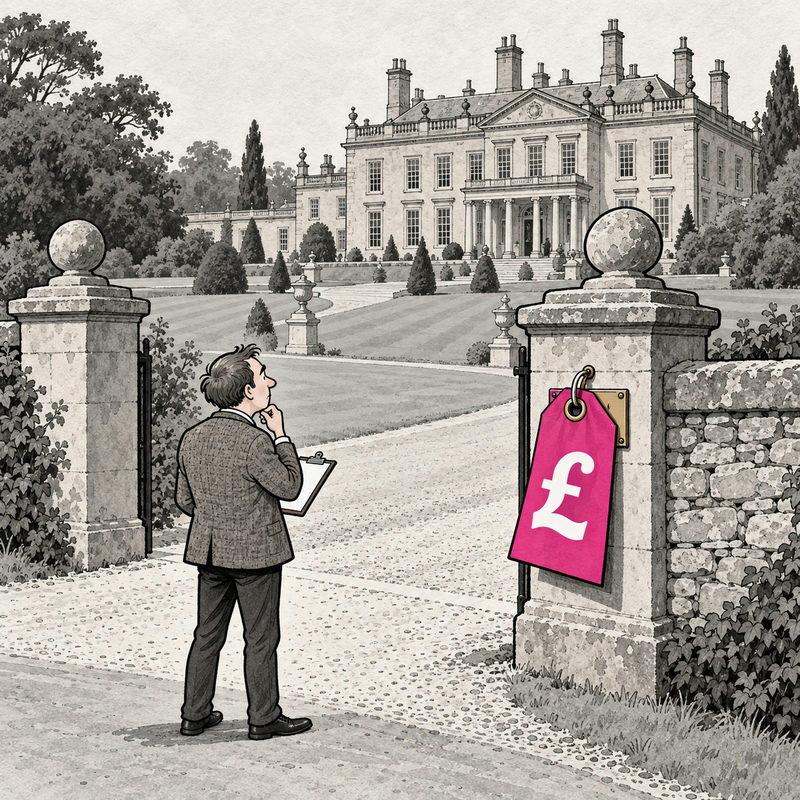
Britain has reached the radical stage of land reform where the government proposes letting people find out who owns the land. Not take it. Not redistribute it. Read the name.
Please allow eight weeks for everyone to recover.
The government on Tuesday proposed opening up Land Registry information, including a free public dataset identifying the owners of significant holdings across England and Wales. Ordinary homeowners would be excluded. The proposals are entering an eight-week consultation, not taking effect immediately, and campaigners told the Guardian they fear major landowners could obstruct them.
The distinction matters. This is not a plan to pin everybody's mortgage paperwork to a bus shelter. It is a plan to make large-scale ownership easier to see. The estate can remain enormous. The mystery around it would have to downsize.
Public bodies would also get free access to information they need to plan homes, schools, hospitals and infrastructure. There is something impressively British about a government trying to build a school while the answer to “whose field is that?” sits behind a payment requirement. Before the children can learn to read, the council must purchase the reading material.
Make powerful people uncomfortable.
Subscribe to Democrawonk.
Transparency is not a bulldozer. Knowing who owns a parcel doesn't settle whether housing should go there, what nature needs protecting or which infrastructure makes sense. It does let those arguments start with the identity of the person who controls the thing everyone is arguing about. A modest administrative advantage over pointing toward the horizon and saying “someone.”
The Country Land and Business Association raises a real concern: publishing personal information can expose families to fraud and identity theft, particularly as AI makes impersonation easier. That deserves safeguards, not an eye roll. The proposal already distinguishes significant holdings from ordinary homes and contemplates separate public-interest access to more sensitive information. Those boundaries should be tested carefully.
But protecting a person's private details and protecting the public from discovering who owns a large piece of its country are not the same service. One is security. The other is a very well-established concierge arrangement.
The consultation is still open to argument, and the outcome is not guaranteed. For now, the proposal offers a wonderfully restrained revolution: no storming the gates, just being able to address the letter correctly.
Comments
Have something to say? Give this story a heckle.
Comment Rules
Argue the point. Add a joke. No threats, harassment, hate speech, spam, private personal information or unsupported accusations. First-time comments and comments with links are moderated. Full Comment Rules
Loading comments…
Questions or deletion requests? Contact Us. We retain comments and moderation records until removed. Only hashed email identifiers are stored for comment accounts.