
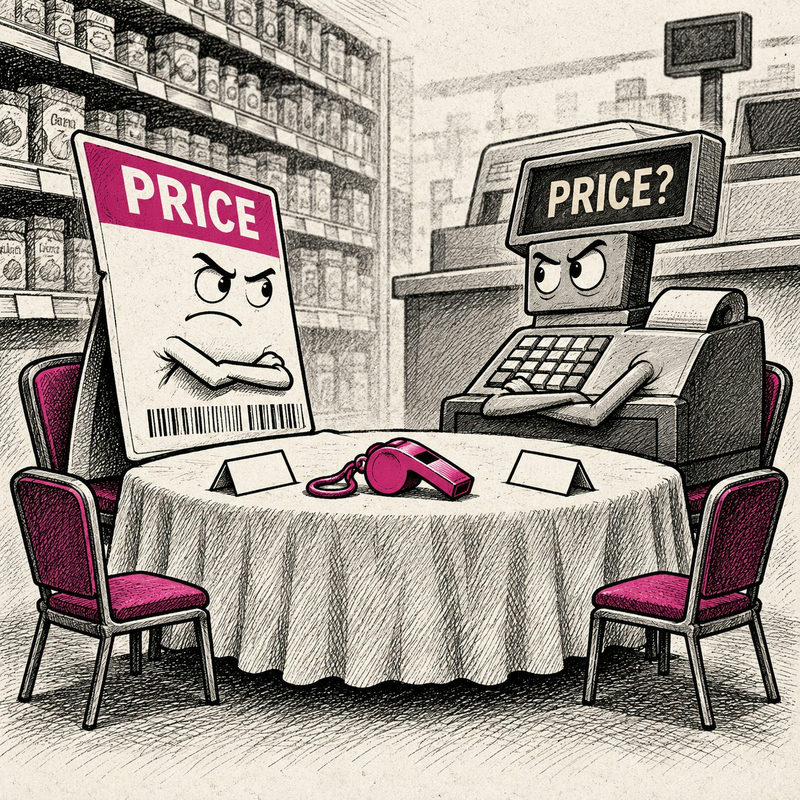
The shelf and the cash register should not need mediation. They work in the same building. Somebody ought to be able to introduce them.
The Federal Trade Commission and 20 states filed suit Monday accusing Dollar General of deceptive pricing and overcharging customers, according to Business Insider. The complaint alleges repeated mismatches involving shelf labels, tags and advertised prices, despite extensive company knowledge of the problem.
Those are allegations, not a verdict. Dollar General rejects the suggestion that it has abandoned its affordability mission. It says accuracy is the goal, store employees are expected to correct discrepancies, and it cooperated with the investigation. The company plans to defend the case while remaining open to a resolution.
Now to the radical regulatory principle underneath the dispute: the price that persuades you to pick something up should still be the price when you arrive at the register.
Not a preliminary estimate. Not an opening bid. Not a number that had a promising interview but failed the background check.
This is why consumer enforcement is a political function, not merely a customer-service preference. An individual shopper can dispute a charge. Regulators can investigate whether the same problem keeps happening, whether the company knows, and whether its proposed fixes actually fix it.
Make powerful people uncomfortable.
Subscribe to Democrawonk.
Without that distinction, every customer becomes an unpaid auditor. Congratulations on finding the discrepancy; your compensation is the possibility of paying the price you were offered in the first place.
That burden matters especially at a retailer serving many rural and lower-income customers. It is easy to call a small mismatch trivial when you are not the person budgeting around it. Requiring each shopper to catch and challenge every mistake is not a cheap enforcement system. It just transfers the work.
Our recent look at affordability and political messaging concerned whether the campaign story matched the household bill. This case asks a narrower question: does the store’s own number match the store’s other number?
The lawsuit cannot settle every argument about inflation, and it has not yet established the FTC’s claims. The company is entitled to contest them.
But whatever the eventual ruling, accurate advertised pricing should not be controversial. The customer already made a trip to the store. They should not need a second trip through the appeals process to buy the same groceries.
Comments
Have something to say? Give this story a heckle.
Comment Rules
Argue the point. Add a joke. No threats, harassment, hate speech, spam, private personal information or unsupported accusations. First-time comments and comments with links are moderated. Full Comment Rules
Loading comments…
Questions or deletion requests? Contact Us. We retain comments and moderation records until removed. Only hashed email identifiers are stored for comment accounts.