
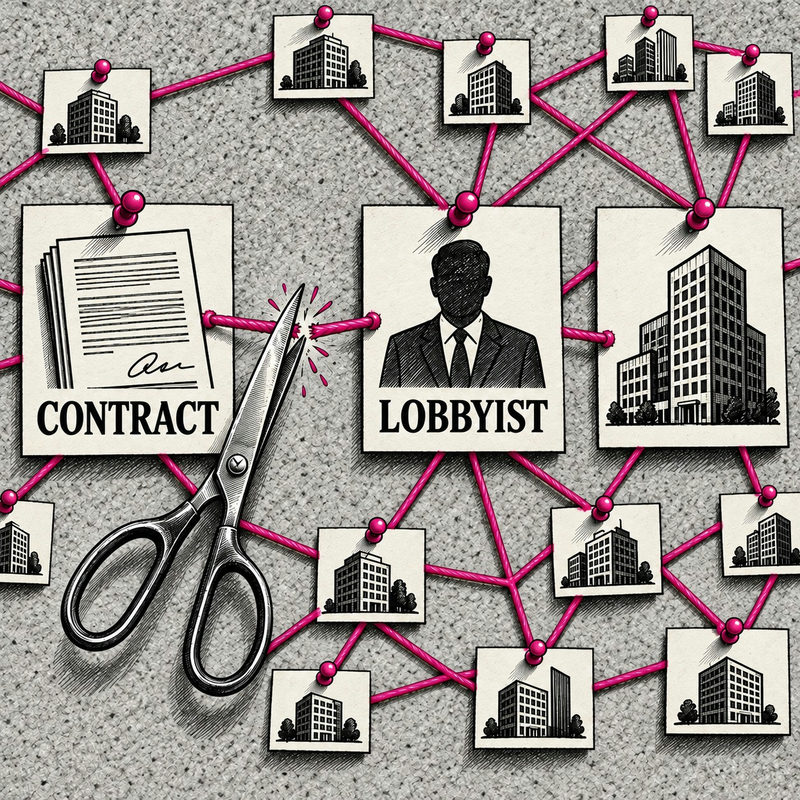
Washington's latest national-security diagram required room for your lobbyist's other client.
Reuters reports that a federal judge on Monday granted Alibaba a preliminary injunction against restrictions that reached beyond the Chinese company itself. The order bars the U.S. government from denying Pentagon contracts to companies because they, their parents or their subsidiaries do business with firms lobbying for Alibaba.
Follow that chain carefully. The contractor need not be Alibaba. The contractor's subsidiary can do business with a lobbying firm that represents Alibaba. At some point the procurement office needs a corkboard, string and a person explaining that everyone should remain calm because this is merely the simplified version.
There is a serious question underneath the office-supply requirements. Alibaba is challenging its June designation by the Pentagon as a company allegedly assisting China's military. It denies military ties and says its services concern retail, logistics and enterprise technology. The government made the designation; the company disputes it. Monday's injunction does not resolve that dispute or remove Alibaba from the list.
What it does, Reuters reports, is allow Alibaba to retain U.S. lobbyists who also represent Pentagon contractors. That removes a potential obstacle to its effort to challenge the designation. According to a source with direct knowledge cited by Reuters, Alibaba fired dozens of Washington lobbyists after the Pentagon's action.
Make powerful people uncomfortable.
Subscribe to Democrawonk.
This is Washington, so the endangered species in this particular procedural dispute is the retained lobbyist. Sympathy need not be lavish. The principle still matters: a government designation should be defensible on its evidence, not made harder to contest by turning representation into a commercial hazard for other clients.
The designation is not a formal sanctions order. It restricts Pentagon contracts with listed companies and, beginning in 2027, purchases of their products or services through third parties. Those are consequential procurement rules. Calling every restriction a sanction, or this injunction a complete victory over the blacklist, would obscure what actually happened.
The narrowness of the ruling is the point. One set of consequences attached to shared lobbying relationships has been restrained while the larger challenge continues. Alibaba has not received a judicial certificate declaring every government concern imaginary.
Nor does protecting a route to challenge government action require becoming an enthusiast for Alibaba. A system that lets an agency make an allegation should also permit the affected company to dispute it without every nearby business relationship becoming a new pressure point.
National security deserves evidence and enforceable rules. It should not depend on how many corporate boxes can be connected before somebody runs out of pink string.
Comments
Have something to say? Give this story a heckle.
Comment Rules
Argue the point. Add a joke. No threats, harassment, hate speech, spam, private personal information or unsupported accusations. First-time comments and comments with links are moderated. Full Comment Rules
Loading comments…
Questions or deletion requests? Contact Us. We retain comments and moderation records until removed. Only hashed email identifiers are stored for comment accounts.