
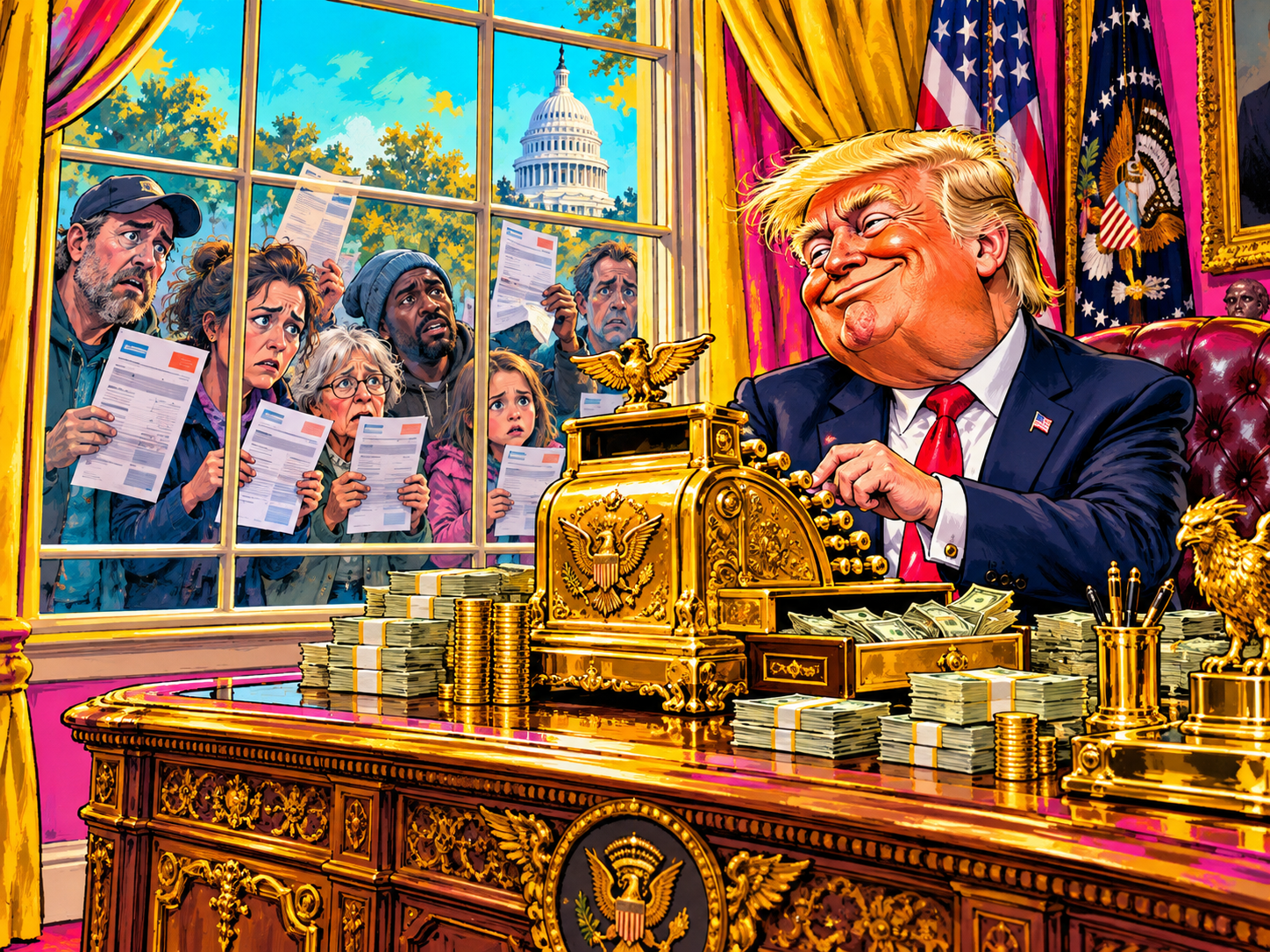
There is something wonderfully economical about a presidency that promises to put America first and leaves Americans wondering whether America is the name of a family investment vehicle. At least the branding department can keep the same stationery.
A new AP-NORC poll released October 13 offers a less flattering interpretation of the sales pitch. Fifty-six percent of adults say Trump has prioritized his personal business interests a lot, compared with 23 percent saying that about the country overall and 11 percent about people like them. The survey interviewed 2,140 adults September 24–28 and reports a margin of error of about 2.9 points. These are public perceptions, not legal findings.
That distinction matters. A poll cannot convict anybody. It can, however, tell you whether the public thinks the person driving the bus is more interested in the passengers or the souvenir shop he owns at the next stop.
Public service, with a private checkout lane
The presidency is supposed to be a job on behalf of the country. That is a remarkably simple concept for an institution surrounded by so many people determined to complicate it. If the public begins to see private financial interests as the priority, something more substantial than a communications refresh is needed.
You can't repair that impression with a new slogan any more than you can repair a leaking roof by renaming the bucket a precipitation management solution. At some point, the relationship between public decisions and private interests has to withstand actual scrutiny.
The liberal standard should be straightforward: clear disclosures, meaningful separation from conflicting interests, and rules that don't depend on whether the officeholder feels offended by them. A standard that exists only when someone voluntarily feels virtuous is a suggestion with a nice letterhead.
The fan club is not an ethics committee
Some supporters will regard any discussion of conflicts as an attack. Some opponents will treat any suspicious appearance as proof of a crime. Both reactions are convenient shortcuts. Neither is a substitute for evidence.
But insisting on evidence does not require us to pretend that appearances are irrelevant. Public trust is part of the machinery of government. If people believe decisions might be shaped by private interests, officials owe them credible safeguards and explanations. They don't owe them a lecture about how insufficiently grateful they are.
Think about how this works anywhere else. Your condominium board hires the board president's business, and you ask about the process. Nobody needs to prove a felony before requesting the bids. The request is normal. The defensive speech about enemies of the condominium is the weird part.
Democrats don't get a complimentary pass
Liberals should apply the same test to Democratic officials, relatives, donors, and well-connected friends. If the rule changes when the lapel pin changes, it isn't an ethics rule. It's customer service for your preferred political brand.
That consistency makes the criticism stronger. We don't have to argue that every controversial transaction is automatically unlawful. We can argue that public office should be structured to reduce conflicts, explain decisions, and protect the people who don't have access to the inner circle. That's a standard ordinary Americans can understand without hiring somebody who bills in six-minute increments.
The poll is a snapshot from late September, not a permanent verdict on every voter or a forecast of an election. It gives us something narrower and useful: a warning about how the public understands presidential priorities.
If the administration dislikes that picture, it could offer stronger safeguards. Or it could keep trying to convince people that the cash register sound is simply democracy applauding.
Either way, Americans shouldn't need a loyalty card to feel like the government is working for them.