
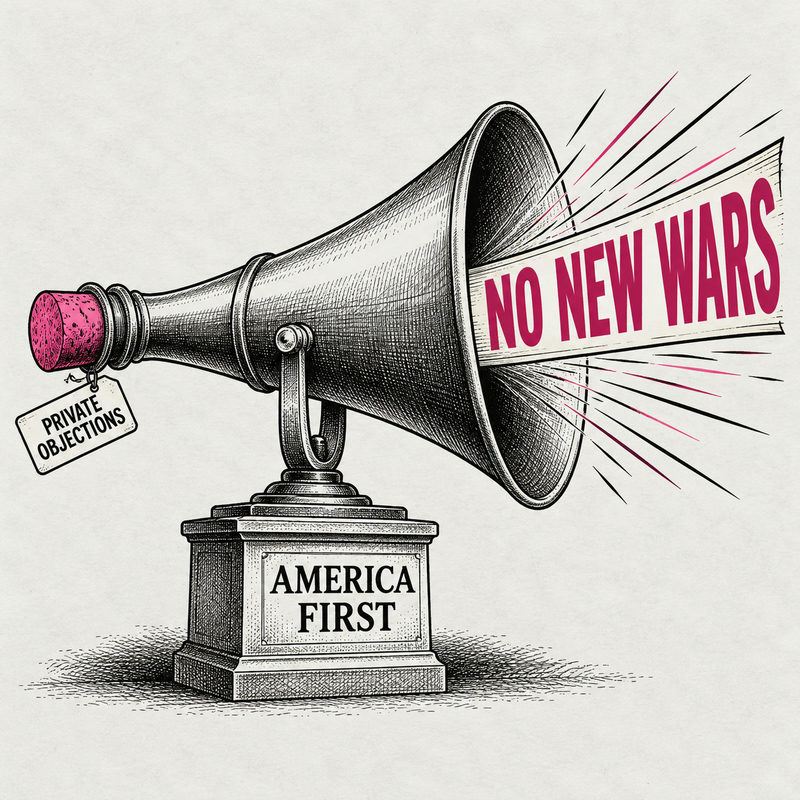
The peace candidate has achieved a remarkable refinement in coalition management: the war is public, while the antiwar position is available on background.
Even the family plan works this way. The Atlantic reports that Donald Trump Jr. has opposed the Iran war in private, including in conversations with his father, according to two people who have spoken directly with him. His spokesman declined to comment. A person close to him told the magazine he would not publicly break with his dad on this issue. The objection has apparently survived. Its public speaking privileges have not.
In 2024, Trump Jr. promoted his father as the man whose strength would keep America out of another Middle East war. That argument had the considerable convenience of being made before this Middle East war. Now the administration has supplied the missing practical demonstration, and the advertised benefit appears to be experiencing distribution difficulties.
One can admire the precision. Ordinary Americans receive the foreign policy. People close to the president may also receive an explanation of why someone close to the president dislikes it. The second product is much quieter and cannot be used at a gas pump.
Make powerful people uncomfortable.
Subscribe to Democrawonk.
The White House did not answer the Atlantic's questions about Trump Jr.'s position. It offered the familiar assurance that Iran had been devastated and the conflict would end soon. A short war has become a grammatical achievement: it remains short whenever described in the future tense.
The administration's original estimate was about four to six weeks, the magazine reports. Nearly half of Americans in a recent Pew survey expected the conflict to last more than a year. Apparently the public has begun doing the scheduling without waiting for the next announcement of imminent success.
The sales proposition was strength without another major war. Delivering a major war does not leave half of that proposition intact. A restaurant cannot serve you the absence of food poisoning and explain that dinner was always an optional interpretation of the menu.
Meanwhile, the economic consequences have escaped the private conversations. The Atlantic describes higher gas prices squeezing household budgets; our look at the stalled housing market follows the pressure into another supposed pillar of prosperity. These consequences do not require anyone's permission to circulate.
The president's son is entitled to disagree privately with his father. The public, however, was invited to trust the argument publicly. It is an oddly exclusive version of America First in which the strongest reassurance goes to the crowd and the reservation about whether it worked stays among people who can get the president on the phone.
Comments
Have something to say? Give this story a heckle.
Comment Rules
Argue the point. Add a joke. No threats, harassment, hate speech, spam, private personal information or unsupported accusations. First-time comments and comments with links are moderated. Full Comment Rules
Loading comments…
Questions or deletion requests? Contact Us. We retain comments and moderation records until removed. Only hashed email identifiers are stored for comment accounts.