
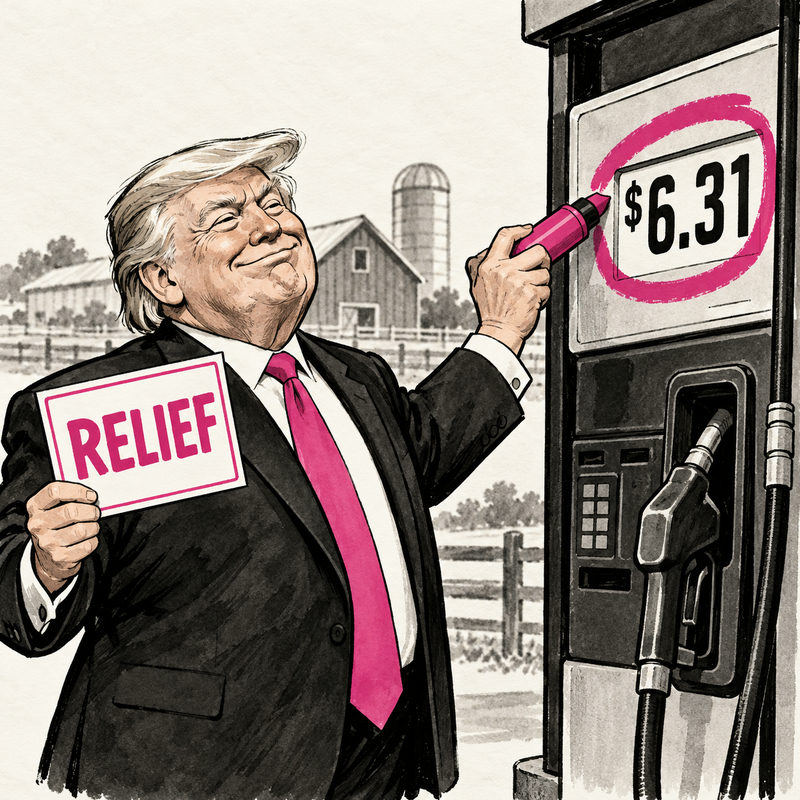
Helping farmers pay for fuel is a good idea. Requiring the help to double as proof that the president has mastered fuel prices seems like a lot of additional work for a payment.
Trump has announced an $8 billion Harvest Fuel Relief Program. Let us take the reassuring version seriously: farmers are facing a punishing expense, and government can absorb some of it. There is nothing embarrassing about public assistance doing something useful. The embarrassment begins when assistance is asked to impersonate the disappearance of the problem.
The number on the pump remains there. Very inconsiderate of it.
Yahoo Finance reports that the program is expected to deliver one-time payments through the Farm Service Agency. It will not directly reduce fuel costs. Diesel hovered around a national average of $6.31 a gallon Monday, amid wars in the Middle East and Ukraine and constrained refining capacity. The money can soften that expense. It cannot retroactively turn $6.31 into a reasonably priced gallon.
This ought to be an easy distinction for an administration to maintain. Pay part of a high bill; explain that you have paid part of a high bill. Nobody needs to invent a new branch of arithmetic.
Make powerful people uncomfortable.
Subscribe to Democrawonk.
But Trump's announcement also promises more farm funding when Republicans win and says fuel prices will tumble once the Iran war ends, which he predicts will happen very quickly. So the reassurance arrives in three separate pieces: assistance now, additional assistance attached to an election result, and cheaper fuel attached to the end of a war.
Individually, I can follow the sentences. Together, they leave an awful lot of farming dependent on events that a farmer cannot arrange before the next fill-up.
Our earlier look at the squeeze on farm country concerned costs and campaign turnout. This new $8 billion announcement supplies an actual policy response. It deserves to be judged as one, rather than dismissed because of who announced it—or promoted into evidence that the underlying crisis has already surrendered.
The limits of a presidential fuel deal matter for the same reason. Supply, refining and war do not become predictable because a campaign needs a clean closing argument.
I would rather the payment help farmers than win an argument about whether they should need it. Accepting assistance does not require accepting the president's timetable, his electoral condition for more, or his implication that the price problem is nearly finished.
For now, the modest claim is the defensible one: government intends to help cover expensive diesel. The grander claim still has several appointments to keep. The farmer, unfortunately, has to buy the fuel before finding out whether any of them show up.
Comments
Have something to say? Give this story a heckle.
Comment Rules
Argue the point. Add a joke. No threats, harassment, hate speech, spam, private personal information or unsupported accusations. First-time comments and comments with links are moderated. Full Comment Rules
Loading comments…
Questions or deletion requests? Contact Us. We retain comments and moderation records until removed. Only hashed email identifiers are stored for comment accounts.