
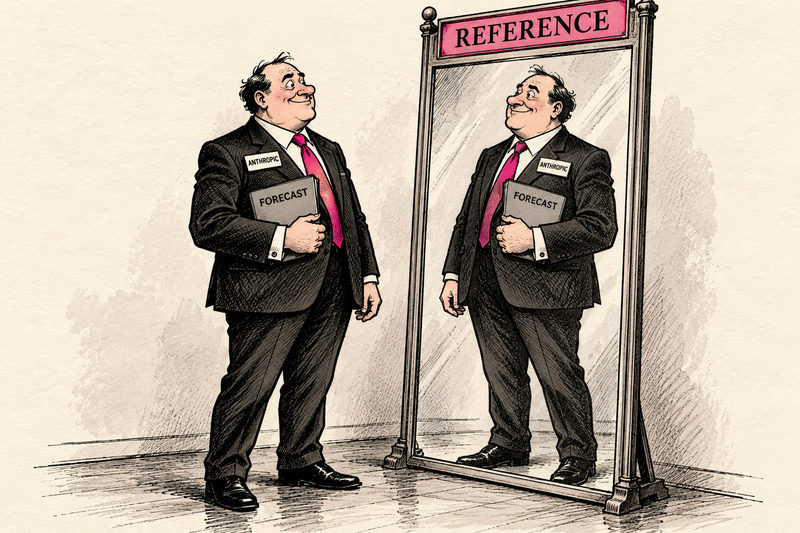
Welcome to our fictional reference check for the future. The candidate is extraordinarily promising. It has not started work yet, but the person recommending it is already describing the expansion it could bring to the organization. Excellent initiative. Usually applicants wait until the second interview to redesign the economy.
Reuters reports that Anthropic co-founder Jack Clark presented a conditional internal-model scenario in which AI could help lift U.S. economic output to $44 trillion by 2030. The scenario depends on continued technological improvement and the creation of new industries and inventions. It is not an achieved result or a guaranteed forecast.
Our imaginary hiring manager studies the application. Previous experience: the future. Availability: later. Outstanding qualifications: potentially extraordinary. Reference: the company whose technology features prominently in the proposed extraordinary events.
A very strong cultural fit.
We Have Heard Wonderful Things About Us
The reference check is conducted entirely in parody. The manager asks whether the future is reliable. The reference explains that, under the right conditions, it could be magnificent. Could it provide an example from a previous position? Not without becoming the past, which would substantially reduce its excitement as an investment proposition.
This is the beauty of hiring tomorrow. Yesterday has results, awkward comparisons and people who remember the original presentation. Tomorrow has an enormous addressable market and no former supervisor willing to contradict the résumé.
The $44 trillion scenario comes from a company internal model, according to Reuters. That origin does not make it wrong. It does make the return address worth noticing before policymakers mistake an interested participant’s projection for the future’s independently verified employment history.
In our imaginary interview, the candidate offers references from its own reference’s reference. The manager pauses. How impressive: vertical integration has reached character assessment.
The boardroom would particularly like someone capable of creating new industries. The future says this is part of the scenario. Wonderful. We can put it under accomplishments, provided everyone promises not to look too closely at the tense.
A Candidate With Excellent Timing
Reuters places Clark’s remarks at the IMF and World Bank meetings as Anthropic prepares an IPO. Clark also urged serious international rules and human oversight. He was not presenting a simple demand to leave the industry alone.
One can favor those safeguards and still decline to let a spectacular growth scenario conduct its own interview. A potential benefit is an argument to examine, not a recommendation to abandon reference checks. The company sells a consequential technology. We are allowed to notice when the possible future gives it exceptionally good lighting.
Our fictional hiring manager asks the final question: when could we judge performance? The candidate suggests after arrival. Until then, it would appreciate being discussed as transformational, indispensable and a little underappreciated by people asking about the assumptions.
The manager is delighted. At last, an applicant with both unlimited potential and a convenient explanation for the absence of completed work.
References available upon request. They work here.