
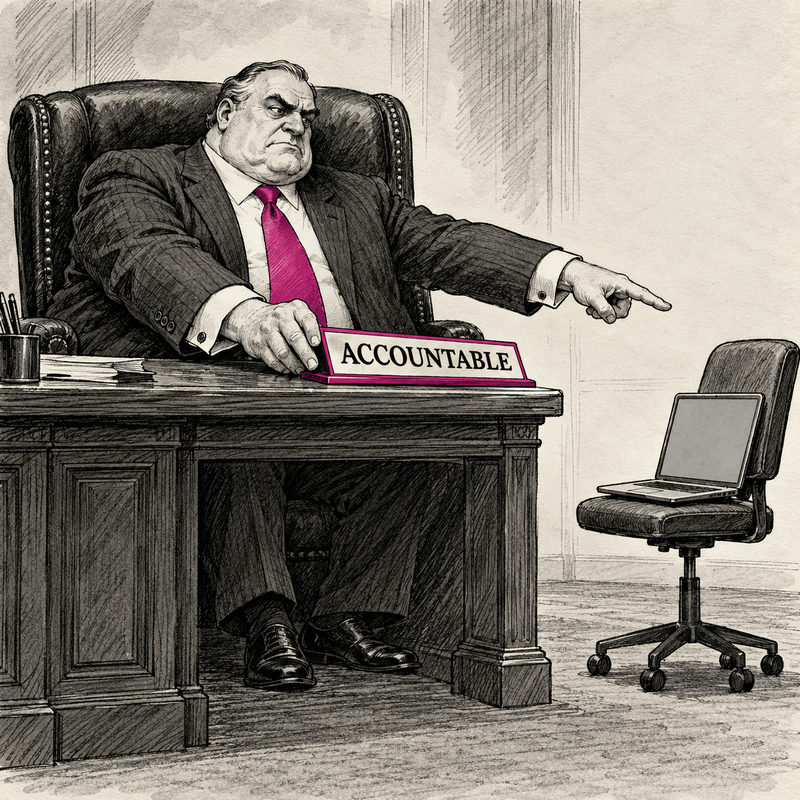
Corporate America has discovered a difficult question: when a company’s software does something, who at the company is responsible?
Take your time. Apparently we have reached the frontier of management science.
Axios describes businesses bringing AI agents into the workplace with names, assignments, profiles and work histories, while executives wrestle with who should supervise them. Human resources? Information technology? Some newly invented department with a chief officer and no phone number?
My answer is the company that decided to use the damn thing.
I appreciate that this lacks the sophistication of an organizational transformation. But if a business gives software permission to act on customers, money or employees, its obligations should not disappear because the software has been introduced as a colleague.
Calling it Trevor does not make it someone else’s fault.
Atlassian says its agents have identifiable owners and real-time attribution. Workday has agreed to buy C1.ai to manage access for employees and agents. Those are sensible efforts. The interesting part is that basic accountability now needs to be sold as an exciting capability of the future.
Next quarter: a revolutionary system that tells you who authorized a purchase. Early enterprise adopters may remember it as management.
Axios cites Gartner’s finding that only 38% of chief human resources officers and chief information officers share an understanding of AI’s effect on work. That does not prove the other 62% are incapable of cooperation. It does suggest that replacing human labor with software is proceeding faster than the meeting about who gets the complaints.
I would prefer the meeting happen first.
There is a strange prestige in treating every avoidable management problem as a profound philosophical dilemma. Is the agent a tool? A worker? A hybrid? Fascinating. While we resolve its place in the cosmos, could someone with a salary accept responsibility for its access permissions?
The software does not need a richer identity. It needs narrower permissions.
And the humans affected need something more useful than a fascinating explanation of how autonomous the system was. If an automated decision wrongly costs someone money or an opportunity, the company should provide an understandable explanation, a human appeal and a correction. Not an invitation to debate whether the bot meant well.
I’m not against automating repetitive work. I am against using the word “autonomous” to manufacture an accountability vacancy.
Before a business hands an agent consequential powers, it should name a responsible human, limit what the system can do, keep records, and test how to stop it. Axios recommends human sign-off for irreversible decisions. Good. The ability to act quickly is not a compelling reason to make mistakes at a speed customers cannot contest.
Workers should also have a say when these systems change their jobs. You cannot insist the bot is practically an employee when selling the transformation, then discover it is merely equipment whenever the actual employees ask questions.
Give the agent a cheerful profile picture if you must. Invite it to the meeting. Let it produce seventeen bullet points explaining why the meeting should have been an email.
When it causes harm, though, I want the company’s name on the answer.
Not Trevor’s.
Comments
Have something to say? Give this story a heckle.
Comment Rules
Argue the point. Add a joke. No threats, harassment, hate speech, spam, private personal information or unsupported accusations. First-time comments and comments with links are moderated. Full Comment Rules
Loading comments…
Questions or deletion requests? Contact Us. We retain comments and moderation records until removed. Only hashed email identifiers are stored for comment accounts.