
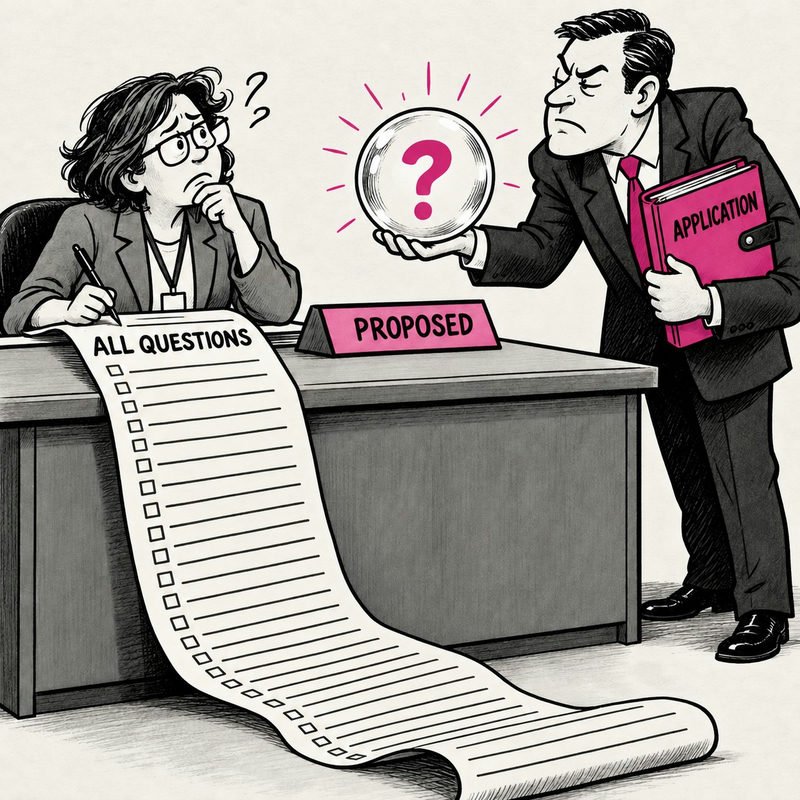
California’s Proposition 45 promises faster environmental reviews for essential projects, including housing and clean energy. Among its proposed changes: regulators would have to specify all the information developers must supply at the beginning of the application process, rather than repeatedly asking for more.
Finally. An investigation designed for people who already know what they’re going to find.
I sympathize with anyone trying to build housing while an application spends years acquiring stamps. The California and Hawaii NAACP supports the measure because delays and rising costs hit working families and communities of color particularly hard. Supporters say this is accountability, not a removal of environmental safeguards.
Fair. A process can be slow and stupid. But there is an exciting gap between speeding up a review and requiring the reviewer to develop clairvoyance.
Imagine arriving at the doctor. Before I tell you what’s wrong, please list every test you might require. No additions after I mention the antlers. You had your chance to ask about antlers when you assumed I was a normal fucking patient.
The proposed timetable is specific: 365 days for the environmental impact report, 270 days to resolve legal challenges and 45 days for public comment. Existing law sets a minimum public-review period, not this maximum. Prop 45 would also limit required tribal consultation to federally recognized tribes, rather than all potentially affected tribes covered by the current requirements.
Everybody gets a clock. Some people also get told they are not on the consultation list. Efficiency is much easier once you stop counting all the people who might answer back.
Then there is the alternatives process. Agencies currently develop alternatives to reduce environmental and health risks. Under the proposal, the developer would supply a single alternative for regulators to consider.
A single alternative. I love a consultation that arrives with its own other opinion.
The Daily Heckler: five or six selected stories.
Political satire for your morning inbox.
Here is what we want to build. Here is the other thing we have agreed you may ask us to build. We have worked very hard to provide the full range of our preferences.
At this point, why not have the developer conduct the public hearing in front of a mirror? The reflection can raise a concern. The developer can nod gravely. Excellent point, handsome. We incorporated that before you arrived.
Even a court finding that the agency failed to comply with California’s environmental-review law would not let the judge halt the whole project. The proposition would allow pauses of specific problematic parts instead. Environmental lawyer Fernando Gaytan objects that harm can be difficult to undo after a project begins.
So the review must anticipate everything, the alternatives come from the applicant, and the judicial emergency brake is sold in separate sections.
I’m trying to picture the courtroom. The judge finds a failure in the review. Work continues elsewhere. Counsel asks which bit must stop. The judge points. The excavator outside moves slightly to the left. Somewhere, a project manager congratulates everyone on finding a constructive way forward.
There is also an unresolved fight over whether data centers could qualify through the measure’s broadband-infrastructure category. Critics say developers could fit projects into its language; proponents say supporting the internet does not make a data center an eligible broadband-access project. That dispute is not settled by my ability to make a joke about a server wearing a hard hat.
The procedural changes are worth scrutinizing whichever buildings qualify. Housing is needed. Cleaner power is needed. Neither need makes future questions predictable. Sometimes the reason an agency asks another question is the answer to the first one.
I have an alternative proposal. Let developers submit the entire review before anyone builds anything, including every surprise their project will produce, every correction they will need and a comprehensive list of things nobody has thought of yet.
What? That’s impossible?
Good. Put that in the application. We have a follow-up question.
Comments
Have something to say? Give this story a heckle.
Comment Rules
Argue the point. Add a joke. No threats, harassment, hate speech, spam, private personal information or unsupported accusations. First-time comments and comments with links are moderated. Full Comment Rules
Loading comments…
Questions or deletion requests? Contact Us. We retain comments and moderation records until removed. Only hashed email identifiers are stored for comment accounts.