
Scott Perry faces an ethics complaint over a campaign video that appears to have been recorded in his congressional office. The House’s campaign-activity guidance puts the relevant restriction at number one: no campaign activities in official buildings or using official resources. Perry’s campaign and congressional office did not respond to the reporting.
Number one. Not a footnote reached by holding the document upside down under ultraviolet light. The first thing on the list. Before the reader has even developed a reasonable excuse for wandering off.
Defend the Vote, a liberal PAC that endorsed Perry’s opponent, Janelle Stelson, filed the complaint. It has donated $10,000 to her campaign since July 2025. This is an interested accuser making an allegation, not an ethics finding descending from a cloud in sensible shoes.
But its political interest does not make the room disappear. That is the fascinating difficulty with filming things. You finish explaining your point, upload your evidence, and the background has submitted evidence of its own.
The video first appeared on Perry’s campaign page in November 2025 and was posted again on October 16. It responded to criticism of his comments about Democrats and the military. In other words, a rebuttal from last year was brought back to do another shift, and now somebody is asking whether its original workplace was authorized.
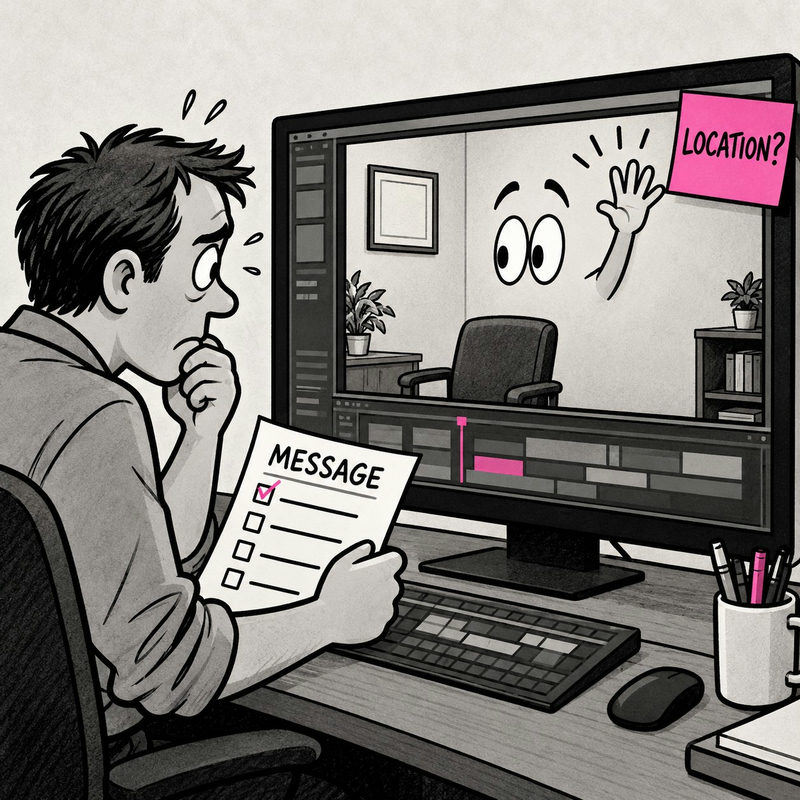
I’m imagining the edit session. We need to defend the congressman’s record. Good. Tighten the opening. Improve the sound. Is there anything distracting in the frame? Just the possible ethics issue behind his head. Can we blur that? Not sure; it appears to be the location.
Campaigns spend remarkable amounts of effort controlling what viewers see. Flags. Lighting. Serious expression. A room that says authority. The difficulty is that a room can say authority rather too accurately when the rule is that you cannot use the official one for this.
The Daily Heckler: five or six selected stories.
Political satire for your morning inbox.
There may be an explanation. The footage appears to show the office; the complaint has not established a violation. I would nevertheless suggest that the background is now sufficiently involved to merit its own media-training session.
When asked whether you are a congressional office, do not immediately list your official address. Bridge to the message. You are a space where important conversations happen. No, do not point to the government equipment. We discussed this.
Campaign Legal Center ethics expert Kedric Payne says the central principle is that taxpayer resources cannot be used for campaign activity. Potential violations can differ in severity, he notes; that does not make a smaller one cease to be a possible violation. The complaint also raises a separate campaign repost of footage from official House proceedings.
So even the archive may need a chaperone. We have reached the stage where a campaign's fact-checking process should ask not only whether a clip says what we claim, but whether we are allowed to take the clip home from Congress.
And then comes the procedural punchline. According to the reporting, if Perry wins reelection the ethics committee could rebuke him in writing. If he loses, the complaint becomes moot.
I need to appreciate the elegance of that. Winning could preserve the possibility of an official letter about the campaign. Losing would eliminate the committee’s need to send it. The electoral consequences and the paperwork have arranged to approach from opposite ends of the corridor.
The campaign wants to keep the office. The complaint concerns whether the campaign used the office. An election loss would make the complaint moot because he no longer holds the office.
Somewhere in this circle there is a door. For the next campaign video, perhaps walk through the fucking thing first.
Comments
Have something to say? Give this story a heckle.
Comment Rules
Argue the point. Add a joke. No threats, harassment, hate speech, spam, private personal information or unsupported accusations. First-time comments and comments with links are moderated. Full Comment Rules
Loading comments…
Questions or deletion requests? Contact Us. We retain comments and moderation records until removed. Only hashed email identifiers are stored for comment accounts.