
Opinion & Satire
Concrete is famously unmoved by a strongly worded statement. It does not read the governor's priorities, admire a legislative accomplishment or become structurally sound because somebody has scheduled another meeting.
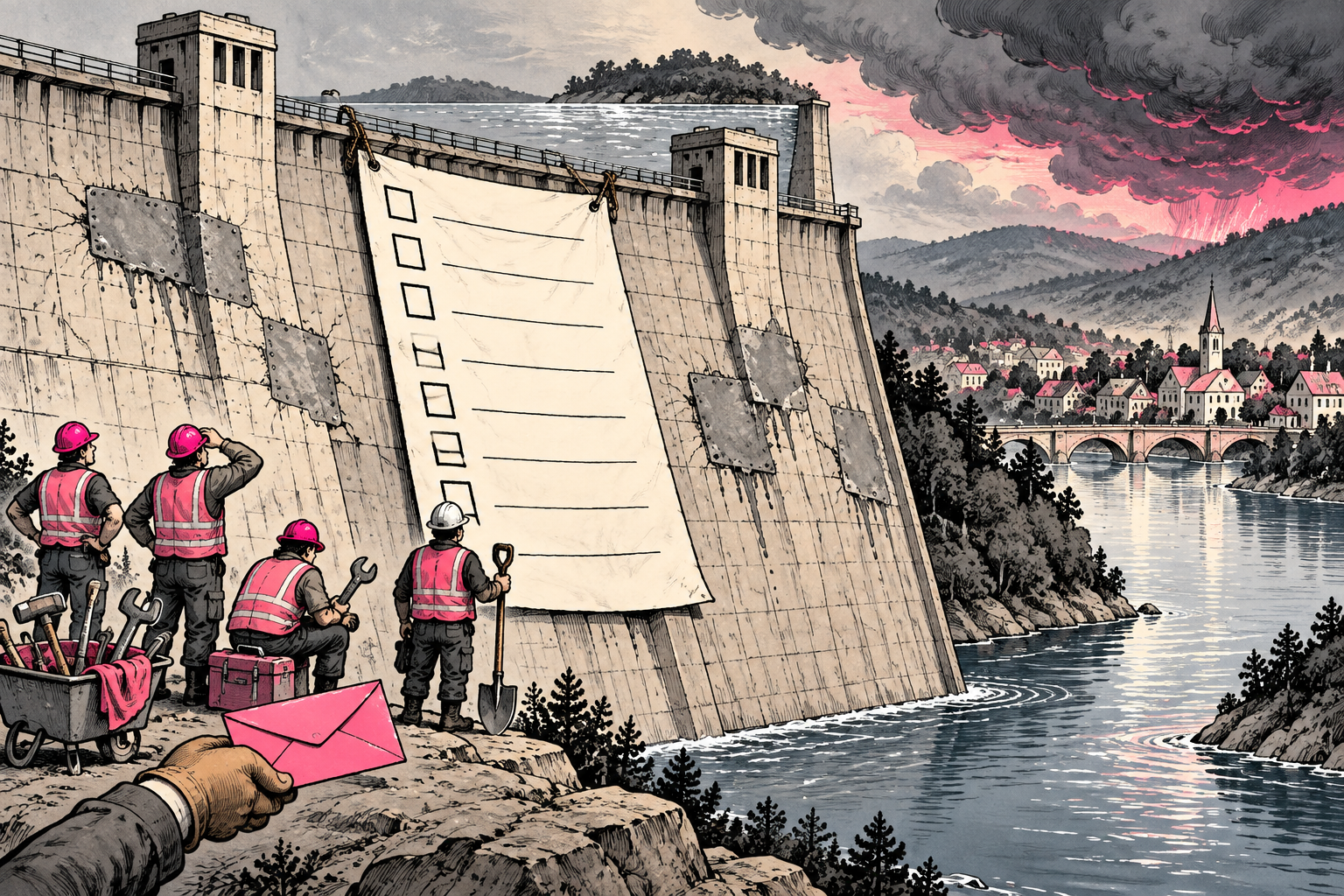
California's state auditor published a dam-and-levee oversight report October 13, followed by CalMatters' reporting October 14. The audit identifies 57 dams in poor or unsatisfactory condition as of May, including 40 with high or extremely high downstream hazard classifications.
The auditor explicitly distinguishes hazard from likelihood of failure: hazard describes potential consequences, not a prediction that a particular dam will collapse. Most of the assessed dams were satisfactory. There is no basis here to announce an imminent statewide disaster.
There is ample basis to demand better prevention.
The audit criticizes enforcement and emergency planning. Water Resources disputes many recommendations; CalMatters reports the department says it is reviewing them. That disagreement belongs in the story. So does the need for something more useful than competing assurances.
An Inspection Needs A Next Step
Knowing where a problem exists is essential. It is not the same as fixing it.
An oversight system needs a path from identifying a deficiency to obtaining a repair, a funded plan or another defensible way to reduce risk. Otherwise the inspection becomes a very detailed description of what everyone hopes will not happen.
The auditor's recommendations call for stronger enforcement and better deadlines around emergency plans. Those are practical governance questions, not a proposal to replace engineering with outrage.
Repair work can be technically difficult, expensive and slow. Agencies should be able to explain those constraints. They should also be able to explain what happens while the work remains incomplete and who is responsible for making progress.
A deadline without resources can be theater. Resources without a deadline can become a long-running subscription to the same unresolved problem.
The public deserves both a realistic plan and a way to see whether it is being carried out.
Blue-State Branding Does Not Hold Back Water
Democrats should be especially willing to confront this story.
If your argument is that government can protect people and maintain the foundations of a decent society, basic infrastructure is not an optional side project. It is a fairly direct test of the proposition.
A progressive slogan does not make a maintenance backlog more acceptable. A Republican attack on California does not make the underlying findings disappear. Residents downstream should not have to choose which party's excuse feels more emotionally satisfying.
The response should start with risk-based priorities, clear ownership responsibilities and an honest account of financing. Local capacity matters. So do the obligations of private owners and the state's responsibility to make oversight effective.
That is not an argument for writing an unlimited check to anyone who owns aging infrastructure. Public assistance should come with conditions, transparency and a demonstrable public purpose.
Nor should enforcement be reduced to finding someone to fine after a disaster. The point is to change behavior and reduce risk before people are harmed.
The most defensible approach would publish understandable progress measures: which actions are required, what milestones have been reached and what temporary protections remain in place. Communities need practical information, not a false choice between panic and complacency.
There will always be uncertainty in managing water and aging structures. Competent government does not promise to eliminate it. It explains the uncertainty and acts on the risks it can address.
California has another warning in hand.
The appropriate response is to make the warning less likely to become a retrospective exhibit—not to congratulate the clipboard for doing its job.