
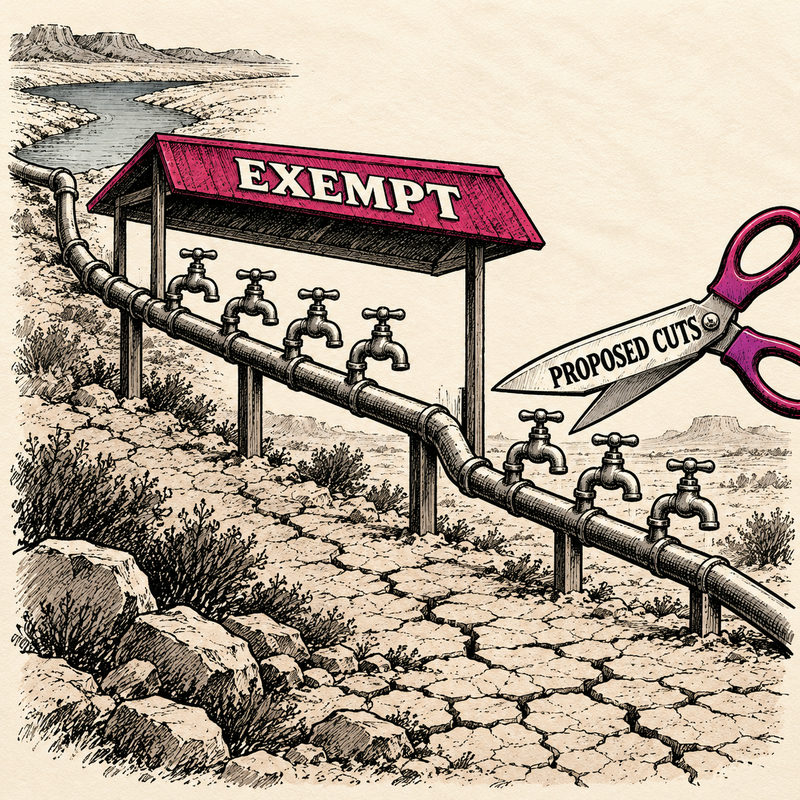
Arizona has joined Nevada’s legal fight against the Trump administration’s proposed Colorado River cuts, the Guardian reports. The federal plan could sharply reduce supplies to the three lower-basin states while sparing four upstream states. Seven states share the crisis. Four appear to have secured the emergency exit marked geographical advantage.
The proposed restrictions could affect Arizona, California and Nevada over the next two years, depending on the river’s condition. Wyoming, Colorado, Utah and New Mexico were spared. That is a remarkably tidy dividing line for a river that has declined to organize its shortage around state governments’ preferred explanations.
The upper-basin states argue that downstream users are responsible for the reservoir shortages and should take the biggest cuts. That is their position, not a scientific finding established by the reporting. It is also a very comfortable position to hold upstream. The burden travels in the same direction as the remaining water. How convenient that the physics and the politics have such compatible schedules.
A Shared Crisis, Selectively Shared
Federal intervention followed missed deadlines for a state agreement. This is what makes the exemption worth examining: the process failed collectively, but the proposed consequences are concentrated downstream. Consensus proved elusive. A line separating the people facing cuts from the people spared them was considerably easier to locate.
None of that establishes that the states have identical legal entitlements or should receive identical reductions. A water-allocation dispute is not settled by counting states on either side of a dam. But neither is a selective remedy rendered wise by calling it federal action and pointing sternly downhill. A plan still needs an explanation sturdier than the position of its beneficiaries on a map.
Lake Mead and Lake Powell have fallen to historically low levels amid overuse and a changing climate, the Guardian reports. The feared endpoint is deadpool: reservoir levels so low that water effectively cannot flow downstream. That is a physical limit, which is an irritating kind of limit for politicians. It cannot be negotiated into someone else’s jurisdiction.
The Sand Is Not The Scarce Resource
Arizona governor Katie Hobbs said the state was drawing a line in the sand. In a fight over dwindling water, the choice of writing surface is painfully well supplied.
Hobbs argues that Washington is failing to hold upper-basin states to their delivery obligations and threatening cuts beyond the lower-basin states’ voluntary conservation agreement. Those are Arizona’s arguments in the dispute, not a court’s conclusions. The new legal action is an attempt to contest the federal allocation, not evidence that Arizona has already won it.
Arizona’s water director says joining Nevada’s case protects the state’s rights while leaving room for cooperation with California and Nevada. The Interior Department did not immediately comment to the Guardian. For now, the administration’s proposed geography is more specific than its public explanation in that report.
The actual reservoirs do not get a litigation extension. Nor will a winning argument about whose fault this is replenish them. Yet the proposed plan has managed to preserve something with impressive efficiency: a clear category of states that will not face these cuts.
The river is running out of water. The exemptions remain fully replenished.
Comments
Have something to say? Give this story a heckle.
Comment Rules
Argue the point. Add a joke. No threats, harassment, hate speech, spam, private personal information or unsupported accusations. First-time comments and comments with links are moderated. Full Comment Rules
Loading comments…
Questions or deletion requests? Contact Us. We retain comments and moderation records until removed. Only hashed email identifiers are stored for comment accounts.