
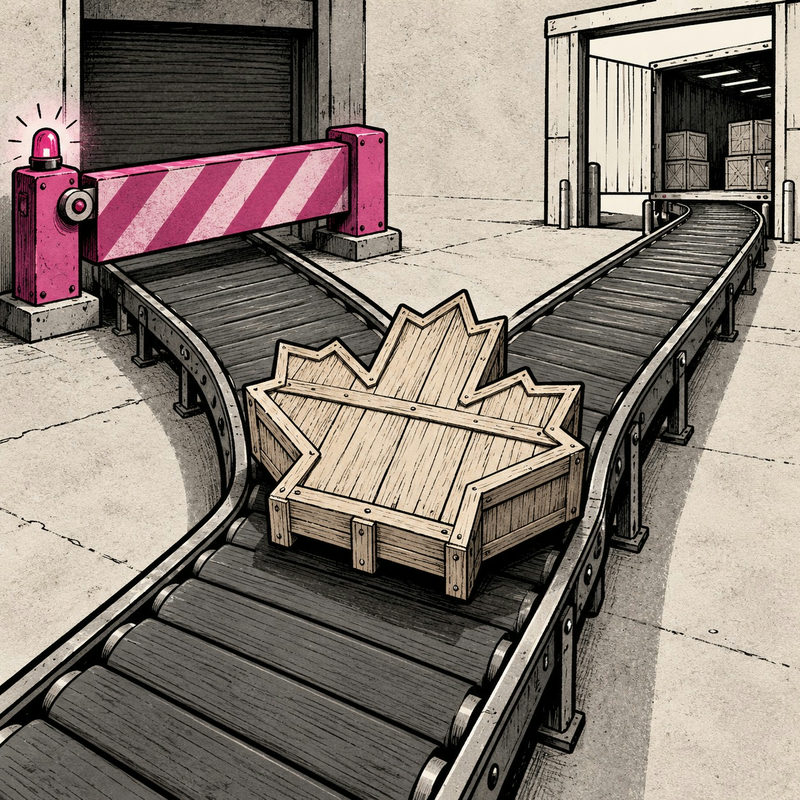
Canada has signed a trade agreement with the United Arab Emirates. Donald Trump’s tariff strategy has helped provide the motivation, although there does not appear to be a special negotiating prize for making your customer explore other suppliers.
Reuters reports that the deal, signed Tuesday, is intended to lower trade barriers and improve investment and market access. Prime Minister Mark Carney has been pursuing alternatives as talks with Washington have broken down. The United States has a very large economy. It does not, however, have exclusive distribution rights to the planet.
Canada’s government says the agreement, once fully implemented, would reduce or remove tariffs on more than 99 percent of current Canadian exports to the UAE. That is a claim about that particular export market, not 99 percent of everything Canada sells abroad. The agreement is expected to take effect in 2027. The signing ceremony did not instantly teleport a fleet of trucks into a new economic reality.
The scale matters too. Reuters puts last year’s two-way trade at 3.5 billion Canadian dollars. This is diversification, not an announcement that a Gulf trading relationship can replace the United States overnight. Anyone promising an instant substitute would merely be offering a different brand of tariff fantasy.
The Daily Heckler
The best of Democrawonk.
No algorithm required.
But a customer does not have to replace every purchase to make a supplier’s threats less effective. Additional markets create options. Options change negotiations. The person who can leave the room generally has a different conversation from the person who has nowhere else to go.
That is the neglected administrative detail in the politics of permanent pressure. Tariffs are presented as something one country does to another. The other country is then expected to stand still, preferably looking suitably chastened for television. Instead, it can book meetings.
Carney has pledged to double non-US trade over a decade. A pledge is not an accomplishment, and a signed agreement still needs implementation. Canadian exporters will have to find buyers, navigate rules and make the commercial relationships work. None of that is solved by giving a press conference a globe backdrop.
Still, the direction is plain enough. Firms asked to plan around repeated disruption have reason to look for more predictable routes. Governments can help build those routes rather than spend every negotiating cycle asking Washington what mood the loading dock is in today.
The deal also gives the UAE opportunities, and its officials describe benefits for their own exporters and investors. This is not international charity for a country with an irritating neighbor. Both governments see something to gain.
Trump likes leverage. Canada is trying to acquire some. The awkward part of teaching every trading partner to worry about depending on you is that, eventually, a few of them do the homework.
Comments
Have something to say? Give this story a heckle.
Comment Rules
Argue the point. Add a joke. No threats, harassment, hate speech, spam, private personal information or unsupported accusations. First-time comments and comments with links are moderated. Full Comment Rules
Loading comments…
Questions or deletion requests? Contact Us. We retain comments and moderation records until removed. Only hashed email identifiers are stored for comment accounts.