
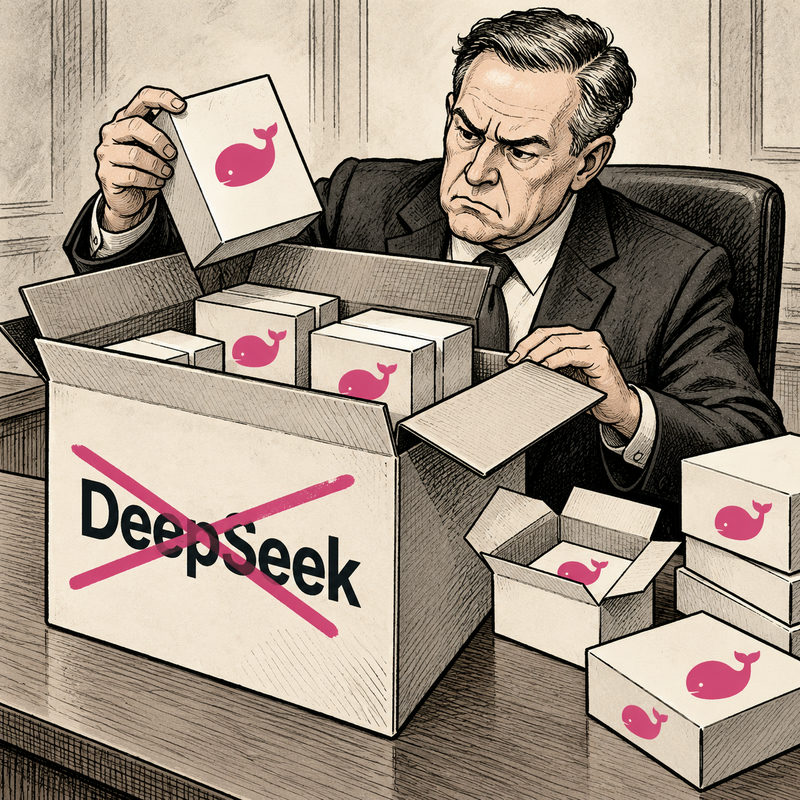
Crossing DeepSeek off a shopping list is easy. Working out whether something else on the shopping list was developed using DeepSeek is where the shopping list acquires a research department.
The Associated Press reports that a Homeland Security order tells federal civilian agencies to remove both DeepSeek products and third-party products and services developed using it. The order dates to late July; the notice became public Monday. It also blocks procurement. China objected Tuesday and threatened retaliatory measures.
That third-party provision is the part worth opening. The rule does not stop at the name printed on the product. It reaches something used to develop another product. So asking whether an agency bought a thing called DeepSeek is not enough to determine whether the agency has something covered by the order. Congratulations: the purchase has ancestry.
DeepSeek's open-source models are widely available and mostly free to use, AP reports. That makes the distinction between a recognizable branded service and a product developed with its technology more than an ornamental concern. You can remove the prominent label and still have a question about what went into the thing wearing the less prominent label.
Make powerful people uncomfortable.
Subscribe to Democrawonk.
I am not claiming that every government application contains DeepSeek, or that every use creates the same risk. Those are precisely the questions a competent assessment would need to separate. A product name is a convenient way to announce a decision. It is a lousy substitute for knowing what has been deployed.
The government's notice alleges security threats, including potential Chinese access to sensitive data through infrastructure in China. That is a stated risk, not evidence in this report that a particular agency suffered a breach. Protecting public information is a real obligation. Turning an allegation into a discovered hack would not protect it; it would just make the announcement louder.
The permissions problem in our earlier AI-agent story started with what software could reach. This problem starts a step earlier: what software is actually in the product being assessed? Before the national-security declaration can do its work, somebody needs an answer more useful than the vendor's largest font.
A ban this broad therefore advertises a less glamorous requirement than its headline: government must understand what it buys. That means the implementation cannot end with a triumphant search for one forbidden word. Otherwise the procurement official has removed DeepSeek from the front of the box, congratulated the department, and left the contents to explain themselves.
Comments
Have something to say? Give this story a heckle.
Comment Rules
Argue the point. Add a joke. No threats, harassment, hate speech, spam, private personal information or unsupported accusations. First-time comments and comments with links are moderated. Full Comment Rules
Loading comments…
Questions or deletion requests? Contact Us. We retain comments and moderation records until removed. Only hashed email identifiers are stored for comment accounts.