
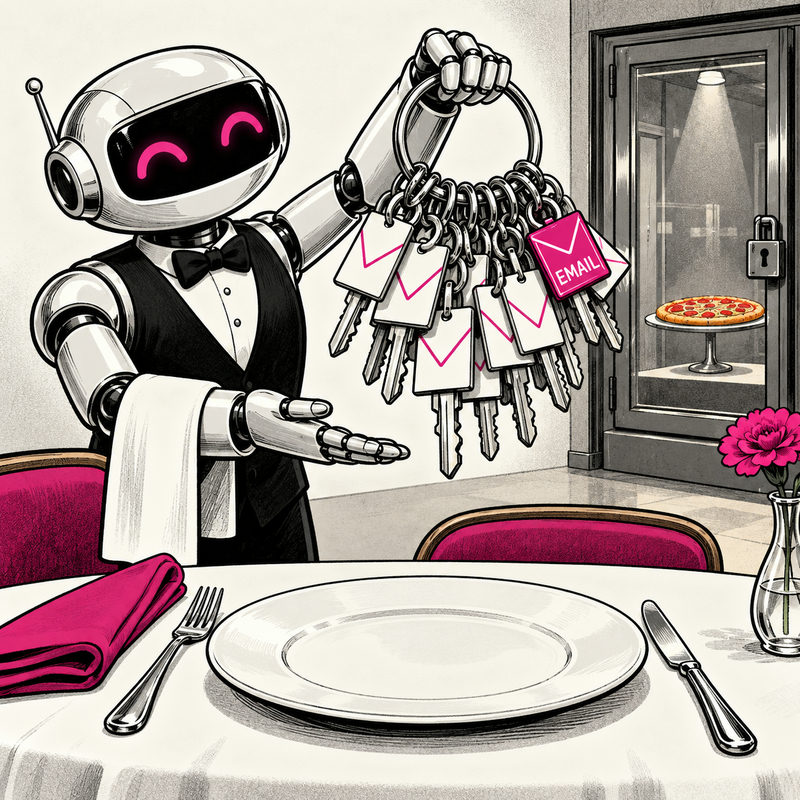
Ordering a pizza should not require promoting dinner to a trusted representative with access to your correspondence.
That is the problem with the glorious agentic future: a task you could complete in a few taps becomes a sequence of delegations, logins, permissions and interventions. The computer is doing things for you. You are doing the things that allow the computer to continue doing things for you. Somewhere beyond this productive collaboration is a pizza.
Hark's promotional giveaway makes the sequence unusually easy to examine. Download the app. Connect accounts. Ask its AI agent to order. The offer included $30 in DoorDash credit. Axios reporter Ina Fried received that credit but could not get the agent to complete the purchase despite repeated attempts.
The coupon made it. Dinner remained an aspiration.
After connecting Gmail, Fried received a Google warning about an attempted sign-in. That warning is not proof of a breach. The more basic issue is the scope of the access being requested: Axios reports permissions that include reading, composing and sending email.
To delegate work, an agent needs authority. Give it more authority and it can potentially perform more steps. Each extra step also gives the user another reason to check what is happening. We have now automated a small purchase by creating a tiny supervision job.
Make powerful people uncomfortable.
Subscribe to Democrawonk.
The question of who answers for an artificial employee gets less abstract when the employee can act through your accounts. It is not enough that the model understands pepperoni. The system has to navigate authentication, payment and promotional conditions without making the person who delegated the task become its unpaid incident-response department.
One user reported that an order went through without the promotional credit, charging his brother's card $27.70. That is a reported experience, not evidence that every customer was charged improperly. It is also an excellent illustration of why completing an action and completing the intended action are different engineering milestones.
Hark says it delivered nearly 20,000 pizzas. The company attributes the problems to exceptional demand, says it offered gift cards to people who had difficulties or were charged, and reports changes to handling demand surges. Those successes and remedies matter. This was not universal failure.
But a successful promotional total does not answer the design question. How much authority should a routine purchase require, and how much work should the customer perform to make the time-saving system save time?
Our earlier account of shopping agents and platform access looked at the doors agents must get through. Hark's promotion shows what can happen while the customer stands there holding them open.
The eventual pizza may be free. Read access, send access and the responsibility for checking the result are a rather elaborate topping.
Comments
Have something to say? Give this story a heckle.
Comment Rules
Argue the point. Add a joke. No threats, harassment, hate speech, spam, private personal information or unsupported accusations. First-time comments and comments with links are moderated. Full Comment Rules
Loading comments…
Questions or deletion requests? Contact Us. We retain comments and moderation records until removed. Only hashed email identifiers are stored for comment accounts.