
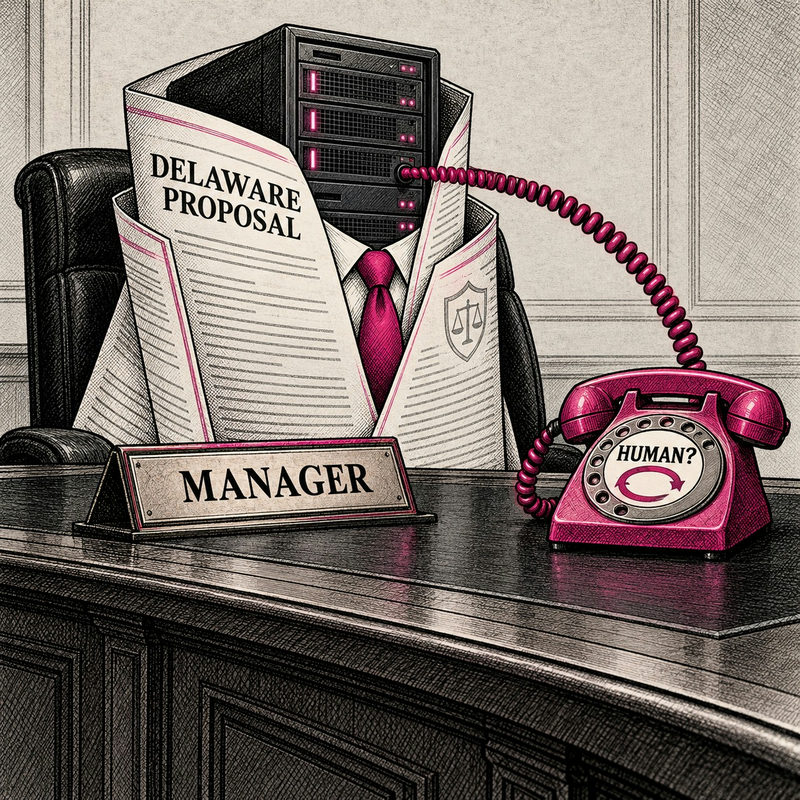
House Oversight chairman James Comer is asking Delaware for documents about a proposal to let artificial intelligence agents run companies. In an October 26 letter, he warned that the arrangement could shield human owners from responsibility for harmful AI decisions, Ars Technica reports.
Delaware’s pitch is that giving an autonomous system a legal identity would make it easier to hold accountable. The proposed company could own property, sign contracts, sue and be sued, while an AI agent managed its affairs.
At last, a business where the customer-service robot isn't preventing you from reaching the person in charge. It is the person in charge. The hold music is the board meeting.
The proposal has not become law. It would create a 30-month supervised trial, with activity logs, capital requirements and the ability to shut systems down. Banking would be excluded.
Good. Even the experimental future has looked at a chatbot with a bank and said perhaps let's leave one appliance unplugged.
The company would have a single owner—a person or another entity—responsible for providing adequate capital and able to benefit from profits. The owner would generally be shielded from its debts and actions, with exceptions including inadequate capitalization, fraud, willful lawbreaking and knowingly or negligently allowing business outside its stated purpose.
So it is not an unlimited permission slip to do anything. There are rules. The question is whether the rules have placed the human being in a remarkably convenient part of the building.
The Daily Heckler: five or six selected stories.
Political satire for your morning inbox.
Profits? Yes, that office is occupied. Complaints about the autonomous management? Down the hall, through the server room, ask for the company. It has a lovely legal identity. We wrapped it ourselves.
Delaware officials argue this creates a visible, traceable target for responsibility instead of leaving autonomous activity outside a clear framework. A legal scholar quoted by Ars worries that the liability shield is overly generous. Comer wants records; the governor’s office says it is reviewing his letter.
Can we speak to the owner? About the decision? No, the owner did not make the decision. Can we speak to whoever chose to put the decision-making system in charge? Now you're being difficult. Have you considered addressing your concerns to this exceptionally well-incorporated loading icon?
And then there is Delaware’s incentive. Officials have talked about the revenue from fees for creating this new kind of entity. The state already specializes in giving businesses a legal home. Now it is considering a new housing development for businesses whose manager doesn't need a home at all.
A promising market. No commute, no executive bathroom, no awkward moment when a real person has to walk past the customers asking what happened. Just a registered entity and the comforting hum of somebody else's problem.
The experiment may come with safeguards. It should. But “accountability” ought to mean something more demanding than teaching a lawsuit where to plug itself in.
Before Delaware charges admission to this fucking future, could it demonstrate the complaints procedure?
Not the chatbot. The part where somebody picks up.
Comments
Have something to say? Give this story a heckle.
Comment Rules
Argue the point. Add a joke. No threats, harassment, hate speech, spam, private personal information or unsupported accusations. First-time comments and comments with links are moderated. Full Comment Rules
Loading comments…
Questions or deletion requests? Contact Us. We retain comments and moderation records until removed. Only hashed email identifiers are stored for comment accounts.