
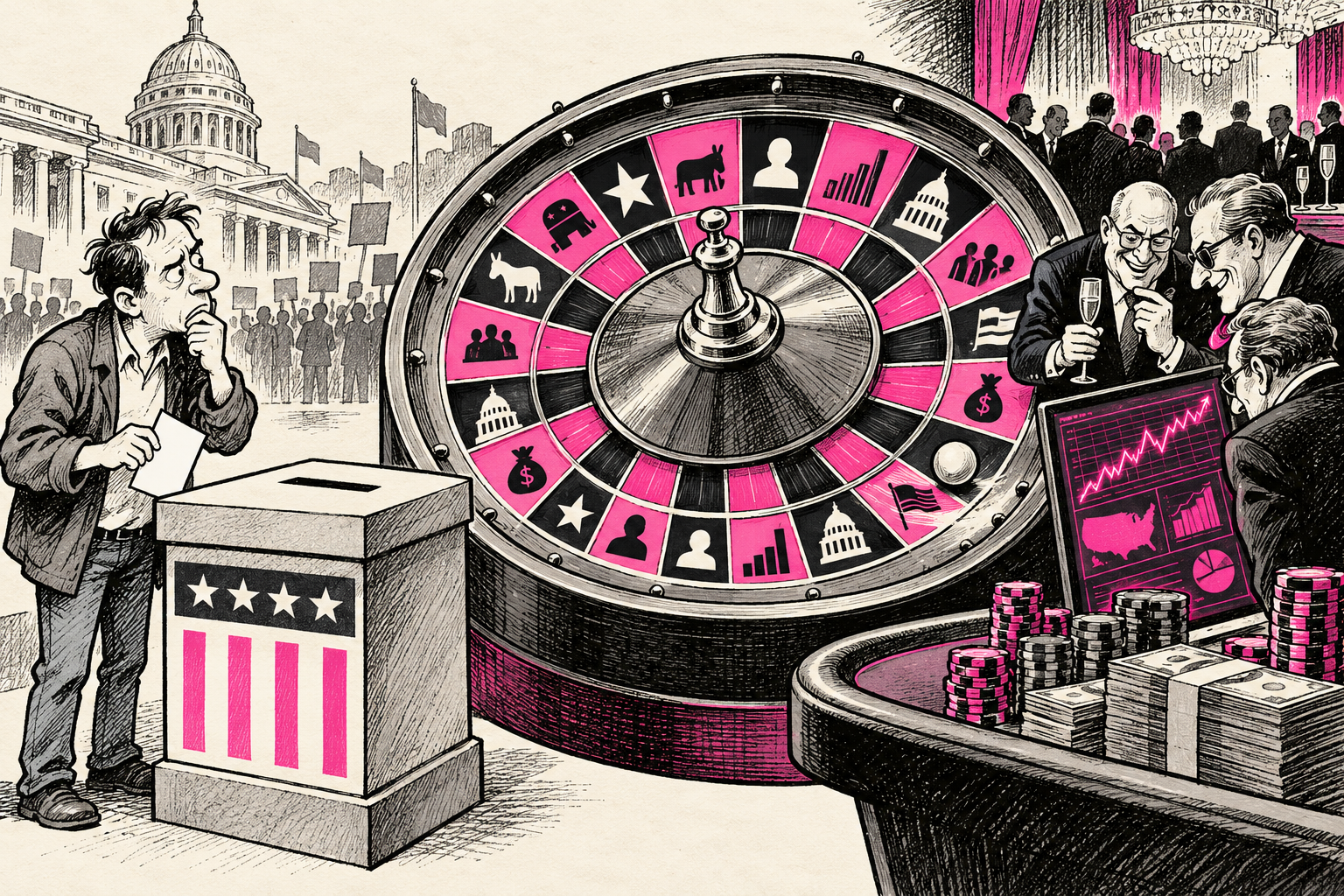
Apparently, democracy was missing a feature: the chance to lose money while watching the same campaign ads that were already making you miserable for free. Innovation truly never sleeps.
A Reuters report published October 14 examines the growth of congressional-election betting on Kalshi and Polymarket. Citing research by the Anti-Corruption Data Collective, it reports more than $220 million in bets this cycle, compared with $92 million in the 2024 congressional cycle. The platforms defend their markets as useful information and say they guard against misconduct.
The Commodity Futures Trading Commission’s explainer describes event contracts and says their prices reflect traders’ perceived probabilities. That is not the same thing as measuring a representative sample of voters, and it certainly is not the same thing as counting ballots.
A Price Is Not A Public Mandate
Markets can reveal information. They can also reflect who participates, how much they trade, and what they believe. Those observations can be interesting without becoming a replacement for democratic judgment.
The mistake is to take a number displayed with financial confidence and treat it as a superior version of citizenship. A voter gets one ballot. A trading account gets a position. These are different relationships with an election, even if both participants spend the evening checking their phones.
Money on the line does not automatically eliminate bias. It can create a reason to investigate carefully; it can also create a reason to become unusually attached to your own theory. Anyone who has defended a terrible purchase understands that cash does not guarantee intellectual liberation.
The useful question is what these products add and what risks they introduce. A trading platform’s commercial incentive to increase activity should not be mistaken for the public’s interest in a trustworthy election.
Put The Safeguards Before The Sales Pitch
My concern is not that every participant is doing something improper. It is that an election market connects private financial incentives to a public process whose legitimacy depends on people accepting its results.
Regulators should demand meaningful controls against manipulation and misuse of nonpublic information. Disclosure should be understandable, and enforcement should have enough resources to matter. A beautifully designed warning box is not an enforcement department.
The platforms’ defenses deserve to be heard and tested. If they say their safeguards work, there should be evidence that supports the claim. Criticism should likewise distinguish a documented violation from a possible incentive or risk. We do not improve democracy by inventing a scandal simply because a product seems obnoxious.
Still, public officials should ask whether the social costs of these markets are being treated with the same enthusiasm as their commercial possibilities. A product does not become a public good merely because its founders can use the word transparency in a sentence.
Liberal politics should defend participation that does not require disposable income. Political information should help people understand choices and hold power accountable. It should not teach us that the most sophisticated citizen is whichever person has placed the largest wager.
There is also a cultural cost to turning every shared decision into another opportunity for speculation. The winner of an election will make choices affecting people who never opened an account. Their interests should remain at the center of the discussion, even when the trading interface has better graphics.
We can examine these markets without promoting them, and acknowledge that they may supply useful signals without treating their prices as democracy’s final answer. The election still belongs to voters.
Before approving the casino upgrade, perhaps someone should ask whether the public ordered it. Citizenship already has enough fees without adding a house edge.