
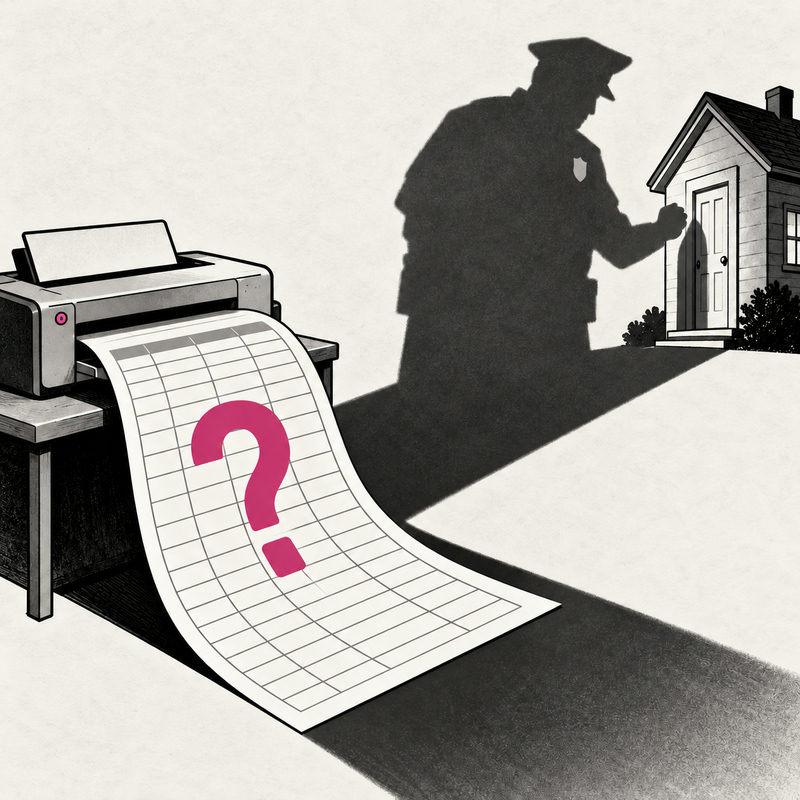
A name match is not a citizenship determination. That sounds like a modest technical point until the next component in the system is an armed federal agent standing on a porch.
CBS News’s October 21 investigation describes how the Trump administration’s search for alleged noncitizen voters moves from databases to people’s doors. DHS combines internal records, voter rolls and other datasets, then employees attempt to match names against citizenship information. Hundreds of Homeland Security Investigations agents were reassigned from their cases to the effort, according to documents CBS reviewed. The database does not just produce a spreadsheet. It can produce a visit.
A USCIS whistleblower said employees had been given quotas of 40 subjects a day, roughly twelve minutes per person. DHS disputes the suggestion of rushed work, calling the investigations diligent and professional and saying there is no quota on criminality. That is an answer about how many crimes it is willing to pursue. The whistleblower’s claim concerns how much time employees get to establish what a record means. Criminality has no quota; the workday still has a clock.
Consider what the matching must distinguish. A record concerning a person and that person’s current eligibility are not interchangeable. Nor are allegations, registration and a proven illegal vote. CBS reports that DOJ has charged 156 people with voting-fraud-related offenses since this administration began. Those are charges, not 156 convictions, and that category is broader than a tally of illegal ballots. An integrity operation should be particularly attached to what its numbers count.
Make powerful people uncomfortable.
Subscribe to Democrawonk.
The next step makes those distinctions expensive to get wrong. CBS documented armed agents visiting homes in several states. More than twenty green-card holders were arrested in California on allegations of illegal registration or voting. Lawful residence does not confer a right to vote in federal elections; the point is not to pretend otherwise. It is to ask whether the machinery reliably identifies a violation before the machinery reaches somebody’s door.
A lawyer with Protect Democracy told CBS that an earlier Nevada list supposedly identified nearly 16,000 noncitizens on voter rolls, but officials ultimately could not substantiate a single illegally registered voter. That criticism does not establish that every new list is wrong. It does give the quality-control stage something more demanding to do than admire the size of the file.
DHS says people here legally who are not breaking other laws have nothing to fear. Civil-rights advocates warn that the visits could discourage lawful voters. The assurance depends on the system accurately distinguishing those people before it approaches them.
That is the missing technical dependency. If a list needs checking, adding a firearm does not improve its spelling.
Comments
Have something to say? Give this story a heckle.
Comment Rules
Argue the point. Add a joke. No threats, harassment, hate speech, spam, private personal information or unsupported accusations. First-time comments and comments with links are moderated. Full Comment Rules
Loading comments…
Questions or deletion requests? Contact Us. We retain comments and moderation records until removed. Only hashed email identifiers are stored for comment accounts.