
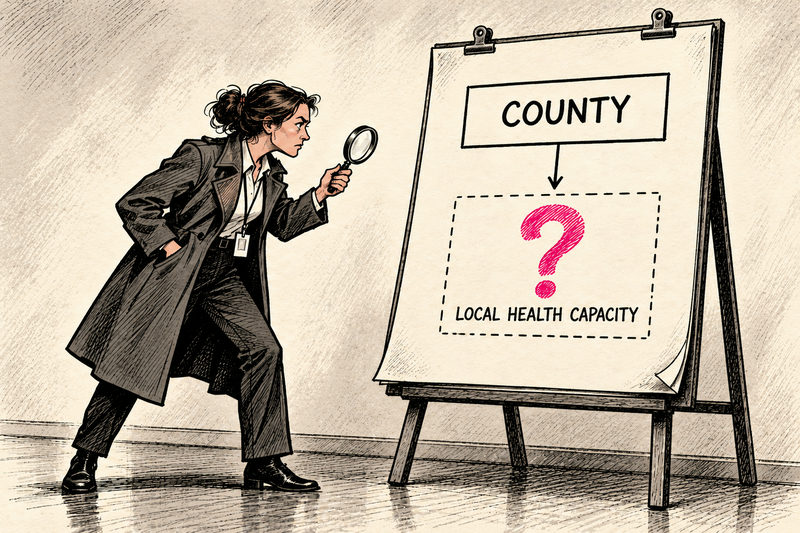
The detective arrived to find the most suspicious thing in the room was not there.
The CDC is sending a disease detective to help Pennsylvania’s measles response. Lancaster County, at the outbreak’s center, has no local health department. That is the factual setup. The following noir scene is parody, although public administration has done an unreasonable amount of the plotting.
It was the kind of county where Prevention didn’t have an office. Reaction had a corner suite, an emergency parking space and the confidence of a man who always arrived after something expensive had happened.
“Who was watching the place before I got here?” asked the detective.
Reaction adjusted his tie. “We prefer not to duplicate the work of a person we don’t employ.”
The detective lit a desk lamp. No cigarette: this was public health, not a prestige drama with a tobacco sponsor.
On the wall hung an imaginary organizational chart. It showed a large blank space labeled LOCAL CAPACITY. Someone had drawn a reassuring arrow around it. The arrow led back to the blank space. An impressive administrative achievement: a hole with continuity of service.
“A department costs money,” Reaction explained.
“So does this.”
“Yes, but this is urgent. Money becomes much more respectable once it has to run.”
The Alibi
The detective interviewed an imaginary suspect named Efficiency. Efficiency wore a tailored suit and insisted he had never opposed public health. He merely preferred that it remain available without occupying any identifiable space in the budget.
“Surely you can’t maintain every conceivable capability,” Efficiency said.
“This one has its own name.”
“That sounds like mission creep.”
“It’s the mission.”
Efficiency looked disappointed. He had hoped the mission could be handled by the creep.
Outside the parody, Lancaster officials have described the disadvantage of lacking a local department: less immediate local information and no established departmental staff with community relationships. That is not a claim that a department could have prevented every case. It is a rather basic distinction between having people in place and discovering that people would be useful.
Inside the parody, Reaction offered the detective a map. It showed the route from Not Our Department to Someone Should Do Something. Both destinations were clearly marked. There was no road between them.
“You must understand,” he said, “we were prepared for an ordinary day.”
“What was the plan for an extraordinary one?”
“To call somebody who prepares for those.”
The Reveal
At last the detective gathered the imaginary suspects. Efficiency protested that he had an excellent alibi: he had been admiring the absence of expenditure. Reaction said he was indispensable now, which was true in the least reassuring possible way.
The detective turned the lamp toward the empty space on the organizational chart.
“This isn’t a locked-room mystery,” she said. “It’s an unstaffed-room mystery.”
Everyone waited for her to identify the missing department’s replacement. Surely the visiting specialist could simply remain the entire institution, provided nobody asked about next month.
Efficiency watched her pack.
“Could you leave the magnifying glass? We’d like to describe that as succession planning.”
The Comment Section Has Entered The Chat.
Argue the point. Add a joke. No threats, harassment, hate speech, spam, private personal information or unsupported accusations. First-time comments and comments with links are moderated. Comment Rules
Loading comments…
Questions or deletion requests? Contact Us. We retain comments and moderation records until removed. Only hashed email identifiers are stored for comment accounts.