
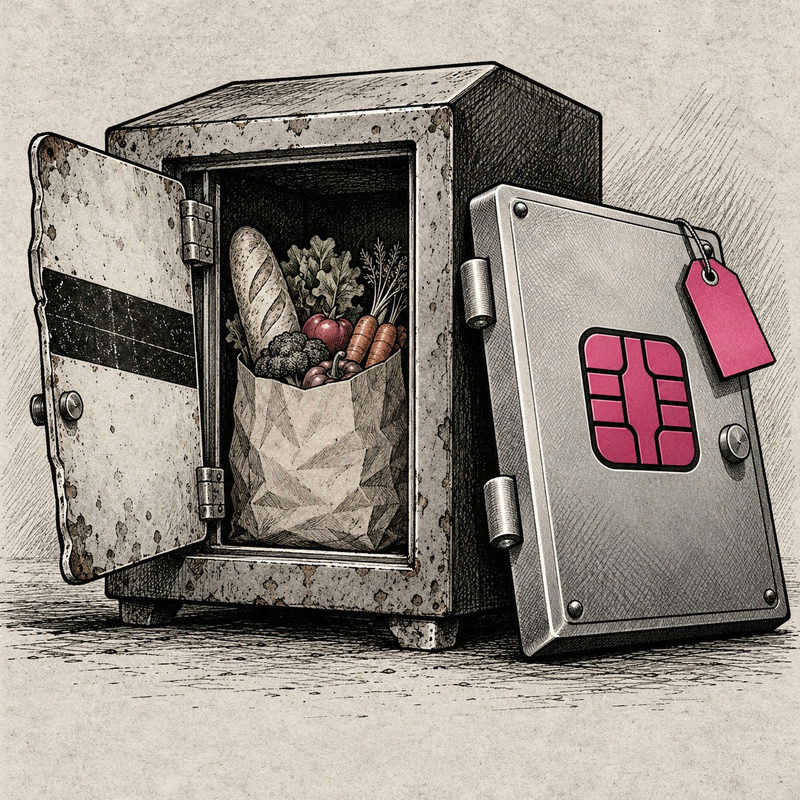
Here is a fraud crackdown worth doing: make it harder for thieves to steal people's grocery money. Not discover that somebody bought the wrong sort of sandwich. Not turn a struggling family's shopping basket into a morality hearing. Stop the money being stolen.
NPR reports that the Agriculture Department has proposed requiring states to issue chip-enabled Electronic Benefits Transfer cards for SNAP. Retailers accepting the benefits would also need terminals that support tap-to-pay. The proposal was released last week, not enacted, and the department is considering a two-year implementation deadline after a final rule.
This is welcome. It is also the sort of technological breakthrough that much of the banking system made more than a decade ago. Food assistance should not have to wait for the magnetic stripe to qualify for a historic-preservation plaque.
Most SNAP cards still rely on those stripes, making them vulnerable to skimming: thieves extract card information at payment terminals and drain accounts. According to USDA, fewer than a third of states have switched to newer cards or are in the process of doing so. Chip and tap technology is more secure, not a guarantee that every form of fraud disappears.
The distinction between stealing benefits and receiving them matters. In this case, SNAP recipients are the people being robbed. NPR reports that most states do not replace stolen benefits, leaving households to skip meals or borrow for groceries. The punishment for being targeted by a thief can therefore be an empty refrigerator.
There is broad support for modernising these cards, including from state officials, federal watchdogs and members of both parties in Congress. This is not a mysterious ideological puzzle. The cards should protect the money they are designed to deliver.
Make powerful people uncomfortable.
Subscribe to Democrawonk.
The obstacle is money of a different kind. NPR cites the Government Accountability Office's finding that chip cards cost about ten times as much to produce as magnetic-stripe cards. That is a comparison of card production costs, not a claim that the entire SNAP programme becomes ten times more expensive. States also face new budget pressures from Trump's One Big Beautiful Bill Act.
The proposed rule recognises the financial burden and invites states to comment on costs. When NPR asked whether USDA would provide funding to help with the upgrade, the department responded that states had previously had access to administrative funds and few acted.
That is an answer to “Why hasn't this happened already?” It is not an answer to “Who pays for it now?” The new lock is on the shopping list; the receipt is being addressed to a previous conversation.
USDA estimates the changes would reduce stolen benefits by at least $1.5 billion over the next decade. That is the department's projection, not money already recovered. It also says the rule has been in development for nearly four years. The public has 60 days to comment before a final rule, including on whether the proposed implementation period is sufficient.
Those details are the work. Set a workable timetable, make sure states can implement it, and require retailers to support the cards. A security announcement does not protect an account until the security reaches the checkout.
The administration deserves credit for proposing a change that treats recipients as people entitled to protection. It should finish that job rather than leave the funding question standing in line.
People should be able to spend their food benefits on food. It is not a lavish vision of government. Somehow it still requires an upgrade.
Comments
Have something to say? Give this story a heckle.
Comment Rules
Argue the point. Add a joke. No threats, harassment, hate speech, spam, private personal information or unsupported accusations. First-time comments and comments with links are moderated. Full Comment Rules
Loading comments…
Questions or deletion requests? Contact Us. We retain comments and moderation records until removed. Only hashed email identifiers are stored for comment accounts.