
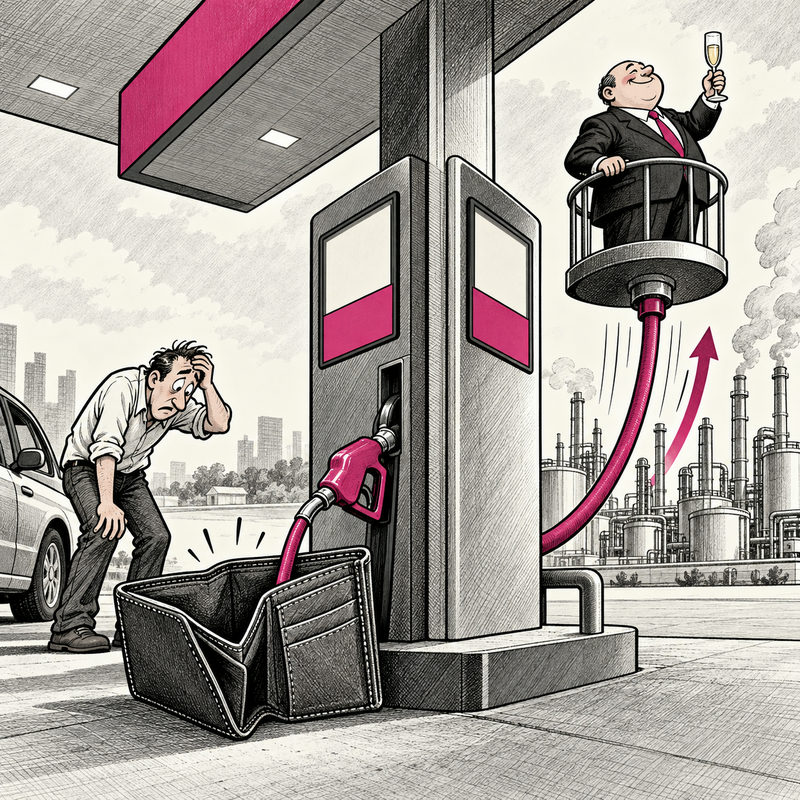
Somebody is having a good time at the gas pump. They are not standing beside it holding the nozzle.
Bloomberg reports that Citgo has lifted its full-year operating earnings outlook by roughly $2 billion. The new forecast is $7.7 billion to $8 billion in earnings before interest, taxes, depreciation and amortization, up from $5.8 billion previously. That is a forecast, not money already counted as final annual profit. But it is quite a cheerful forecast for an industry whose customers have been advised to appreciate the difficult circumstances.
Here is the useful part of the transaction. A refiner buys crude oil and turns it into fuels. Crude has become more expensive. Gasoline and diesel have risen faster. The distance between those prices has widened, and that distance is where the conversation changes from hardship to opportunity.
At the pump, the price increase is something you must absorb. In the investor document, the same market becomes an improved outlook. You have both encountered the geopolitical situation. Only one of you gets to call it upside.
Citgo operates three large American refineries. According to the document Bloomberg obtained, it had about $5.6 billion in cash on October 15. The company declined to comment on the document and revised forecast. None of that establishes illegal price-setting or proves the company caused the shortage. The point is more ordinary, and less comforting: a business can profit handsomely from a disruption it did not need to arrange.
Make powerful people uncomfortable.
Subscribe to Democrawonk.
That should complicate the political habit of describing expensive fuel as a hardship shared equally by the nation. There is no national household gathered around one very expensive receipt. There are buyers and sellers, different positions in the chain, and a spread that gets larger while everyone is encouraged to use the word together.
Bloomberg describes the Iran conflict and consequences of Russia's war in Ukraine pushing fuel markets higher. Those costs travel into food and transportation. They do not politely remain inside the fuel sector until a consumer has found some spare money. A refiner's stronger margin can reach the grocery budget without the shopper ever owning a car. Very impressive distribution. Usually businesses pay extra for that kind of reach.
We have seen financial markets anticipate profits from political changes in health care. Investors are allowed to notice an advantageous arrangement. The rest of us are allowed to notice what makes it advantageous. And the broader argument about inflation around the AI boom is another reminder that rising costs and rising fortunes can occupy the same economy quite comfortably. They simply need different addresses.
Citgo's forecast deserves attention because it translates the crisis into the unit the business actually uses. Not resilience. Not shared sacrifice. A wider margin. When someone next explains that everyone must endure these fuel prices, it would be useful to ask whether endure includes revising expected earnings upward by two billion dollars. If so, I would like to endure from that side of the pump.
Comments
Have something to say? Give this story a heckle.
Comment Rules
Argue the point. Add a joke. No threats, harassment, hate speech, spam, private personal information or unsupported accusations. First-time comments and comments with links are moderated. Full Comment Rules
Loading comments…
Questions or deletion requests? Contact Us. We retain comments and moderation records until removed. Only hashed email identifiers are stored for comment accounts.