
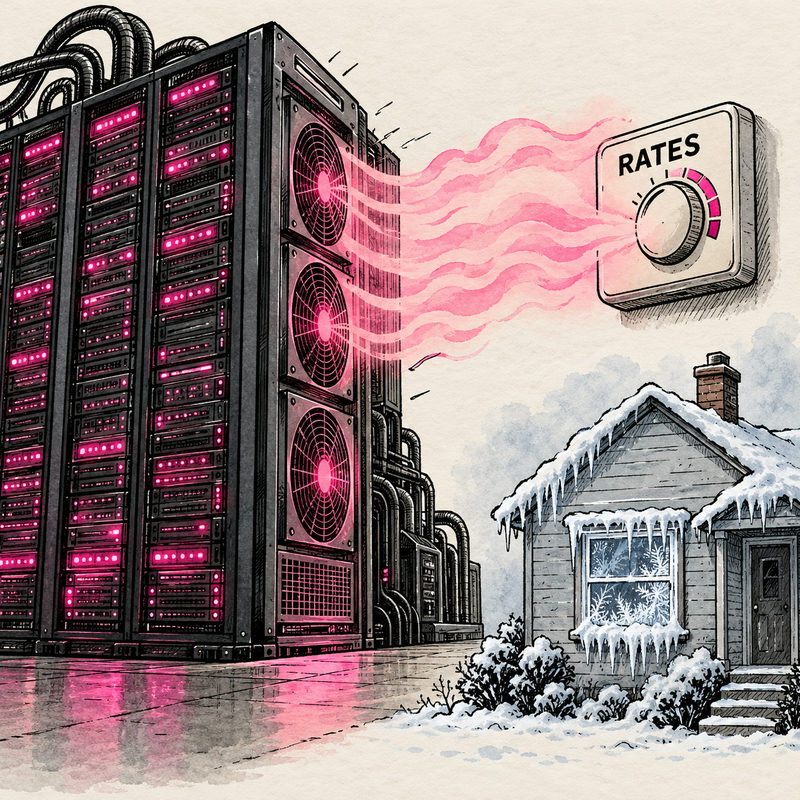
The AI boom has discovered a remarkably efficient way to manage its inflation problem: make somebody else's loan more expensive.
That is the ugly possibility in Reuters' reporting on the Federal Reserve's predicament. Vast technology spending is adding pressure to demand and prices, while the biggest firms may be relatively insensitive to higher interest rates. Smaller businesses and households that depend on borrowing are much easier to slow down. Congratulations on the productivity breakthrough. The discomfort can now be outsourced without even opening a new office.
An interest-rate increase does not arrive with a little checkbox marked “only the people building the enormous data centers.” It travels through credit markets. The company with ample cash can keep charging toward the future while the person financing something boring, such as a place to live, discovers that the future has taken their parking spot.
Reuters describes officials debating further increases, not a new rate decision already made. Some policymakers think inflation can fall without much damage to jobs or growth. That would be welcome. I would also like the explanation to contain more than an optimistic gesture toward a horizon currently obscured by server construction.
Fed chair Kevin Warsh acknowledges that AI investment is a shock to prices and demand while anticipating productivity benefits later. Later is doing a hell of a lot of work in this industry. The expensive part of the promised utopia has excellent punctuality. The broadly shared abundance seems to be looking for its keys.
None of this makes AI the only source of inflation. Oil, tariffs and other pressures matter. Nor does it mean every technology project is financed from an inexhaustible vault; we've examined the boom's own credit risks. The specific problem is that a blunt monetary tool may bite hardest outside the sector contributing to the heat.
Imagine evaluating a cooling system that leaves the hottest room comfortable and freezes the neighbors. You would at least ask the installer some questions. In macroeconomics, we are invited to admire the thermostat.
I want the distribution of the pain discussed as openly as the potential gains. If officials expect households or ordinary firms to pull back, say so. Don't bury them inside a reassuring average and announce that the economy has adjusted. People can be statistically absorbed and still have to cancel an expansion or postpone a move.
The liberal response is to stop treating private expansion as automatically entitled to every scarce resource while public policy disciplines everybody else's demand. Scrutinize the infrastructure demands and public support behind the buildout. Technological ambition should include paying its own way through the world it promises to improve.
If the machines are about to make us all richer, the first demonstration should be more convincing than making the humans borrow less.
Comments
Have something to say? Give this story a heckle.
Comment Rules
Argue the point. Add a joke. No threats, harassment, hate speech, spam, private personal information or unsupported accusations. First-time comments and comments with links are moderated. Full Comment Rules
Loading comments…
Questions or deletion requests? Contact Us. We retain comments and moderation records until removed. Only hashed email identifiers are stored for comment accounts.