
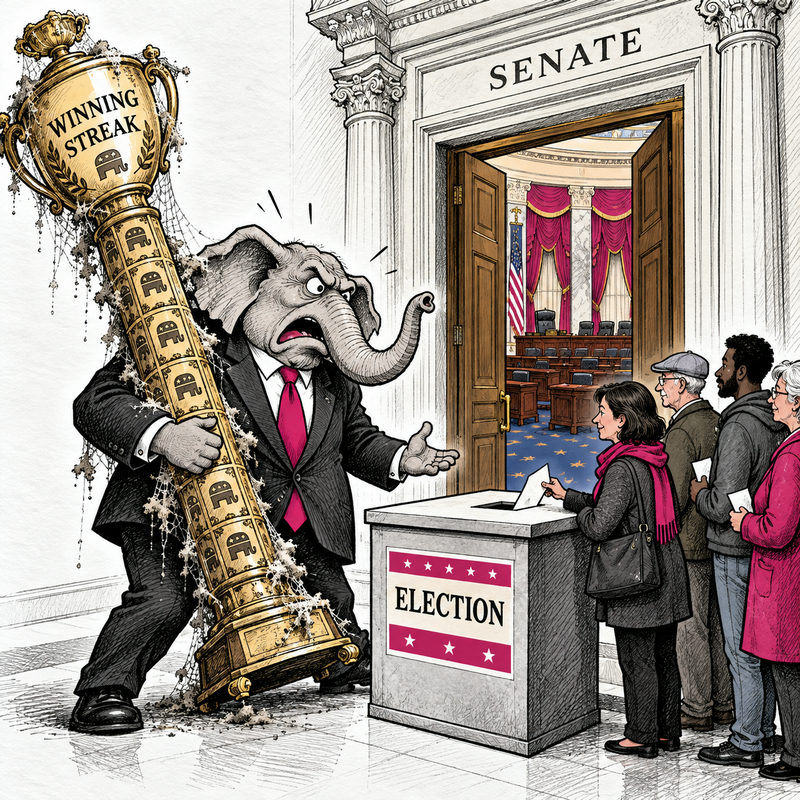
Kansas has not elected a Democrat to the U.S. Senate since 1932. That is a remarkable Republican winning streak. It still does not count as a vote in this one.
Now Republican Senator Roger Marshall faces a competitive challenge from Democrat Adam Hamilton, a Methodist pastor who has outraised him. Axios reports that polls have the two neck and neck and that the Cook Political Report rates the race a tossup.
I find this healthy. An incumbent should occasionally experience the unsettling possibility that an election might select somebody else. Otherwise we could save considerable trouble by replacing the ballot with an annual photograph of the officeholder looking permanent.
The broader Axios report describes competitive Democratic campaigns in several places where Republicans have enjoyed long runs of victories. Not guaranteed Democratic wins. Competitive races. There is a difference, although campaign fundraising emails have been known to approach it at speed without braking.
Texas is another example: Democrat James Talarico generally holds narrow polling leads over Republican Ken Paxton in a Senate race Cook also calls a tossup. South Carolina is a useful warning against getting drunk on possibility: Democrat Annie Andrews has posted competitive numbers, but Cook still rates that Senate race likely Republican.
I want Democrats contesting these races. I do not want them treating favorable coverage as an early form of being elected. A poll lead cannot answer a constituent’s call, cast a vote or prevent the other side from showing up.
But I’m equally tired of the assumption that a state’s political history settles what its voters ought to do next. A long winning streak proves a party has won previous elections. It does not establish that its current candidate is competent, its policies work or its challenger needs permission to bother trying.
Republicans do not get an extra senator because the museum exhibit is impressive.
And Democrats should stop confusing difficult territory with forbidden territory. Recruit serious candidates. Organize. Explain what people would gain from a change. Then do the unglamorous work of asking for votes instead of describing whole states as though their residents came permanently attached to a party label.
That last habit is particularly irritating from people who insist that every vote matters, then spend election season discussing enormous parts of the country like a stain that will never come out.
Voters can change their minds. Parties should have to give them a reason.
My liberal preference is for more actual competition, not simply a more pleasing color scheme on election maps. I want candidates forced to defend what they would do about healthcare, wages and the cost of living. A historic streak is not an answer to any of those questions, unless the question is how long you’ve been avoiding this conversation.
Nobody should confuse a tossup with a victory. Nobody should confuse a tradition with an entitlement, either.
If Republicans want to retain these seats, they can make a case for retaining them. Democrats can make the case for throwing them out. The voters, rather inconveniently for everyone’s assumptions, still get to decide.
Being around for decades is not, by itself, a qualification.
The mold behind the refrigerator can do that.
Comments
Have something to say? Give this story a heckle.
Comment Rules
Argue the point. Add a joke. No threats, harassment, hate speech, spam, private personal information or unsupported accusations. First-time comments and comments with links are moderated. Full Comment Rules
Loading comments…
Questions or deletion requests? Contact Us. We retain comments and moderation records until removed. Only hashed email identifiers are stored for comment accounts.