
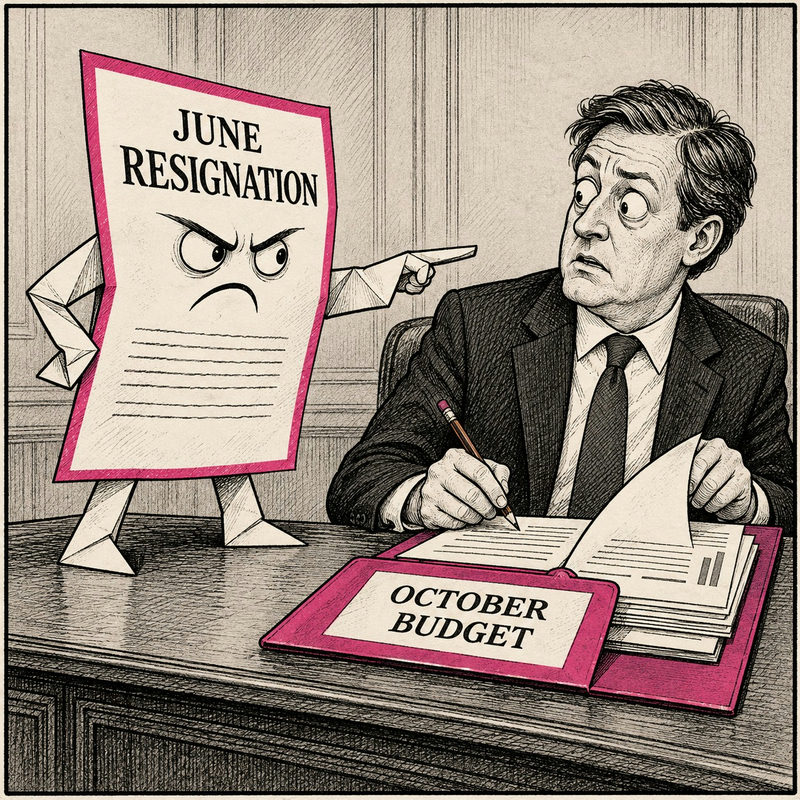
Britain's defence secretary, Wes Streeting, says the government isn't delaying military investment. Parliament's defence committee says the Budget failed to provide a precise path to spending 3% of GDP on defence by 2030. The man who delivered that Budget, Chancellor John Healey, resigned as defence secretary in June because the government wasn't spending enough on defence.
There is a rather demanding former defence secretary available to challenge the chancellor. Unfortunately, he is also the chancellor. Scheduling the confrontation should be easy. Finding someone to mediate might be harder.
Imagine June's Healey walking into October's office carrying the resignation letter. October's Healey asks whether he has an appointment. June's Healey points out that the matter was urgent enough to quit over. October's Healey offers him a chair until the spending review.
The government has put up real money: £4.7 billion to fill a hole in the Defence Investment Plan, funded by asking departments to cut capital budgets by 1%. Tan Dhesi, the Labour MP who chairs the committee, praised that while maintaining his criticism of the missing pathway. Streeting says additional money is flowing and military capability is being funded now.
That isn't nothing. It also isn't an answer to every question about the rest of the plan. Paying for the urgent repair doesn't automatically tell you when the rest of the house will have a roof.
Especially when the man approving the repair previously resigned over the weather getting in.
The Daily Heckler: five or six selected stories.
Political satire for your morning inbox.
Streeting calls the committee's criticism unfair and unfounded. He says the spending review is the right place to consider spending together. The review has no fixed date and could fall in the second half of 2027.
I would like to let the ministers and committee resolve that disagreement without recruiting every past version of every minister as a witness. A government has competing demands. A spending review can serve a purpose. Perhaps June's Healey can wait in reception without writing another letter.
But meanwhile, the government has found considerable precision for what foreign defence suppliers should do.
For contracts above £50 million, a new offset policy will seek equivalent investment in British factories, jobs and training, applied case by case from April 2027. Other countries use similar arrangements. This isn't free weaponry or a second cash payment to the Treasury; it's a requirement intended to spread procurement's economic benefits.
Look at the specificity: a threshold, a start month, categories of investment. The foreign supplier gets instructions with measurements. The government's own route to 3% is still awaiting the next big conversation.
Could we borrow the person who found April and ask them to locate the rest of the plan?
Streeting says Britain is ready for hostile threats but not where it wants to be. The committee wants the route spelled out. And the chancellor has already demonstrated that he understands why someone might find defence funding unsatisfactory.
If the explanation needs testing, read it aloud to his resignation letter.
Comments
Have something to say? Give this story a heckle.
Comment Rules
Argue the point. Add a joke. No threats, harassment, hate speech, spam, private personal information or unsupported accusations. First-time comments and comments with links are moderated. Full Comment Rules
Loading comments…
Questions or deletion requests? Contact Us. We retain comments and moderation records until removed. Only hashed email identifiers are stored for comment accounts.