
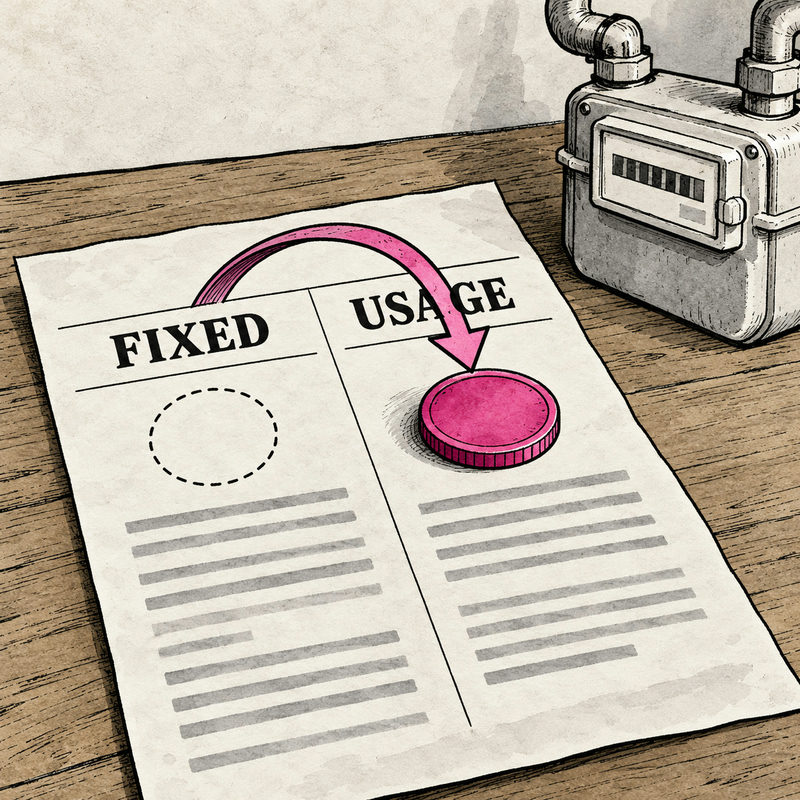
Britain’s gas standing charge is being shown the door. The money, however, has been given directions to another entrance.
In his first Budget, Chancellor John Healey announced plans to scrap the fixed daily gas charges in England, Scotland and Wales during 2027, or as soon as possible afterward. BBC reporting explains the part that deserves to travel with the announcement: those costs will move into the price paid for each unit of energy. Heavy gas users will face higher bills.
The charge is being abolished in the same sense that a guest stops occupying your spare room after moving into your kitchen. Something has changed. You should still count the silverware.
This is a change in how costs are distributed, not proof that everybody’s gas bill will fall. Removing a fixed daily fee can matter to someone who uses little gas. Loading the cost into consumption changes who pays more. A useful public explanation would begin with that trade-off rather than treating the disappearance of a line on the bill as the disappearance of the expense.
There is also actual cash help in the Budget. Healey announced a one-off £100 energy payment for households in council tax bands A to D in England, with Wales saying it would match the payment and Scotland planning to replicate it. He is increasing the surcharge on big banks’ profits from 3 percent to 6 percent, from January next year to April 2028, to help fund the measure.
A hundred pounds is real money to a household trying to pay a bill. It should not have to audition as a complete solution to be worth receiving. The political problem begins when a limited payment and a rearranged tariff are asked to carry the weight of an entire cost-of-living strategy.
Make powerful people uncomfortable.
Subscribe to Democrawonk.
The wider numbers are less accommodating than the presentation. The Office for Budget Responsibility cut its forecast for next year’s growth to 1 percent. Its assessment, as reported by the BBC, leaves households little better off than before the pandemic even a decade after it began. That is a long time to keep promising the next small measure will make the room feel warmer.
The Budget also extends the temporary 5p fuel-duty cut to July and increases minimum wage rates by 3.9 percent in April. Meanwhile, income-tax thresholds remain frozen, and basic-rate tax on income from savings and rental property will rise to 24 percent from April 2027. The government has found several ways to put money into one pocket while asking another pocket to remain available for inspection.
Some of the biggest decisions are still coming. Welfare changes await reviews and legislation next year. The route to the government’s longer-term defence-spending commitments will be set out at next year’s spending review. Healey is operating with stretched public finances and higher debt-interest costs, which are real constraints, not a theatrical excuse conjured from the dispatch box.
That makes clarity more important. Households need to know what is immediate, what is one-off, what is proposed for next year and what merely changes the place where a charge appears. An announcement is not a household budget until somebody can use it to work out the bill.
The standing charge may eventually vanish from the page. Before applauding the empty space, read the unit price underneath it.
Comments
Have something to say? Give this story a heckle.
Comment Rules
Argue the point. Add a joke. No threats, harassment, hate speech, spam, private personal information or unsupported accusations. First-time comments and comments with links are moderated. Full Comment Rules
Loading comments…
Questions or deletion requests? Contact Us. We retain comments and moderation records until removed. Only hashed email identifiers are stored for comment accounts.