
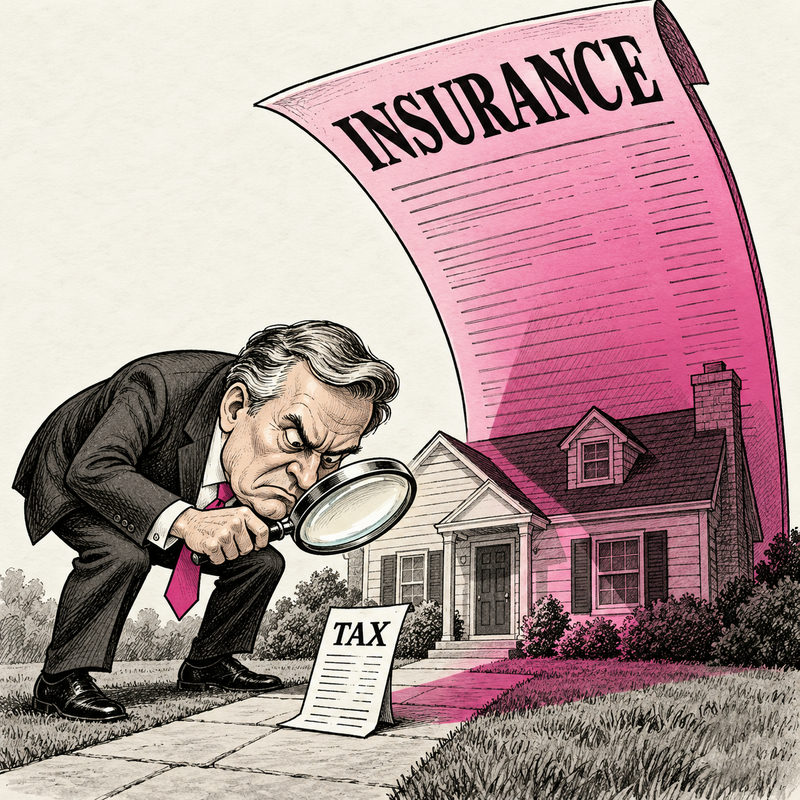
The advantage of a private bill is that it can get very large without becoming big government.
Bloomberg reports that average home-insurance premiums now exceed average property taxes in two-thirds of US counties. Its analysis also finds an inflation-adjusted rise of 45% in homeowner-policy costs over a decade. These are county-level comparisons, not a claim that every household pays the same amount. The direction is nevertheless awkward for anyone selling lower taxes as a complete description of cheaper living.
You can win the argument about the public bill and still lose the argument with your bank balance. Your insurer has not agreed to accept political satisfaction as payment.
Insurance is paying for something real, and extreme weather linked to climate change is part of the upward pressure reported by Bloomberg. Rising premiums are not, by themselves, evidence of a price-fixing scheme or a pile of pure profit. The useful question is what protection the household receives for its total spending. That question does not become less useful when the money goes somewhere other than city hall.
Here is the particular catch: deductibles are rising too. Paying more for the policy does not necessarily mean having less to pay before coverage steps in after damage. The premium can expand while the household's immediate responsibility expands alongside it. A remarkable partnership, with both sides of the expense showing initiative.
Make powerful people uncomfortable.
Subscribe to Democrawonk.
There is another shifting term. Bloomberg describes the Trump administration moving more disaster-recovery responsibility toward states and localities. The cost does not disappear when Washington becomes less involved. It arrives somewhere with a smaller tax base and waits to be described as a local problem. Federal restraint has a forwarding address.
That is why a campaign focused entirely on shrinking one column of household expense leaves such generous room in the others. A homeowner does not occupy separate houses for tax purposes, insurance purposes and storm purposes. The same roof has to satisfy all three departments, none of which seems willing to recognize a victory declared by the others.
Our earlier distinction between fuel assistance and fuel prices applies here in another form: changing one payment does not establish that the underlying burden has fallen. The total matters, along with the conditions attached to it.
Lower property taxes can be welcome. They just cannot do the insurance bill's job. Before accepting an affordability victory, check the premium, check the deductible, and check which level of government now has to fund recovery. Then enjoy whatever saving is actually left. The congratulatory language, at least, remains available without a deductible.
Comments
Have something to say? Give this story a heckle.
Comment Rules
Argue the point. Add a joke. No threats, harassment, hate speech, spam, private personal information or unsupported accusations. First-time comments and comments with links are moderated. Full Comment Rules
Loading comments…
Questions or deletion requests? Contact Us. We retain comments and moderation records until removed. Only hashed email identifiers are stored for comment accounts.