
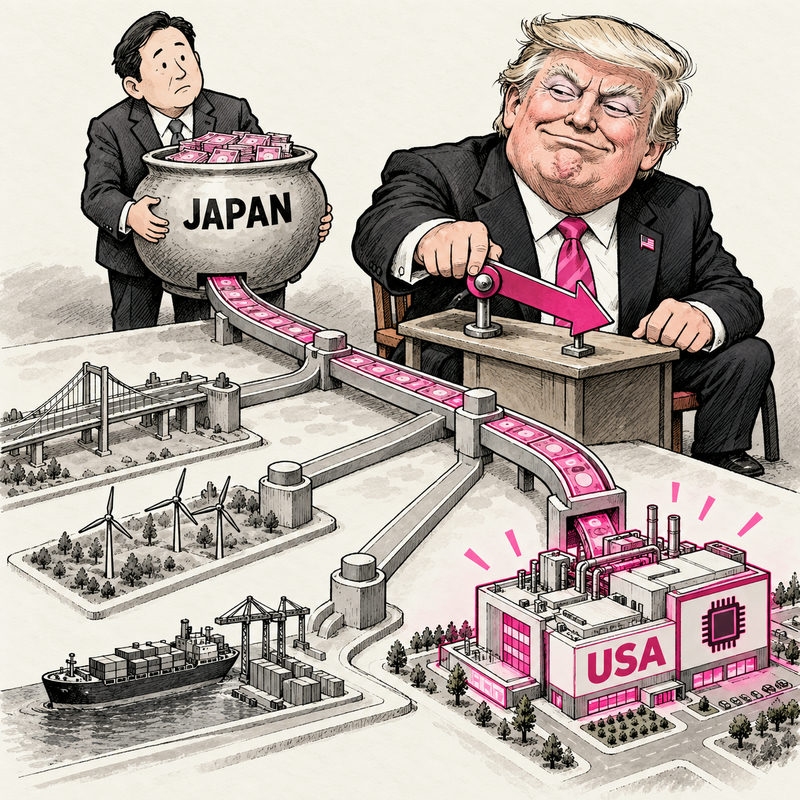
The useful question in Trump's latest chip-industry triumph is not whether factories are good. It is who gets to choose the factories while somebody else arranges the financing.
Reuters reports that Japan will invest up to $21 billion in two GlobalFoundries plants in New York. The announcement sits inside Japan's $550 billion U.S. investment pledge, negotiated in return for lower tariffs. Under that arrangement, the American president selects the projects.
Japan brings the financing. Trump brings the preferences. This is a remarkably efficient way to discover that your partner's industrial strategy looks a lot like your own shopping list.
American manufacturing capacity can be valuable. Japanese equipment suppliers can benefit, and Reuters reports that customers will include Japan's Renesas. The proposed factories can deliver real benefits, and international investment is not inherently a scam. The catch is more specific: an investment advertised as a partnership comes with unusually clear instructions about which partner gets to point.
Japan is also trying to rebuild its own chip industry. Experts quoted by Reuters say the U.S. pledge offers limited help with the advanced technology and domestic manufacturing capacity Japan wants. That does not make every benefit vanish. It means the benefit being purchased is partly the continued tolerability of dealing with Washington.
That is quite a product. First establish a tariff problem. Then allow the trading partner to participate in solving it by financing projects that you choose. A country can be a close ally and still find itself paying for the privilege of having the conversation return to a normal volume.
Make powerful people uncomfortable.
Subscribe to Democrawonk.
The financing has practical complications, too. State-backed and commercial lenders are involved, with guarantees from Japan's export insurer. Japanese banks have been reluctant because of the cost of obtaining the necessary dollars; Tokyo has looked toward U.S. banks for assistance. Even the money needs help getting into the country that has decided where it should go.
GlobalFoundries, meanwhile, is majority-owned by Abu Dhabi's Mubadala. So the patriotic headline contains Japanese financing, American production and an Emirati majority owner. That is not an objection to cross-border business. It is an objection to pretending the entire arrangement can be explained by shouting America First at a semiconductor.
Our earlier piece on research moving to Finland examined another gap between nationalist branding and where industrial work actually happens. Here the revealing detail is control, not geography alone.
A serious account of this deal would distinguish factory capacity from technological independence and investment returns from tariff relief. Those are different gains, accruing to different parties. Trump can celebrate the part America receives. He should not get to describe the whole thing as if Japan independently woke up desperate to fund his preferred projects.
The tariff concession has a price. The particularly good deal for Trump is that he also gets to decide what the payment buys.
Comments
Have something to say? Give this story a heckle.
Comment Rules
Argue the point. Add a joke. No threats, harassment, hate speech, spam, private personal information or unsupported accusations. First-time comments and comments with links are moderated. Full Comment Rules
Loading comments…
Questions or deletion requests? Contact Us. We retain comments and moderation records until removed. Only hashed email identifiers are stored for comment accounts.