
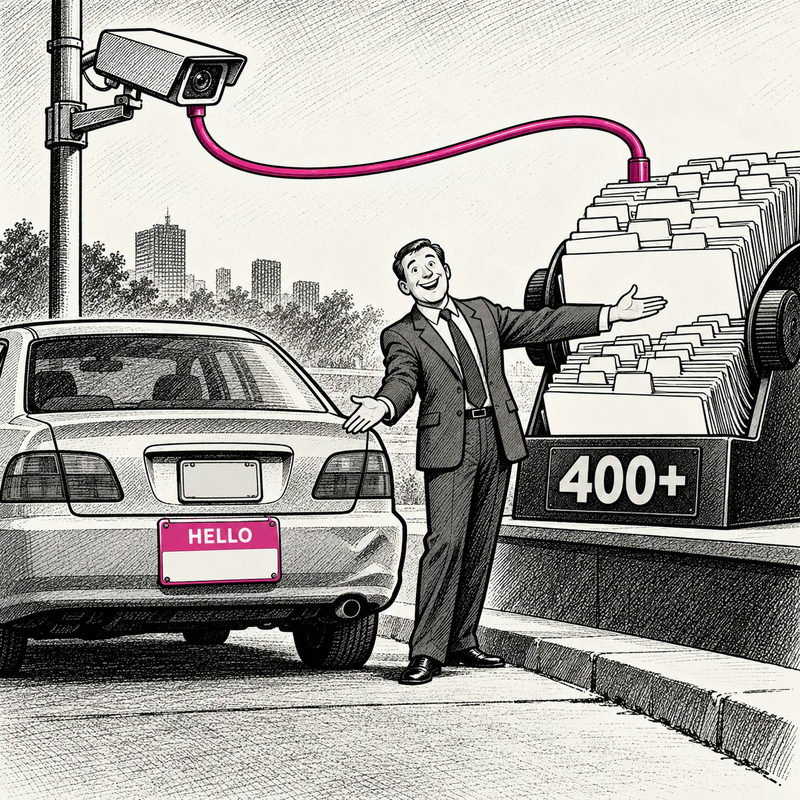
League City voters will decide Tuesday whether their police department should keep using 55 Flock cameras that record passing vehicles. Although Proposition A is labeled nonbinding, the City Council has separately pledged to remove the cameras if voters reject them. Mayor Nick Long says bagging would begin 72 hours after certification.
So this is an actual chance to shut the system down, not a suggestion box welded to a working camera. Good. Now look at the system they're being asked to keep.
The cameras collect license plates, makes, models, colors, dents and bumper stickers. Long says only six local officers have access, and two have to work together to search the data. That's a safeguard. He also acknowledges the bigger concern: what happens after the information leaves League City.
More than 400 agencies can access the city's camera data. According to its transparency portal, all are in Texas except the FBI.
My car apparently has a more extensive professional network than I do. I haven't fixed the dent over the wheel, but the dent has contacts across the state. Perhaps it can introduce me to someone who does bodywork.
I appreciate the two-officer rule. Truly. But you can't explain the security of a shared system entirely by describing how carefully you supervise your own six people. That's showing me the elaborate lock on a filing cabinet, then mentioning that its contents have also been invited to a statewide mixer.
Why is my bumper sticker networking? It was supposed to express one mildly regrettable opinion to whoever got stuck behind me, not build relationships with four hundred agencies.
The Daily Heckler: five or six selected stories.
Political satire for your morning inbox.
The mayor isn't pretending there's no trade-off. He cites the cameras' role in finding a missing girl safely, and Flock points to crimes solved, including a murder suspect's arrest. Those are serious benefits. Long says the cameras work and raise privacy concerns; both can be true.
Both being true is exactly why the public gets to ask questions beyond whether the equipment produces useful results. A database doesn't become harmless because it has a success story. Nor does every agency with access become an abuser. The issue is how much information gets collected and who can use it.
I would like to drive somewhere without turning a chipped paint job into a group project. Just park. Go inside. Come out. Find the car where I left it, with no expectation that its rear fender has spent the afternoon expanding its network.
And while the city asks voters what they think, the cameras keep operating. York, Maine, which also has a Tuesday vote, has covered its cameras pending the result. League City hasn't.
So the system gets to keep collecting while the residents consider whether it should keep collecting. The dent hasn't taken a sabbatical. It's still out there making introductions.
Could we pause the fucking meet-and-greet while we decide whether to host it?
If voters reject the cameras, the mayor's promised next step is refreshingly comprehensible: after certification, start putting bags over them.
After all that technology, privacy may arrive as a person carrying a bag. No app. No password. Just something the camera can't see through.
Comments
Have something to say? Give this story a heckle.
Comment Rules
Argue the point. Add a joke. No threats, harassment, hate speech, spam, private personal information or unsupported accusations. First-time comments and comments with links are moderated. Full Comment Rules
Loading comments…
Questions or deletion requests? Contact Us. We retain comments and moderation records until removed. Only hashed email identifiers are stored for comment accounts.