
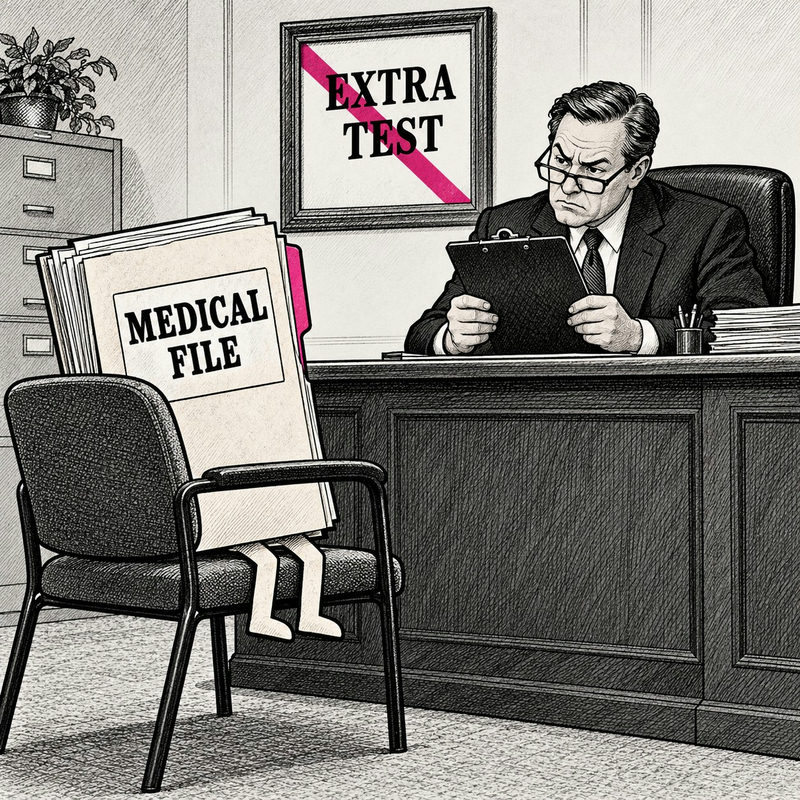
A federal judge in Boston has blocked the Trump administration's extra test for a medically frail exemption from new Medicaid work requirements. People who qualify under the medical categories won't also have to establish that their ability to work is significantly impaired. The work requirements themselves remain, with implementation next year.
This is a partial victory for patients and the states that sued. It is also a useful reminder that Washington can look at an exemption for sick people and decide what it really needs is an admissions committee.
The administration's guidance required a significant condition and significant impairment of the ability to work. The traditional medical definition didn't require that second determination. Imagine sending the government the information that puts you in the exempt category and having it slide the papers back: congratulations on meeting the criteria; we'd now like to know whether you deserve to meet them.
Perhaps the medical file could bring references. The diagnosis is impressive, but we'd like to speak to someone who has seen it perform under pressure.
No. Stop. It's a medical file, not a candidate for regional sales manager. We're trying to establish access to treatment, not see whether the paperwork makes good eye contact.
The rules apply to affected Medicaid expansion and waiver populations, not every recipient, and require eighty hours a month of work, education or volunteering. Mehmet Oz defended the framework as a way to build skills and independence. The states warned that the added medical test would force rushed changes to enrollment systems and could throw eligible people off coverage. Those are feared consequences, not a count of people already removed under next year's rules.
The Daily Heckler: five or six selected stories.
Political satire for your morning inbox.
There is nothing independent about needing a government database to agree that your medical exception is sufficiently exceptional. That's a very long way to travel just to arrive back at needing health insurance.
I would like to accept the court's ruling, put the papers in a drawer and have a quiet minute. One fewer test. State agencies don't have to rebuild their systems around this added condition. A person seeking coverage has one less thing to prove. Let that be good news without assigning it homework.
But the judge upheld two other limits: medical-frailty evidence more than a year old must be rejected, and states may accept only one self-attestation per enrollment period. He found the government's rationale for those provisions non-frivolous. The ruling removes one test; it doesn't end the work rules or the paperwork.
One. Your own formal declaration gets one accepted use. That doesn't mean coverage automatically expires or that nobody can submit other evidence. It means the government has put a usage allowance on this particular way of saying what is true.
And now, now I'm picturing the notification: you've used your complimentary statement of your own circumstances. Further circumstances require supporting documentation. Thank you for choosing to remain a person.
My honesty has a fucking data cap?
I'm trying to keep health coverage, not stream my circumstances in high definition.
Comments
Have something to say? Give this story a heckle.
Comment Rules
Argue the point. Add a joke. No threats, harassment, hate speech, spam, private personal information or unsupported accusations. First-time comments and comments with links are moderated. Full Comment Rules
Loading comments…
Questions or deletion requests? Contact Us. We retain comments and moderation records until removed. Only hashed email identifiers are stored for comment accounts.