
A federal housing law passed this summer removed the requirement that manufactured homes be built on a permanent steel chassis. Experts say dropping that frame could save $5,000 to $10,000 per home and make it easier to build two-story and multifamily versions. State laws now have to catch up.
We have discovered a way to make housing cheaper: stop requiring a heavy, expensive thing that some of the homes do not need.
Excellent. Before we celebrate, please put the heavy, expensive thing down carefully. It has been carrying a remarkable amount of American legal thought.
The chassis requirement dated to 1974. Manufactured homes are built in factories under federal housing standards and transported to their sites. A permanent steel frame became part of how the law recognised them. Now, according to the October 20 Stateline report, roughly 30 states may need to revise their rules to align with the federal change.
The house has lost weight. Its definition is having trouble accepting the new look.
Imagine a state inspector confronting a finished home. Bedrooms? Yes. Plumbing? Yes. Roof? Yes. Where is the expensive metal that tells me what you are? We removed it to lower the price. I see. Unfortunately, affordability has made your identity suspicious.
This is not a collection of states already missing their deadline. States must certify equal treatment of manufactured homes with and without chassis before July 11, 2027, or in 2028 for legislatures that meet biennially. North Carolina, Tennessee and Texas have already modernised definitions to follow federal code updates automatically.
Automatically. North Carolina can look at the federal definition and use it. The house does not have to spend a legislative session convincing two governments that it remains the same house after they stop demanding an undercarriage.
The Daily Heckler: five or six selected stories.
Political satire for your morning inbox.
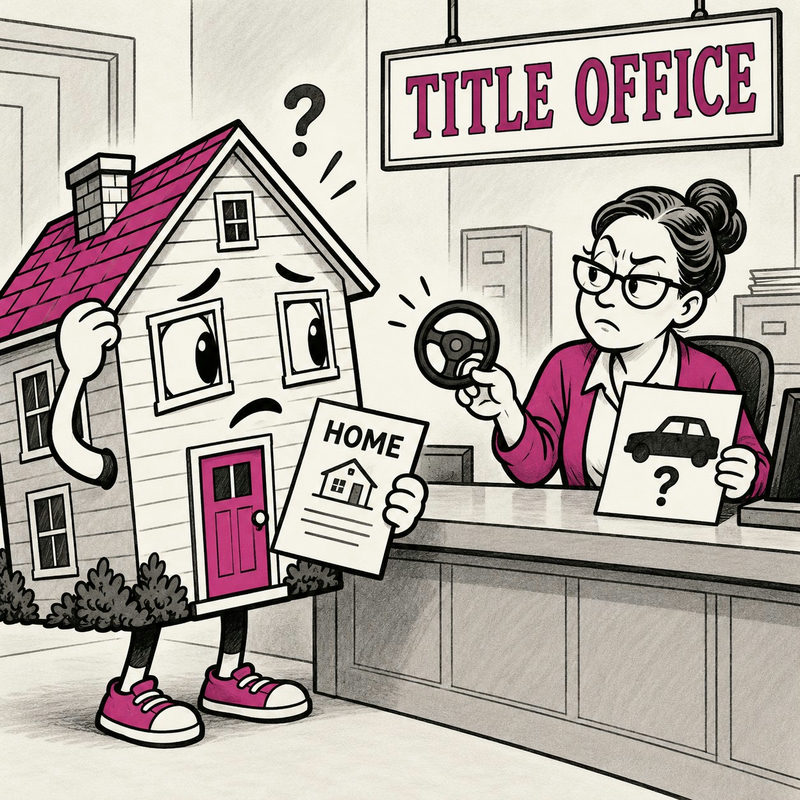
But removing a requirement in Washington does not automatically erase local zoning barriers. Nor does it necessarily fix how a state titles the home. Some manufactured homes are classified as personal property, like cars, rather than real estate. That can prevent their owners from getting mortgage financing, irrespective of the borrower’s creditworthiness or the quality of the building.
Now the house has to explain itself to a lender. I have a kitchen. Lovely. I have a foundation. Very nice. I would like a mortgage. Our records suggest you should be in a driveway.
The occupant is standing in a home. The legal category is honking.
Pew’s example of a typical $100,000 manufactured-home mortgage estimated roughly $49,000 in savings over the loan’s life compared with home-only or personal-property financing. That is an example, not a guaranteed discount for every buyer. It is still an extraordinary amount of money to have lurking behind the question of which noun the state prefers.
People get lectures about making sensible financial choices. Buy something modest. Live within your means. Here is a modest home. Wonderful. Unfortunately, you have purchased the wrong species of modesty, so your financing may cost more.
For fuck’s sake. The country can distinguish between seventeen types of investment vehicle. Could it distinguish a dwelling from a vehicle without making the dwelling produce a steel reference?
There is real progress. Georgia, Maine and New York have made it easier for some owners to convert their homes to real property. The federal change could expand designs and reduce costs. Land prices and zoning still matter; no one has repealed those by unbolting a frame.
But I keep picturing the house arriving at the title office to request recognition. It brings photographs, construction documents and evidence that somebody cooks dinner in it every evening.
The clerk studies the application. You say you are not a car. Then why did you come to us for a change of title? The house goes outside and sits down. Fortunately, it already has chairs.
Comments
Have something to say? Give this story a heckle.
Comment Rules
Argue the point. Add a joke. No threats, harassment, hate speech, spam, private personal information or unsupported accusations. First-time comments and comments with links are moderated. Full Comment Rules
Loading comments…
Questions or deletion requests? Contact Us. We retain comments and moderation records until removed. Only hashed email identifiers are stored for comment accounts.