
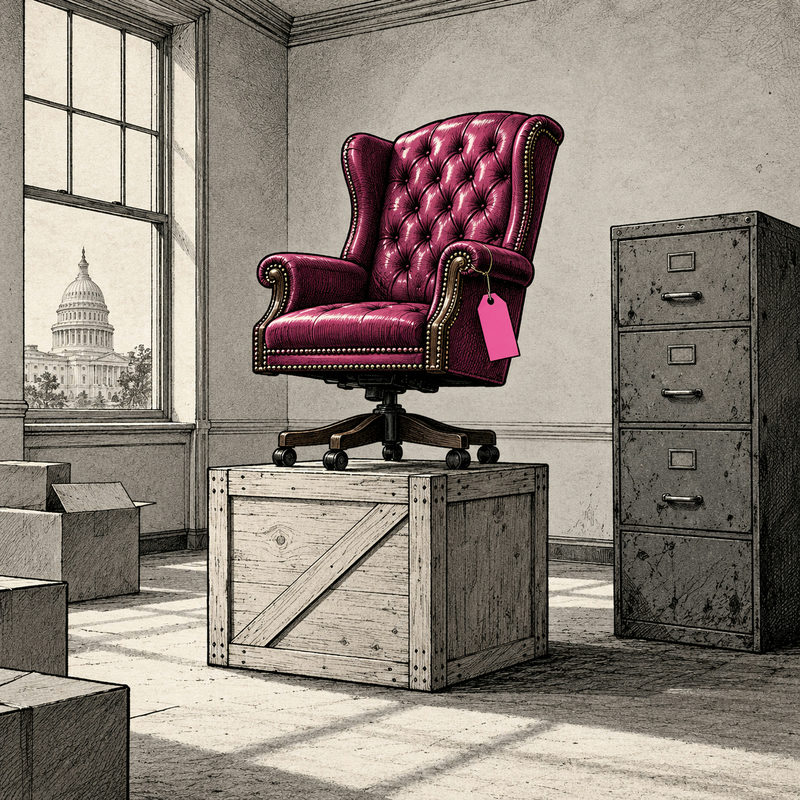
Linda McMahon’s Department of Education is being dismantled, but the secretary’s office apparently deserves a future. Preferably one with a new conference table.
The Guardian reports that McMahon plans to spend $43,278.64 on office furniture as the department relocates to a smaller building previously occupied by USAID. The figure comes from New York Times reporting on non-public records and an unnamed senior official. This is planned spending, not a receipt proving the furniture has already arrived.
The proposed purchase includes a desk, chairs, a conference table and other items. The explanation supplied to Congress says the existing furniture is worn out and cannot fit the new office configurationally or aesthetically. The department may be losing responsibilities, but at least the chairs will retain a coherent design language.
There is a reasonable argument for replacing worn furniture when an office moves. Public employees need somewhere to sit. The department’s press secretary made that argument explicitly, while saying the administration’s cuts are saving taxpayers millions of dollars. McMahon has claimed the relocation itself will save $4.8 million annually.
Those figures should not be pretended away. A $43,278.64 purchase does not mathematically erase a claimed $4.8 million annual saving. The contradiction is about what the administration treats as indispensable, not a discovery that forty-three thousand is secretly larger than four million.
An operating education department is portrayed as an unnecessary bureaucracy. An aesthetically compatible executive office, on the other hand, requires an itemised explanation of why the current furniture simply will not do. The mission must justify its existence. The conference table merely needs to match.
The Daily Heckler
The best of Democrawonk.
No algorithm required.
Congress created the Department of Education, and Congress would have to dissolve it. The Republican-controlled chambers have not done so. Trump has nevertheless directed McMahon to close it, and the administration has reduced staffing and shifted responsibilities through agreements with other agencies.
According to the reporting, staffing has been nearly halved, special education services moved to Health and Human Services, and civil rights enforcement moved to the Justice Department. These are consequential changes in who carries out federal responsibilities. A fresh office suite cannot tell a family where to go when those responsibilities become harder to navigate.
The administration says shrinking the department will empower states and eliminate unnecessary processes. States already control most education policy. That makes it worth asking which federal functions are being removed, which are merely being moved, and what happens to the people relying on them. Calling a responsibility bureaucracy does not make the underlying need disappear.
The furniture story is useful because the administration’s own defense supplies the principle it keeps avoiding elsewhere: institutions require practical resources to do their jobs. Places to sit, write and meet do not materialise because a politician announces efficiency.
If that principle can be understood when the secretary needs a desk, perhaps it can survive the walk down the hall to the people whose jobs the department was created to perform.
Comments
Have something to say? Give this story a heckle.
Comment Rules
Argue the point. Add a joke. No threats, harassment, hate speech, spam, private personal information or unsupported accusations. First-time comments and comments with links are moderated. Full Comment Rules
Loading comments…
Questions or deletion requests? Contact Us. We retain comments and moderation records until removed. Only hashed email identifiers are stored for comment accounts.